EARLY DARWIN
The Government blocks occupied the Esplanade frontage between Mitchell & Smith Streets. The pivot for these images is the corner of Mitchell Street & the SE Esplanade where the Supreme Court stands today - the site of the original Police Station & Inspector's Foelsche's Residence - hence the images.
|
"much of the land being utterly worthless"
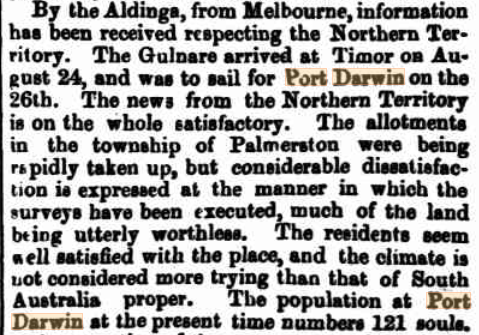
Northern Argus Clare SA 7 Oct 1870
|
Sentinel Dating
Capt. Sam Sweet
In January 1869 Sweet took command of the two-masted schooner Gulnare, which was later bought by the South Australian government for the Northern Territory Survey Expedition. He sailed from Adelaide on 12 February {1870}, returning in June, and again in February 1870 to collect more supplies. He also visited Timor and returned to Palmerston (Darwin) on 15 September with eighteen buffaloes, ponies, monkeys, fruit and vegetables. In September in Darwin he photographed the official party at the ceremonial planting of the first pole of the overland telegraph{15 Sept 1870}; he also took pictures of the township, the men at work and forest scenery. In November he sailed to the Roper River and took part in the survey there before sailing to Normanton, Queensland, for more supplies, returning in March 1871. In October on his way back to the Roper from Darwin the Gulnare grounded on a reef near the Vernon Islands and by 1872 {Gulnare} was condemned.
{Landing the Cable image 7th Nov. 1871}
In January {21/1/1872 Kohinoor} Sweet, a disciplinarian, was piloting the Bengal and other ships, surveying and navigating the Roper, but by the end of April {1872} he was back in Adelaide. [https://adb.anu.edu.au/biography/sweet-samuel-white-4678] Try being master of anything more nimble than a desk & not being a disciplinarian.
Inspector Paul Foelsche
In January 1870 he arrived in the Northern Territory where he spent his remaining years apart from brief visits to Adelaide in 1884 and China in 1897. {ANU Bio}
|
The Residency - aka Government House
The 1879 J.G. Knight and G.R. McMinn stone building, incorporating the circa 1938 verandah. Government House is constructed of locally quarried Porcellanite Stone & Cypress Pine and is set in tropical gardens. 1871 First Residency completed 1874 Second storey added 1877 2nd story demolished by white ants 1878 Architect John George Knight designed 2nd Residency 1879 ‘house of seven gables’, completed in porcellanite & Cypress pine 1897 (7 January) cyclone damage to roof, verandah and flagstaff 1912 Dr John Anderson Gilruth changed name to Government House because it was the seat of Govt. at the time. |

Queanbeyan Age 12-6-1873
|
POLICE BUILDINGS

View from Fort Hill - L>R - Residency - Foelsche's house - 1st Police Station with slab roof & 1st Lands Office SLSA B-4637
1873

Cnr Herbert St & SW Esplanade to Cnr Smith St & SE Esplanade October 1873 - Mike Owen Stitch of NTL PH1060-0034 & NLA.obj-141835455-1 P. Foelsche
SLSA image Summary "Palmerston. Sub. Inspector of Police's Quarters (Mr Paul Foelsche) After arriving in Palmerston and realising there was no Police Station Foelsche and his six troopers built one. His first residence was a two room tin hut which was later replaced by a three roomed house in Mitchell Street. Paul Foelsche was Keeper of the Palmerston Gaol from 1872 - 1874. The quarters were built on the site of what was later to be the Government Administrative Offices, almost facing the Cable Quarters." SLSA B-9733 c1870 Police Quarters

nla.obj-141835455-1 Foelsche 1873 - the reciprocal of image SLSA B-10103 below - image taken from the upstairs middle window

nla.obj-141845508-1 1st Police Res. Pt Darwin PF in same shirt 15/9 Chain fence pre mid 1872
|

nla.obj-141832857-1 First Police Office, Port Darwin, - NTRS 3420 P1 image 43 1870 - flash tin roof so >1873
|

nla.obj-141832754-1 First Police Lock Up, Darwin, ca. 1889 - probably built 1871
|
Paul Foelsche & men arrived 21 January 1870 so images must be between 1870 & 1873
1875

SLSA B-9733 c1870 Police Quarters - in image below by 1873 - famous mousing cat
|

SLSA B-10838 New Gaol c1870 - old Gaol behind was 1871 new gaol by 1875
|

nla.obj-141832658-1 1st Land & Survey Office c 1889 - NTRS 3420_P1_photo 42 1873 - Land Office afterwards used as Police Stn.
|

PIC P827-14 LOC Album 914-1&2-nla.obj-141836657 June 3rd 1875 stitch 4

SLSA B10838 detail old cells roof & tree
|

SLSA B10838 detail old cells door
|

SLSA B10838 Detail new cells & ornate weather board of Lands & Survey Bldg
|

NTRS 3420_P1_photo 14 1887

nla.obj-141837655-1 New Police Station 1875 - Govt Offices 1878
|

nla.obj-141840306-1 Government Offices and Police Inspector's Quarters, June 1879 - confirmed NTRS 3420 P1 image 64 - Govt. Secretary's Office
|
June to December 1879

SLSA B-10107 June 1879 Esplanade looking west
|

SLSA B-10126 June 1879 Esplanade L>R Court House & Medical Officer's Qtrs
|
The materials for the new Police Station are on site and the seven gables on the Residency confirm the date. The extension has been done to the Mitchell Street side of the Government Secretary's buildings on the corner. The Court House is comprised of two timber buildings.

nla.obj-141841656-1 Police Station, Court House & medical Officer's Quarters Palmerston, December 1879 - confirmed NTRS 3420 image 63
The brass plaque on the Courthouse - the only one on these buildings - attests to construction in 1884 as the first Courthouse, Cellblock and Police Station in the NT. The date of construction may refer to the stone Courthouse alone which is a effectively two buildings {as the walls abut} with the front portion - presumably the court - is approximately square whilst the rear, two storey, rectangular & wider portion contains offices, chambers etc. The separate block of 3 cells at the rear now contains the air-conditioning unit in the middle and western cells.

|

Plaque on Court House Built 1884
|

|
Cnr Mitchell St & SE Esplanade
Skyline Sequence

SLVic H141687 Residency & Camp - capt. Sweet's anchor ergo
SLSA Sweet 1870 B-4637 c1870/71 - house on Liberty Pk - Police House - Police Stn before tin roof & all important Lands Survey Office
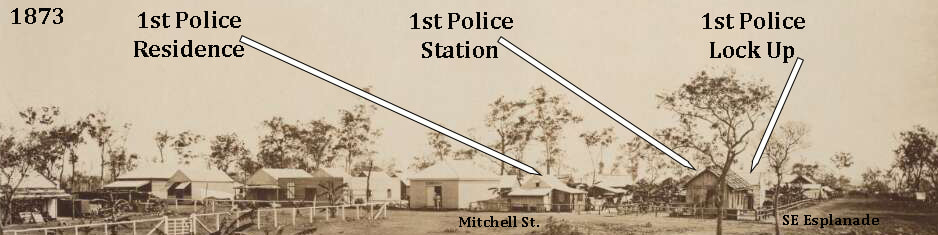
nla.obj-141835455-1 Foelsche 1873 b crop

PIC P827-14 LOC Album 914-1&2-nla.obj-141836657 b June 3rd 1875 stitch 3

B-5039 - 1878 perhaps post white ant conversion - Lands Survey Office still there so pre Police Station Mk2

nla.obj-141833053-1 1889 Foelsche - 2nd Gaol still there so predates SLSA B5060

SLSA Foelsche B5060 & stitch c1887 - 1st & 2nd Gaols gone - Courthouse stone front & back so cells behind - Steamer Tower at far right

The Residency
'Service is held every Sunday morning in the large room at the Residence, and the attendance is usually very good, specially when you take into account the uncomfortable heat experienced here in crowded rooms. Speaking of the large room at the Residence tempts me to say a word or two about this "large room." It was of course built as part of Captain Douglas's house for the private use of himself and family, but he has thrown it open all along for every kind of public accommodation. It has been a Court house, a church, a concert-room, and goodness knows what else, and I cannot tell how we should have managed had not Captain Douglas always readily and cheerfully thrown open his room, at much inconvenience to himself, for any purpose for which it was required. Now that other large rooms are built privately, of course Captain Douglas's is only used on Court business, and for church purposes.' {Southern Argus (Port Elliot, SA : 1866 - 1954), Friday 18 July 1873 - written 8th June 1873}

Residency SLSA B-10103 & NTRS 3420 - 37 1874 - perhaps damage to verandah from white ants - a nice albumen silver nitrate print

Detail PIC P827-46 LOC Album 914-1&2 1879 - new chimney
|

SLVic H141687 Govt House & Camp crop b
|

nla.obj-141840105-1 June 1879 east side
c1870

nla.obj-141845409-1 1st Inspector of Police Residence - NTRS 3420-55 1870 2nd Class Surveyor's Quarters - doubtless multiple users over time.
|

|

Image at right - SLSA B-27498 1894 " 'Blanket Day' when blankets were distributed to the natives by the Government" - caption on card
Dump

Google Earth - Parliament stands on OT & BAT site - Mitchell Street ran through to the SE Esplanade & Bennett St. ran through to the SW Esplanade
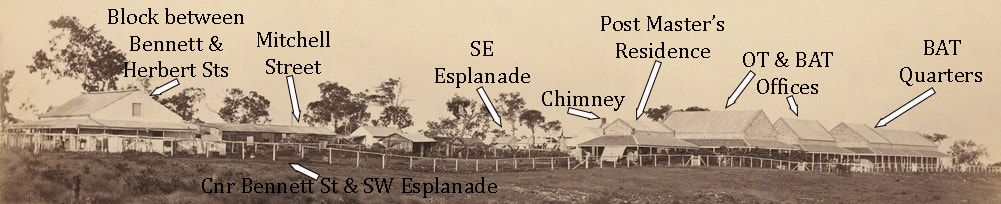
SLSA B-10840 (1) The Telegraph Offices c1870