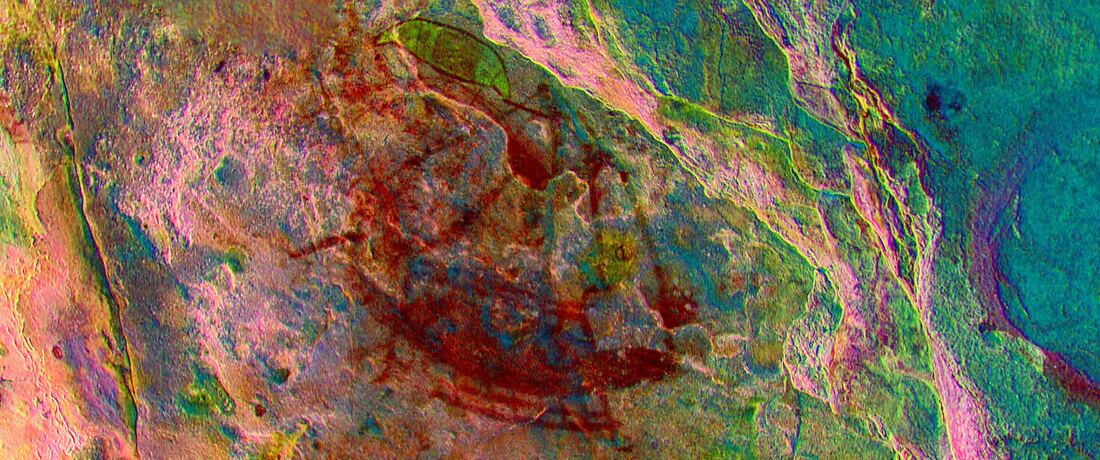
A Double-outrigger Sailing Canoe believed to depict the craft of the protohistoric Wurramala Whale Hunters ©PastMasters
KORA KORA REVEALED
|
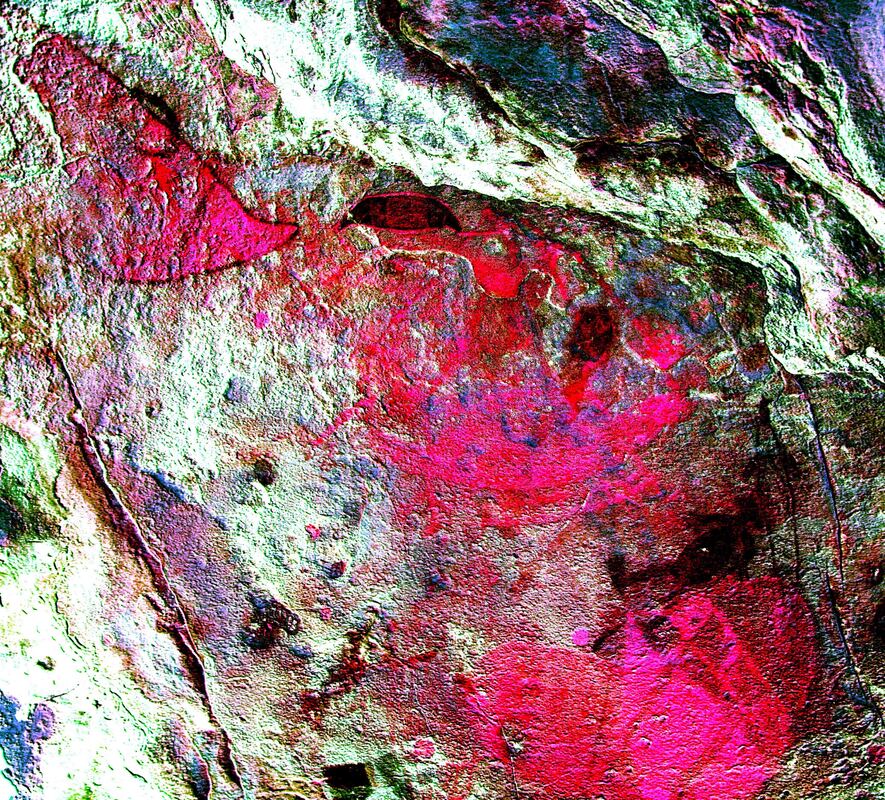
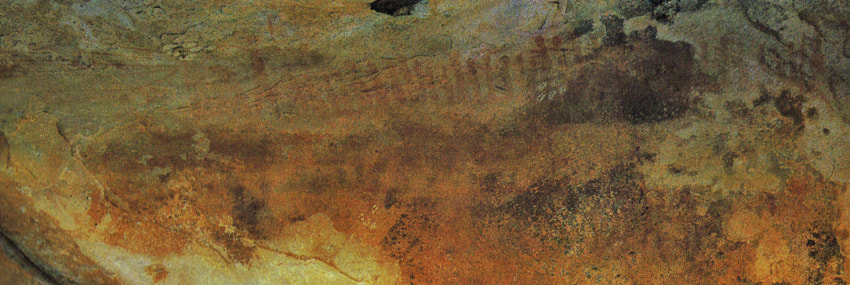
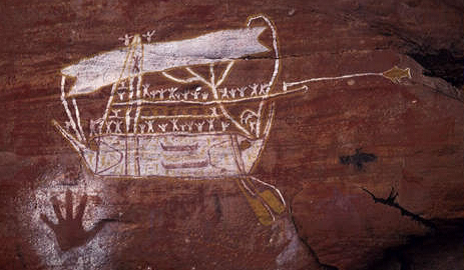
During the PastMasters 'Ancient Coins in Arnhem Land Expedition' in July 2013, Tim Stone found a cave containing old, almost invisible rock art.
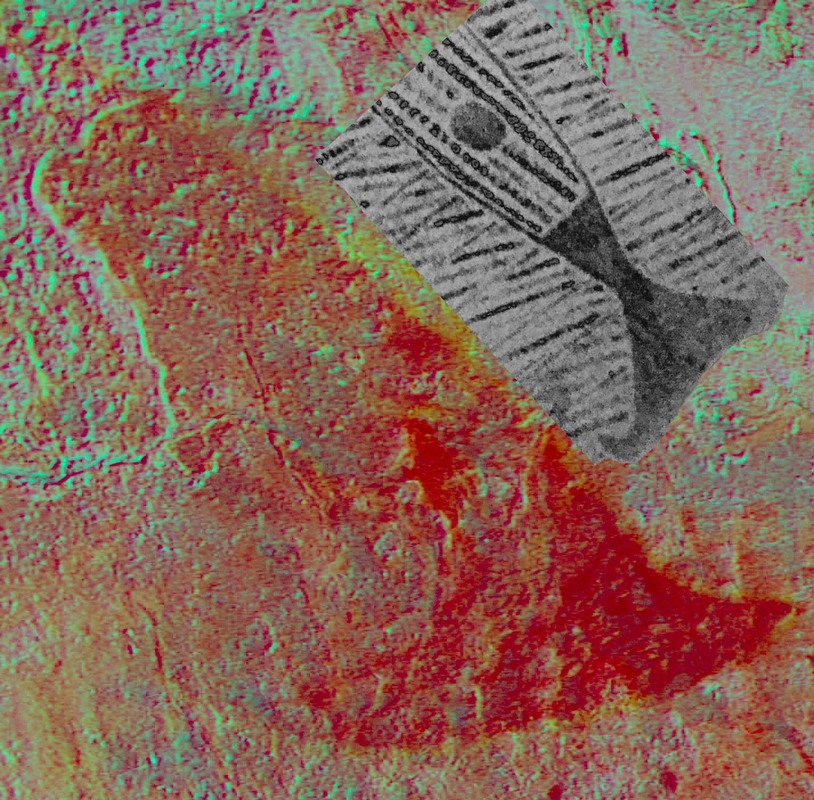
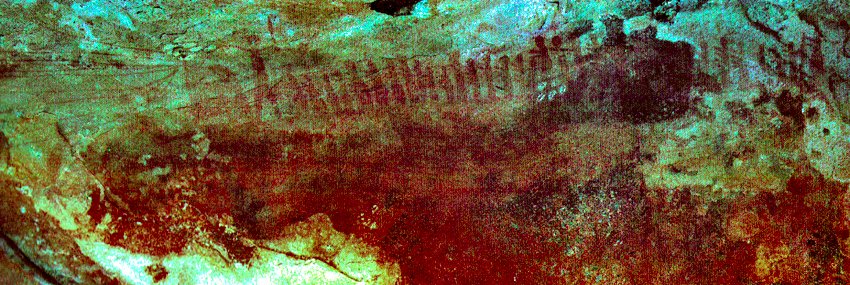
In 2016, during a routine on-line session, Daryl Wesley subjected one of these image to D'Stretch software and instantly revealed the double outrigger canoe which may well be the oldest depiction of a foreign vessel ever found in Australia. Our 2023 Anniversary Expedition got Covid - now as a DGR approved Australian Research Institute, we are raising funds to test the hypothesis that the medieval Kilwa Coins - the Kora Kora & the Pestles & Mortars are evidence of deliberate, recurrent, visitation to Australian shores. |
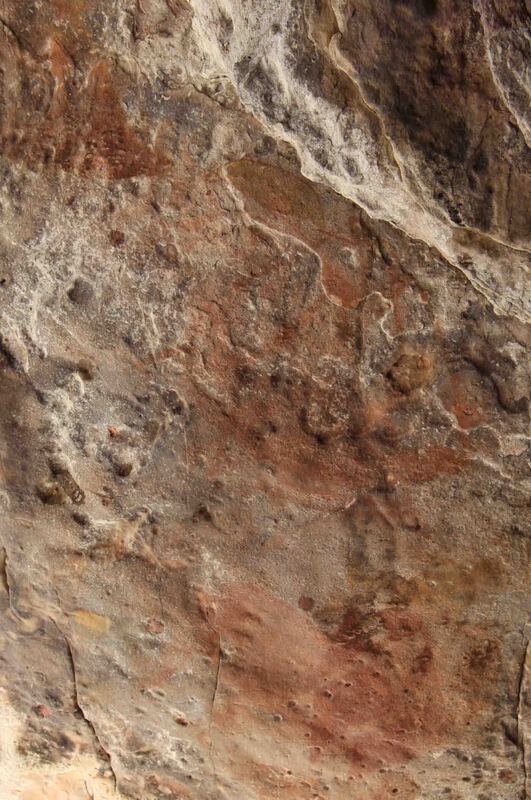
The original Kora Kora Rock Art 2013 ©PastMasters
DStretch is a digital enhancement program used to aid analysis of rock art & other aged or weathered imagery.
|
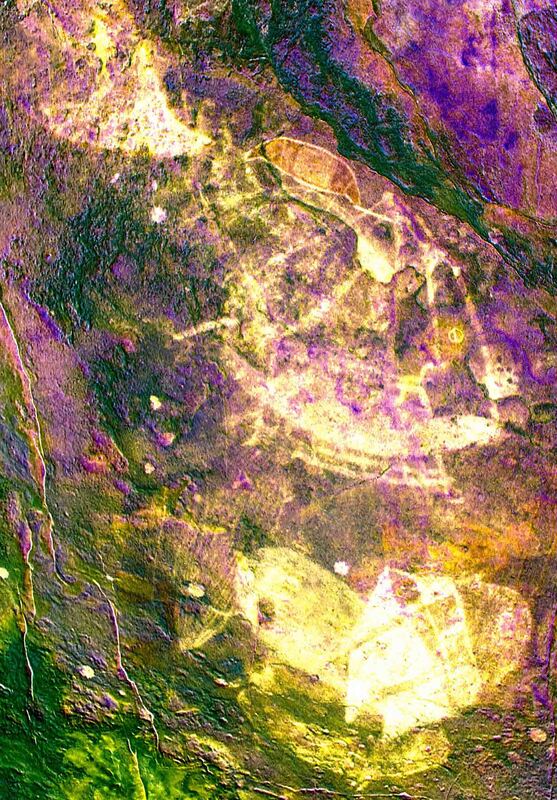
The Kora Kora under D'stretch software ©PastMasters
|
A Pre-Macassan, Double Outrigger, Sailing Canoe
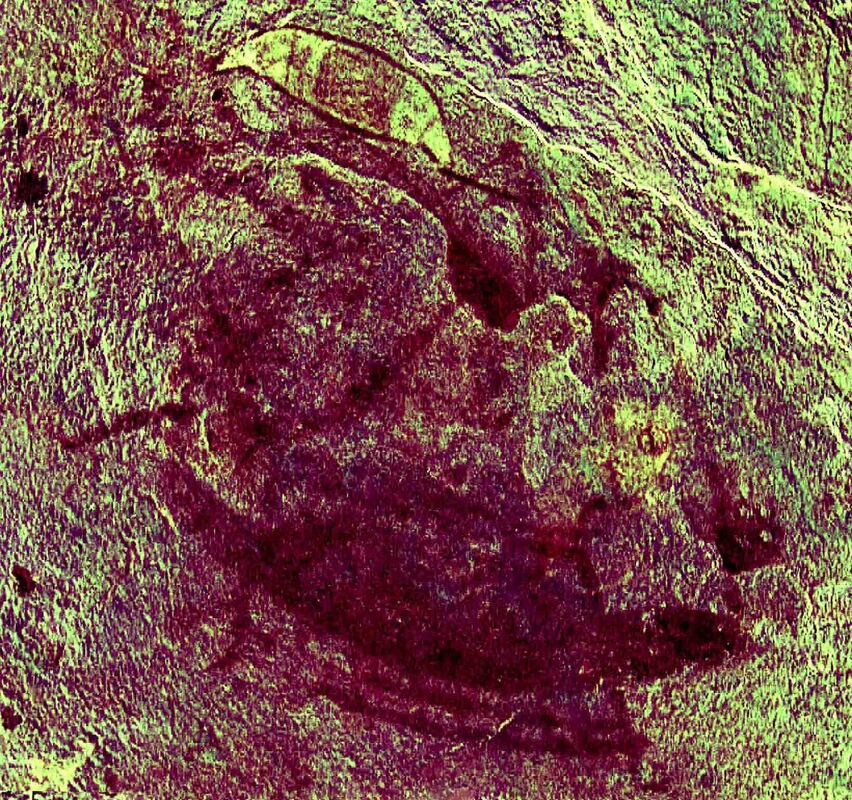
Kora Kora - D'stretch detail ©PastMasters
|
This page considers the discovery of a rock art image that we call the Kora Kora - as in large canoe {it being paddled, not rowed}.
We believe it to represent a craft used by the Wurramala Whale Hunters of Yolngu oral history and therefore amongst the earliest depictions of foreign vessels in north Australia. The double outrigger sailing canoe is the centrepiece of what appears, under D'Stretch enhancement, to be a contemporaneous scheme, executed under a single hand. |
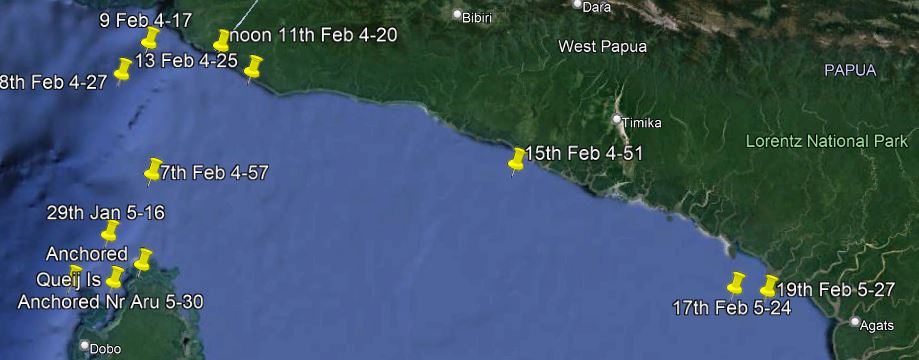
NE Arnhem Land on a Google Earth image
|
"The rock art image of an outrigger canoe represents the first physical evidence of the existence of the totem hunters, though references to them begin with the work of Warner (1969:353) who describes the mortuary ceremony of Yolngu in their ‘eastern Yirritja sea cycle’ of songs. In these mortuary ceremonies, which I have witnessed on multiple occasions, up to 60 dancers in two lines mimic the actions of the hunters in paddling and then killing the whale. Berndt (1948:98) for example, describes the songs where Yolngu sing about Wurramala and Gelurru etc. as they paddle their canoes to Badu [Island of the Dead], beyond the Wessels. It is therefore not surprising that one should find such an image on the Wessel Islands. The long history of association between Yolngu and the totem hunters deserves the sort of attention that academics have given to the Macassans. In all probability, these connections go back many centuries." (Ian McIntosh 1995a)
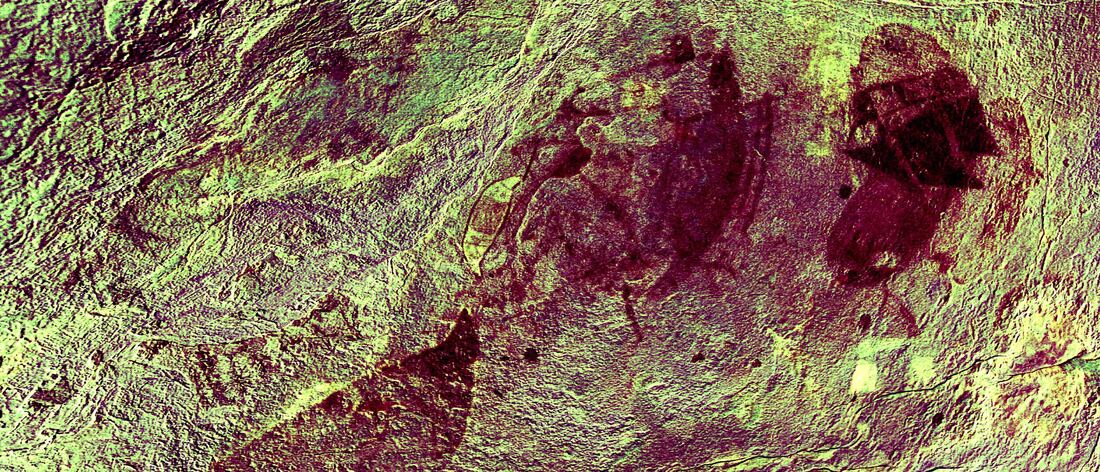
The Kora Kora ©PastMasters - believed to represent a Wurramala Whaling Canoe in rock art of the Wessel Islands in the Northern Territory of Australia
2. The Structural Elements

a. Hull & Stepped Bow
- Construction appears be a dugout base augmented by a sewn plank or hewn superstructure - raising the gunnel & spreading the bow.
- The body of the stern appears lower or a least level with the bow.
- The stern is narrow - the bow flattened & splayed to form a firing step for a harpooneer - perhaps dished for running a line over the bow.
- Conventional, a 'Boat-Header' would stand at the stern & steer the craft when going on a whale.
- The deck-housing, if any, is obscure - perhaps a simple after house or maybe a gap in the centre of a longer feature.
- The aft starboard frame extension appears to trail below but may simply be the aerial view of a raised feature matching the leading element.
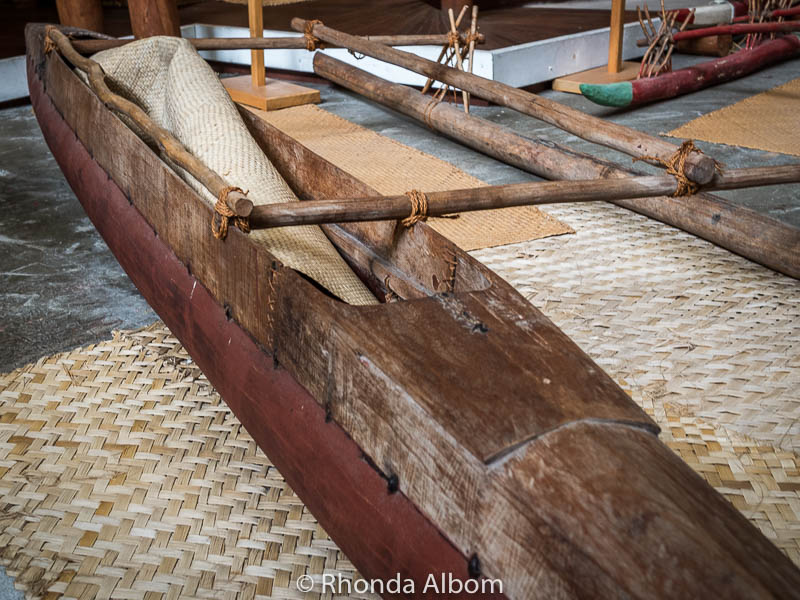
Example of a sewn canoe - Auckland Maritime Museum 7230024-2
|
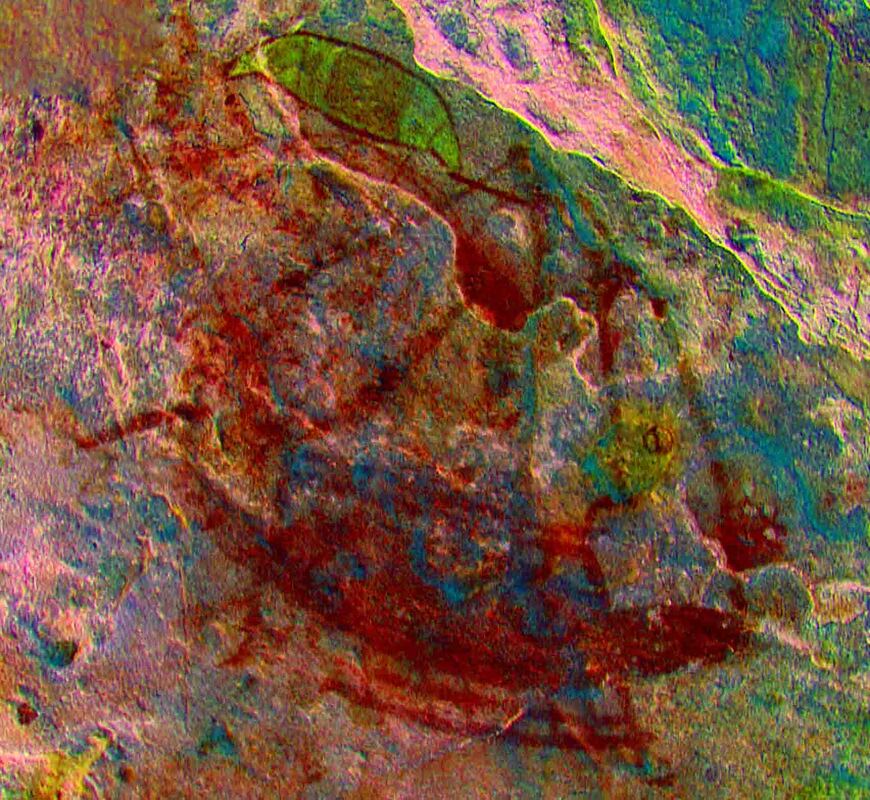
Kora Kora - Wurramala Whaling Canoe ©PastMasters
|
|
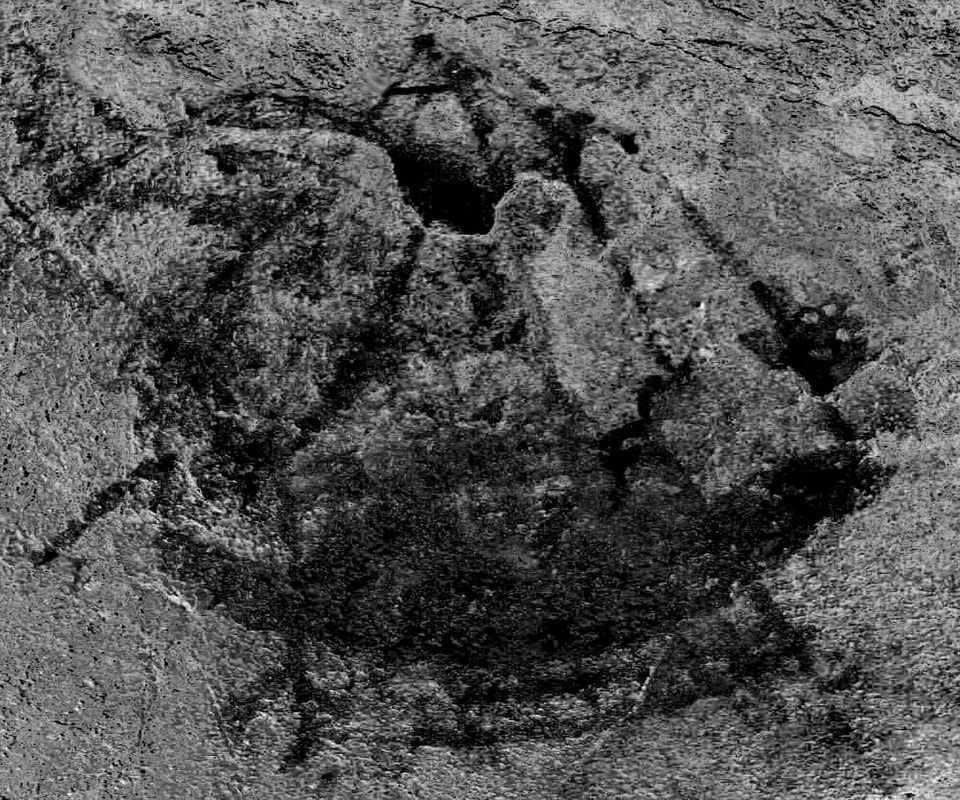
PastMasters Kora Kora - Wurramala Whaling Canoe ©PastMasters
|
b. Mast & Standing Rigging
|
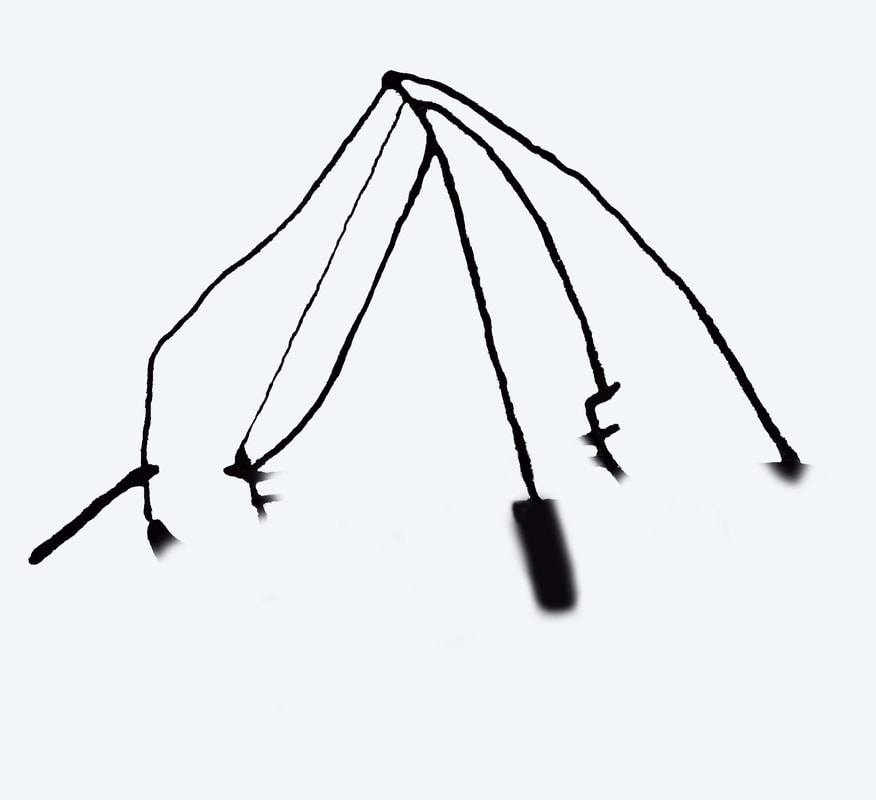
|
c. Canoe at Masthead
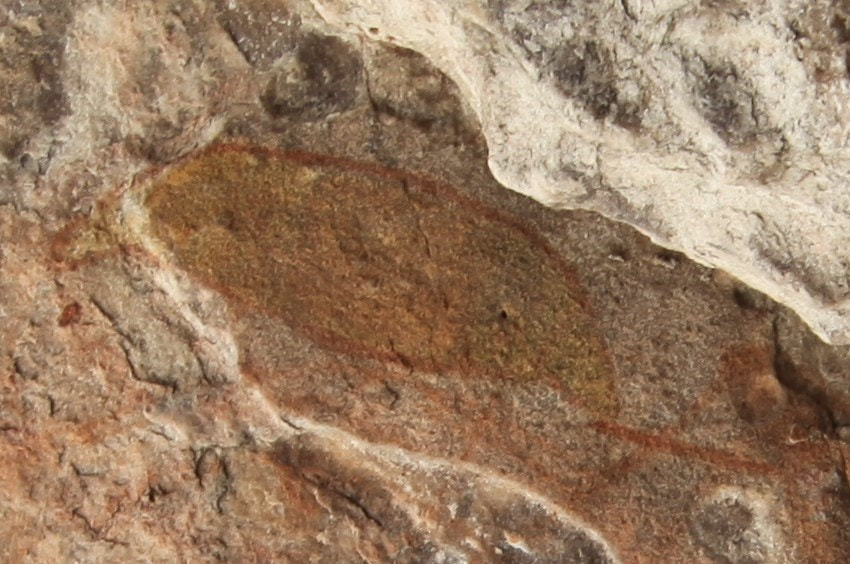
The Kora Kora detail ©PastMasters
|
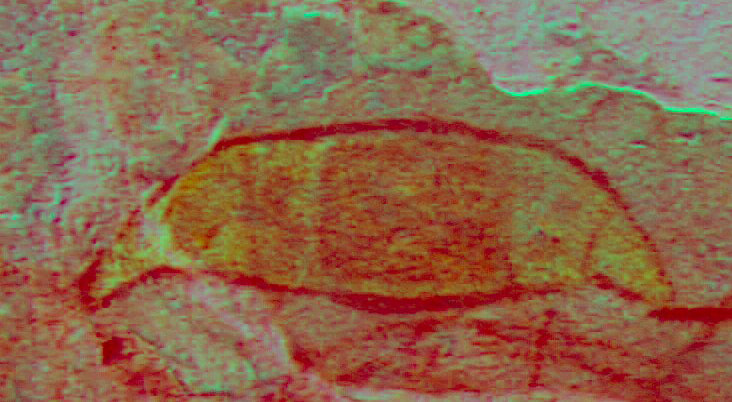
The Kora Kora detail ©PastMasters
|
Notes:
- Red oxide outline – stern & bow delineated by a line – 'yellow' ochre infill not seen elsewhere in scheme or cave – central rectangular motif suggesting cargo - seemingly painted to be more visible. Yellow pigment denotes the great value attached to the subject - i.e. gold.
- Black circle on whale tail canoe – tail notch and line across bow are geological.
- Man and canoe shown in same colour – different from ship, whale tail & KK.
- Yellow canoe at mast maybe just a co-incidental overlay though the red outline is ok and the hard bar in the rigging matches.
- Whale shaped zeppelin lines on image - similar to Chasm Island image of funereal paddlers dance.
- Bloom under ship.
- Man has long ? curved ? flensing knife – fish hat.
- Underlying yellow layer so canoe appears filled in – sails – bow of ship – hull of KK & tail all filled in with pigment unusual?
- Blooms herded fish – net below ship.
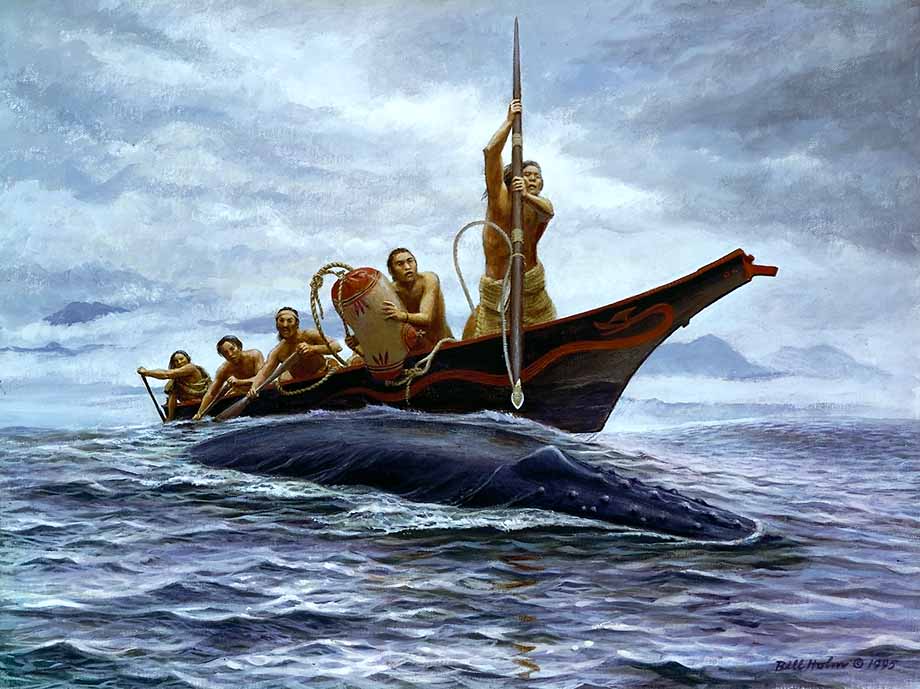
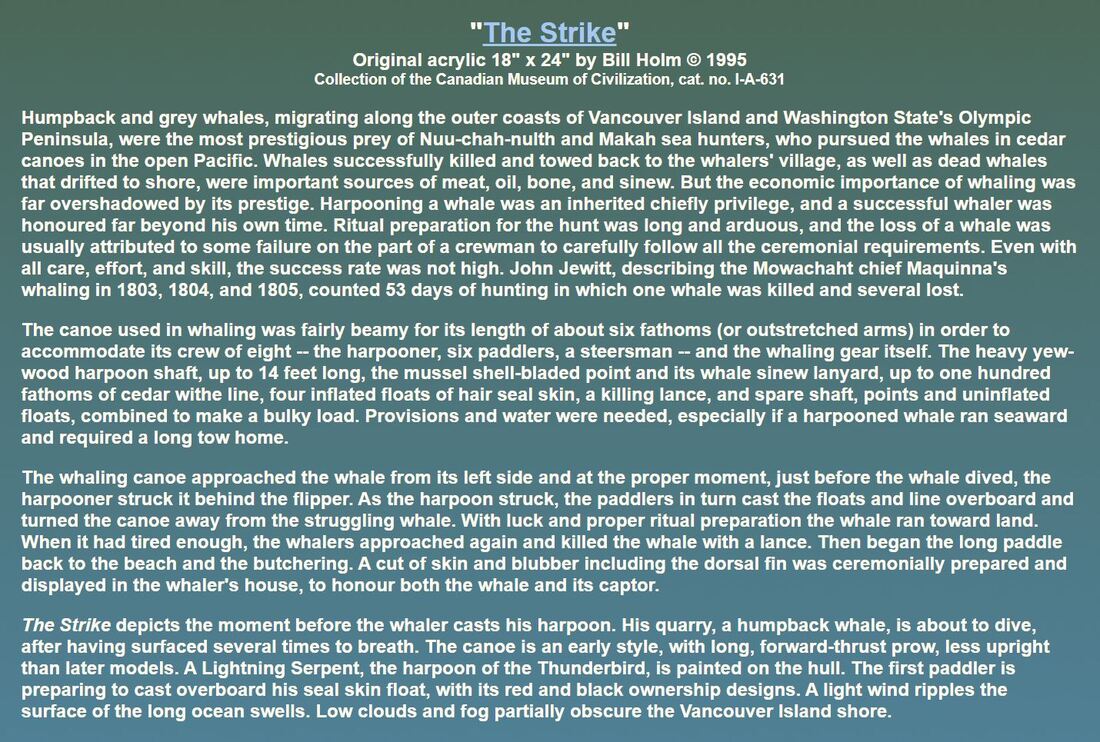
'The Strike' by Bill Holm - Canadian Museum I-A-631
|
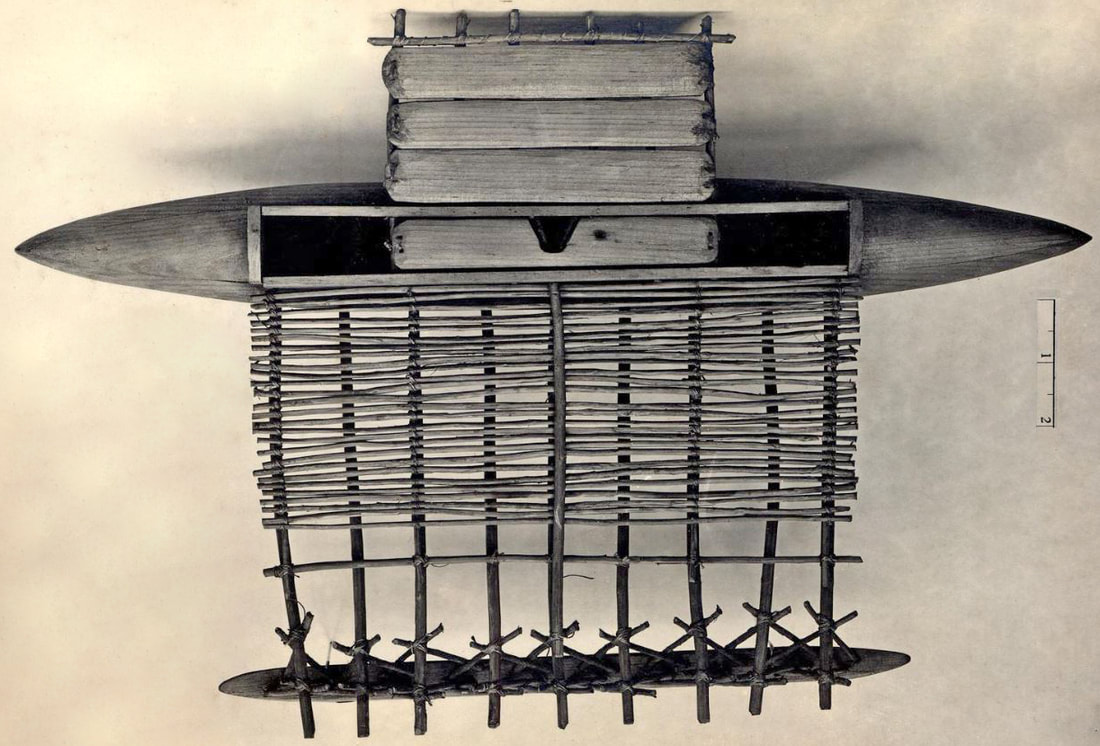
The masthead dugout canoe is thought to be a float - as in the image at left - attached by line to the harpoon whop embedded in the whale. Perhaps the bar is a device to guide the line at the critical moment. It may hold a basic release clip such as on a trolling outrigger.
The Macassans trolling rigs were greatly admired and oft portrayed from the rigging to keep them near the surface where their wake would attract the pelagic quarry. 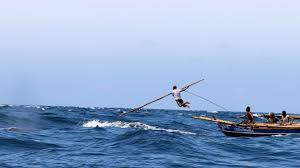
|
A similar arrangement is evident in a large rock art frieze from the same general area which depicts the float & noose version. It is above a complex scheme which suggests a man in a bi-corn hat - a blubber gaff like a question mark and three flensing tools held aloft like pharaonic palm fans.
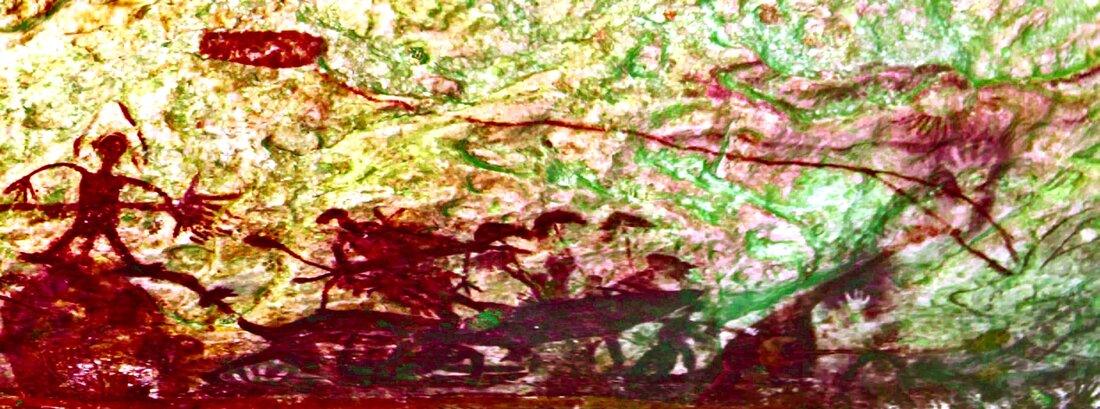
D'Stretch of a Wessels rock art frieze showing the the technique of lasso and float hunting ©PastMasters .
d. Outrigger Frames
Starboard Side - Leading Element - distal terminates in flexion upwards as if to carry a folded lateen sail. Trailing Element - distal terminal appears in flexion downwards - perhaps illusory. |
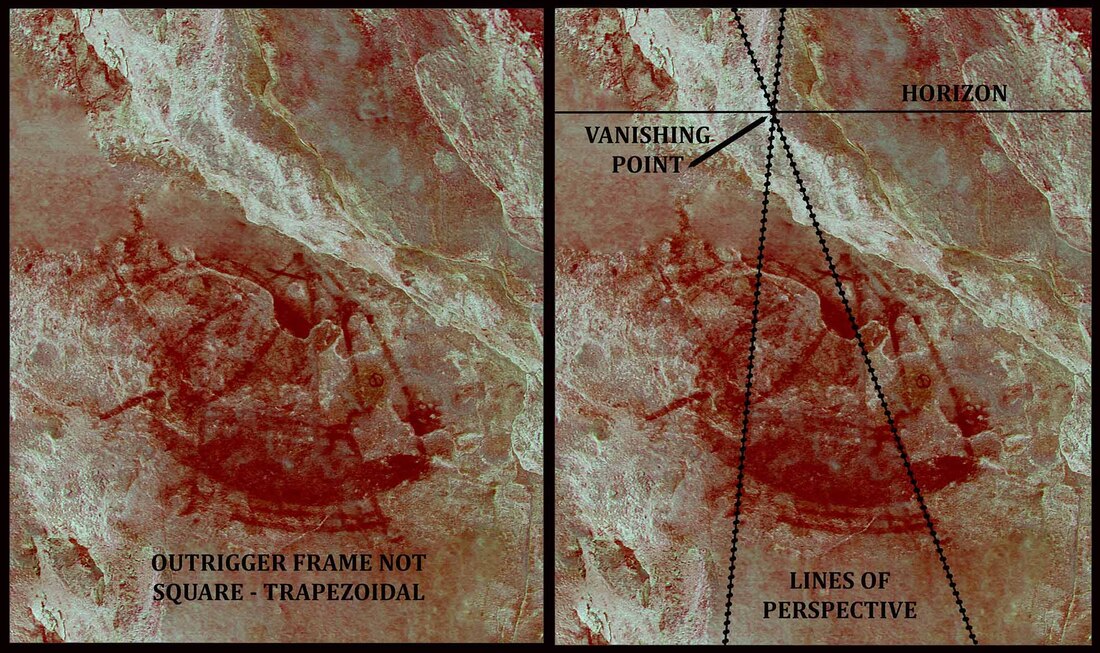
The Kora Kora Detail 2013 ©PastMasters
|
|
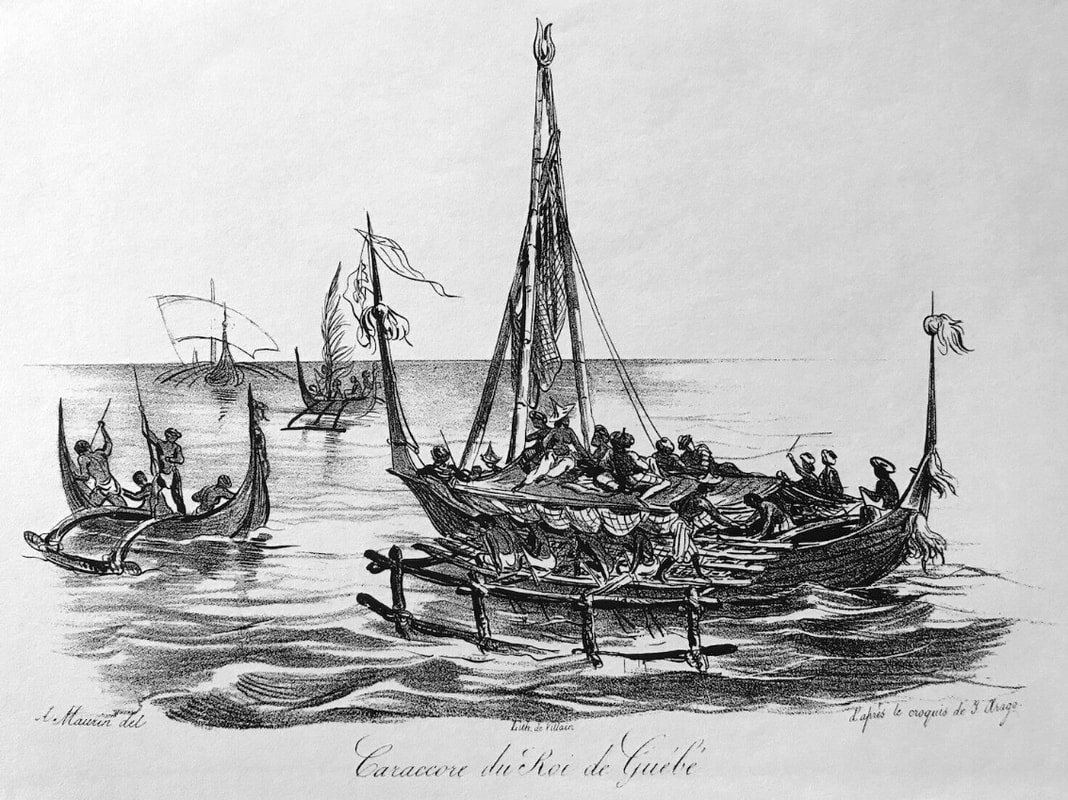
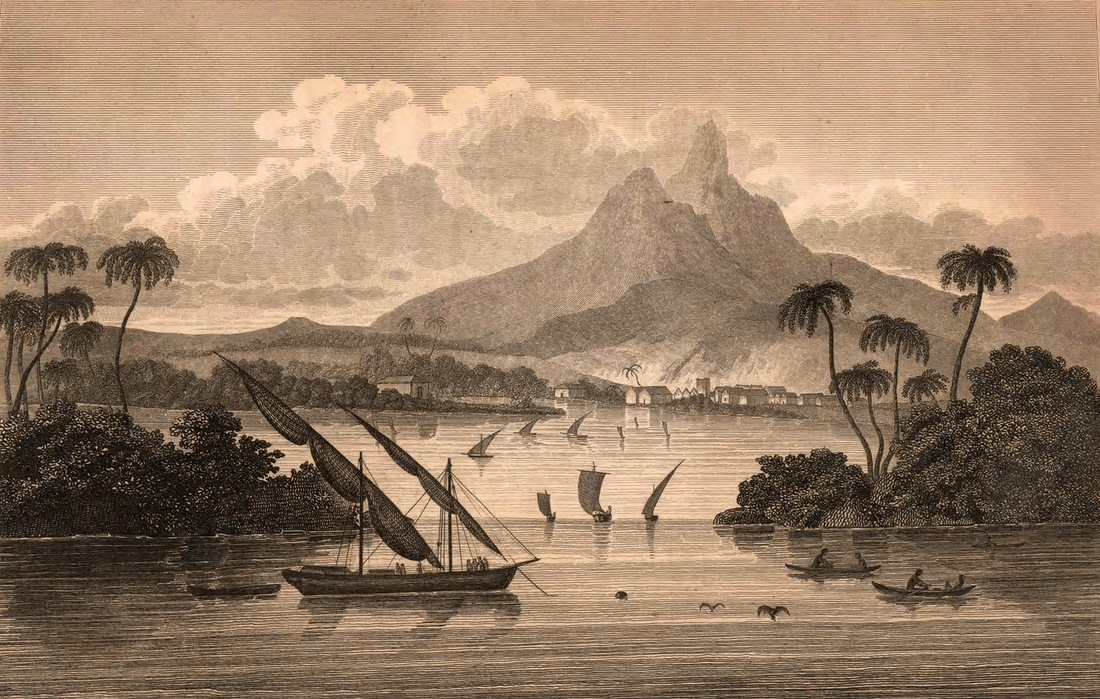
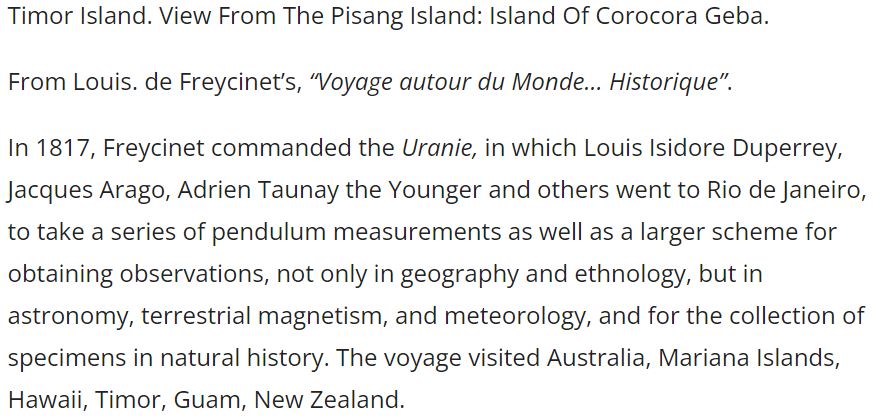
Caraccore of King Guébé - Moluccas Indonesia Engraving 1839v
|
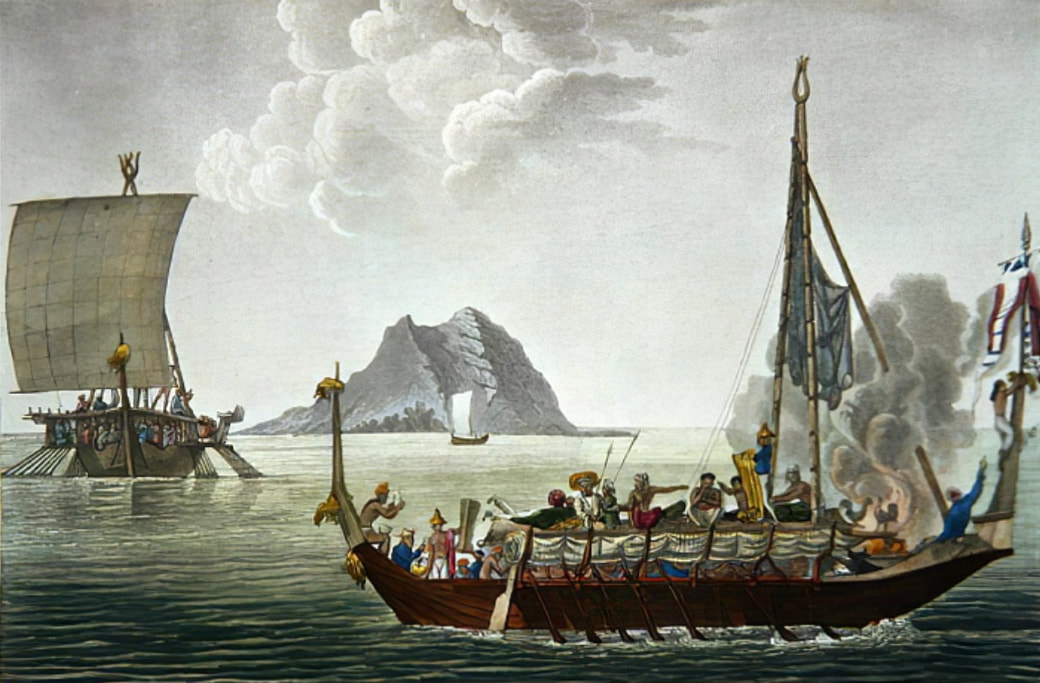
Corocores of the Island of Guebe
|
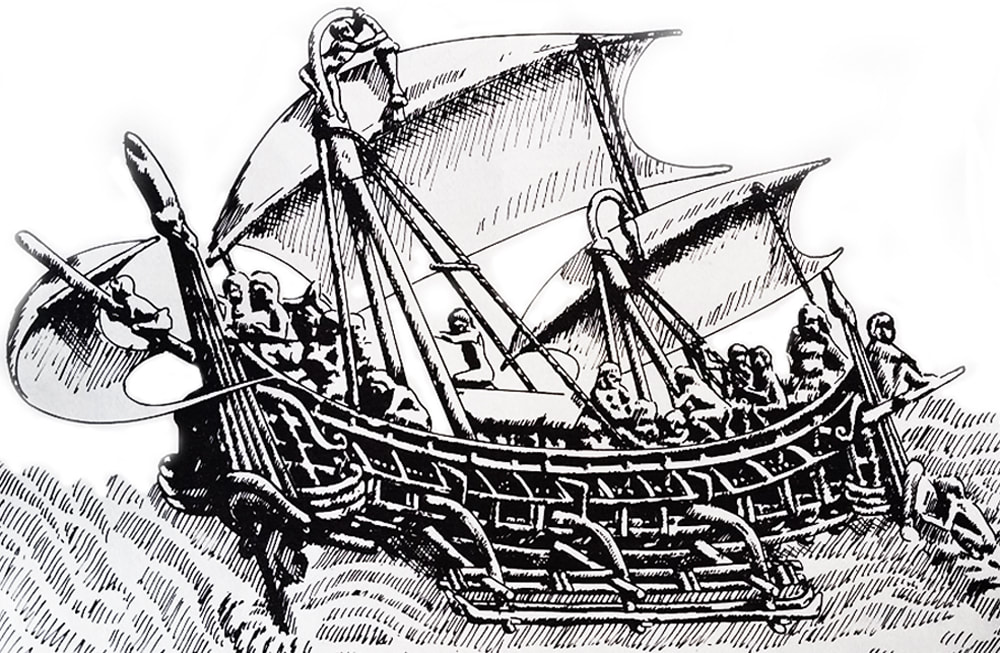
View of the Corocores {i.e. Kora Kora} of the Island of Guebe, from the Island of Pisang, from 'Voyage Autour du Monde sur les Corvettes de LUranie 1817-20' engraved by Coutant, published 1825 by Alphonse after Pelliono.
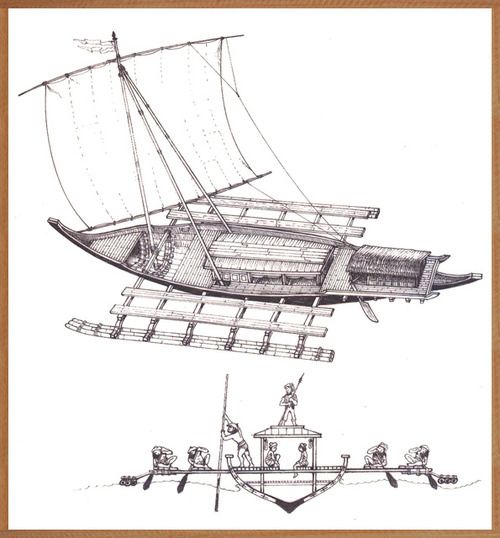
These are rowed & clinker built but show suspended outrigger frames - steering oar position - rigging on one side for a lateen sail - detachable stern & bow elevations - revealing a wide flat bow as a firing step.
|
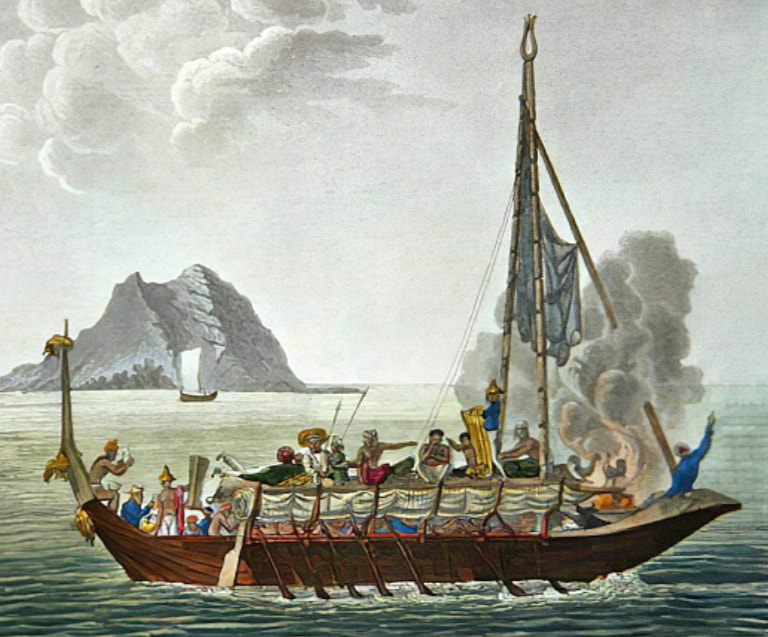
Bow Photshopped to show firing step
|
The large vessel at left has a broad beam, internal & outboard rowers to total 28 men - waterline length and ballast would keep this manageable. Small vessel is side on & has seemingly little or no beam - also 28 rowers - the same masthead emblem & 'seaweed' adornment. Both carry the same number of rowers - sail stowage etc. so must be the same size yet the depth perspective is wrong in a 19th century image. Rag, bow extension, chooks & bonfire.
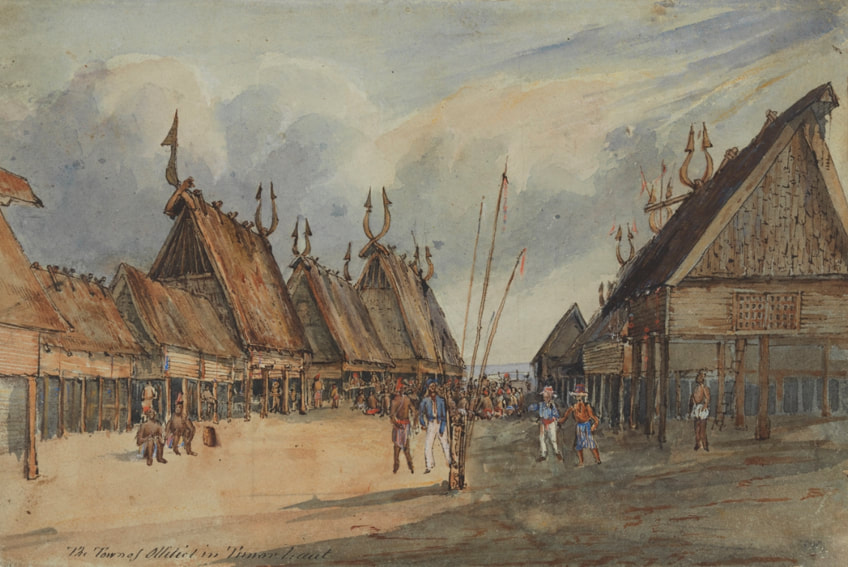
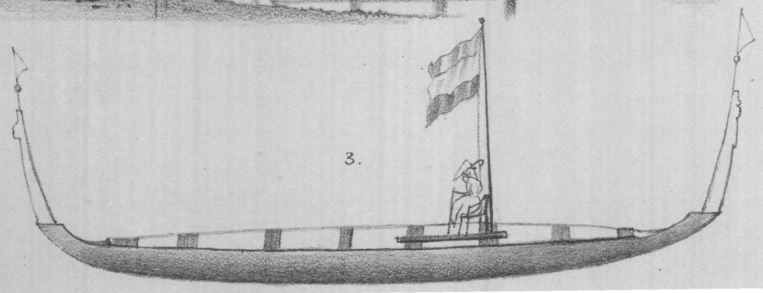
Omele Saumlaki - Timor Laut - Yamdena Is. By Owen Stanley. The finials are similar to those on the vessels above.
|
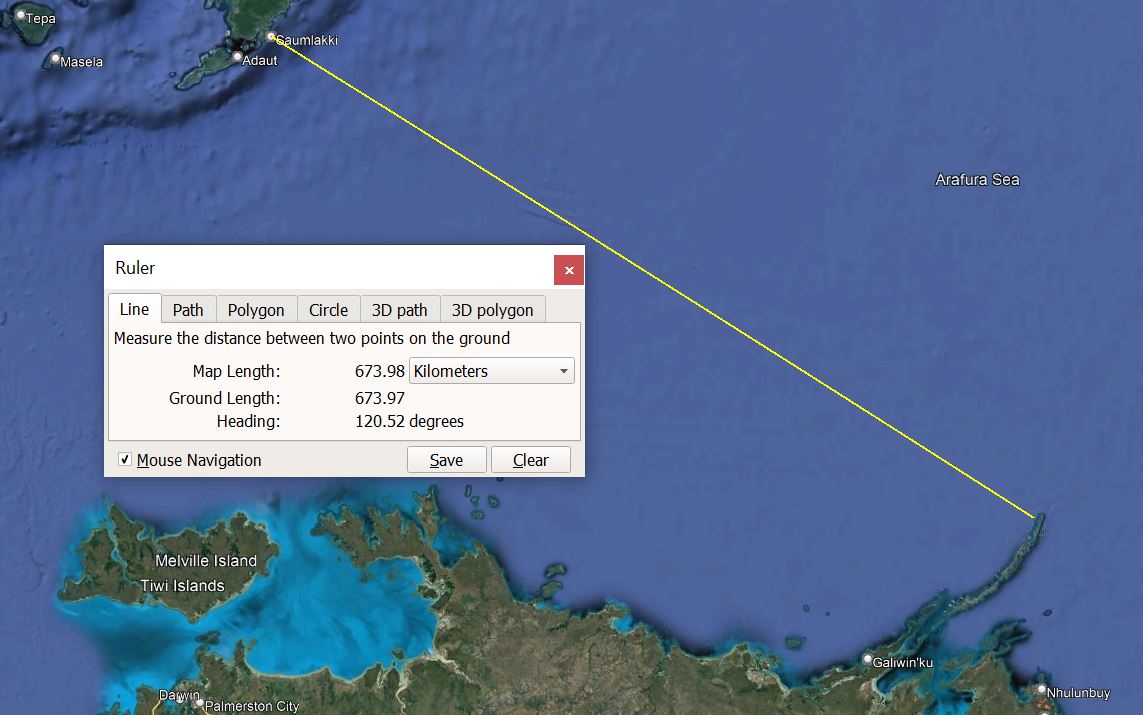
Saumlaki on Yamdena Is. (Timor Laut) is 364nm from the Wessels SE/NW
|
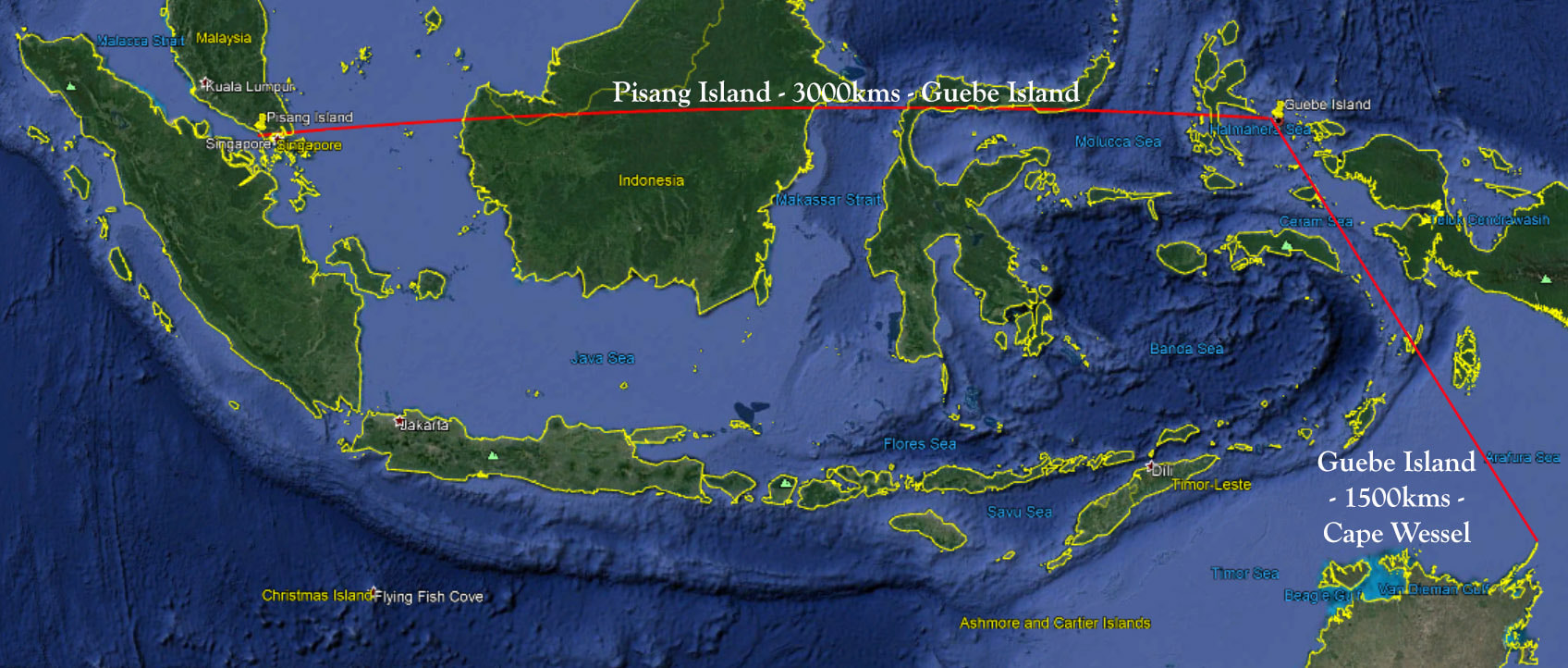
Google Earth - distances between Pisang Island - Guebe Island & Cape Wessel
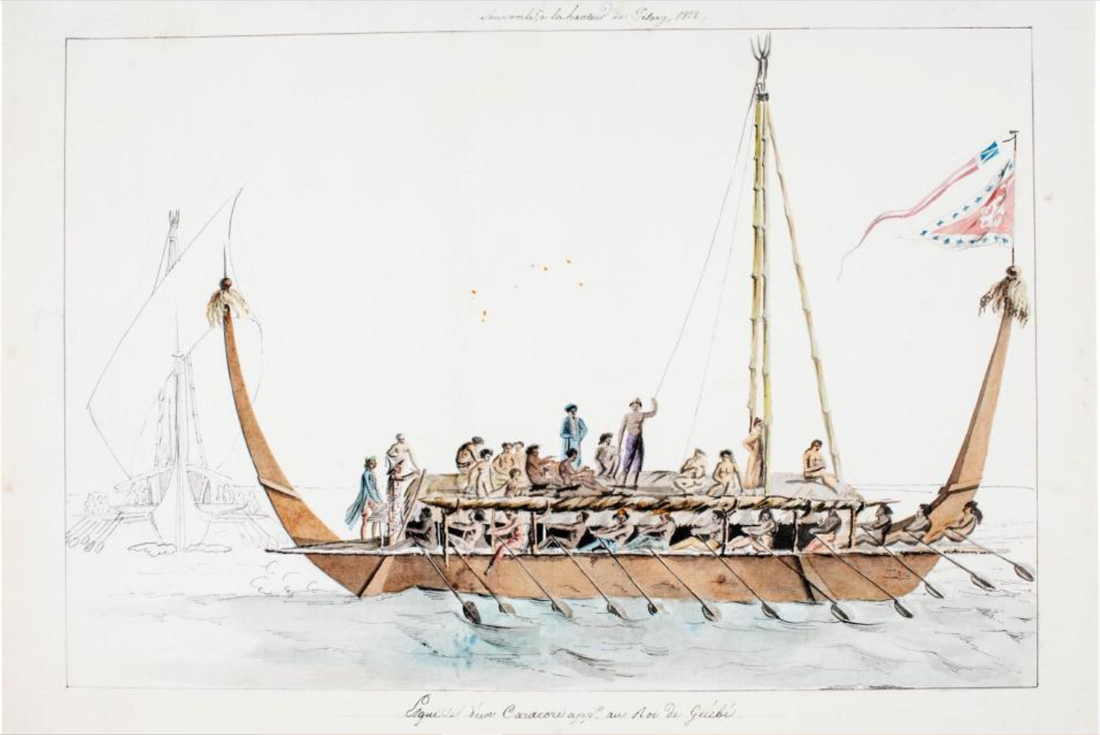
King Guebe before Pisang 1818 likely Jacques Arago - 24 oarsmen
|
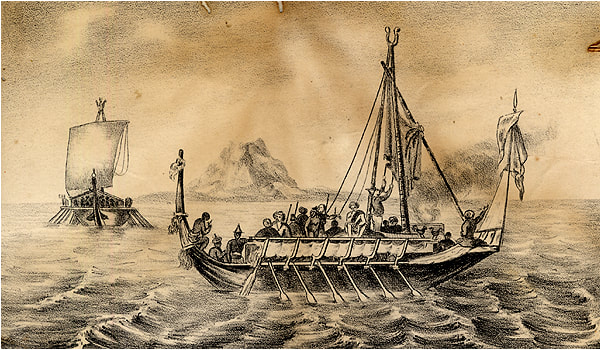
Garay warships of pirates in the Sulu Sea wikiwand - 24 & 12 oarsmen
|
View of the Corocores of the Island of Guebe, from the Island of Pisang, from Voyage Autour du Monde sur les Corvettes de LUranie 1817-20 engraved by Coutant, pub. 1825 by Alphonse after Pellion.
The vessels above are being rowed not paddled but still display practical elements that may be generic to auxiliary vessels across the general area. The cupped frame to hold the furled sail - a detachable bow extension on the smaller Garay vessel - the location of the steering oar - rowers on the larger Garay vessel both inside the hull and on the frame - no pontoons on any of the vessels & a tripod mast rigged on one just side.
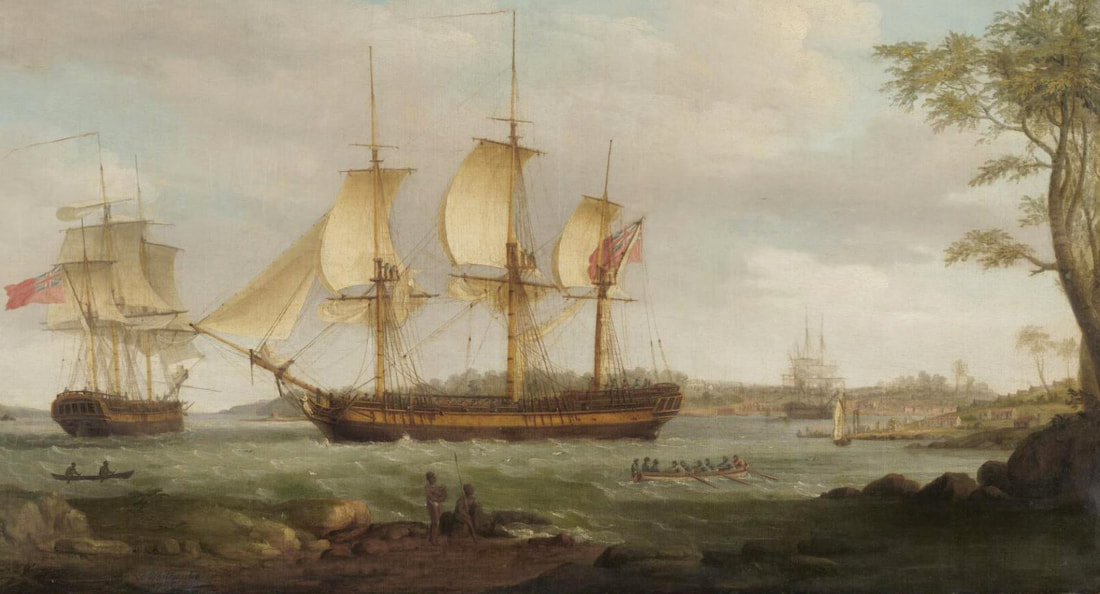
Whaler Brittania 3rd fleet at Sydney 1798 by T. Whitcombe NLA
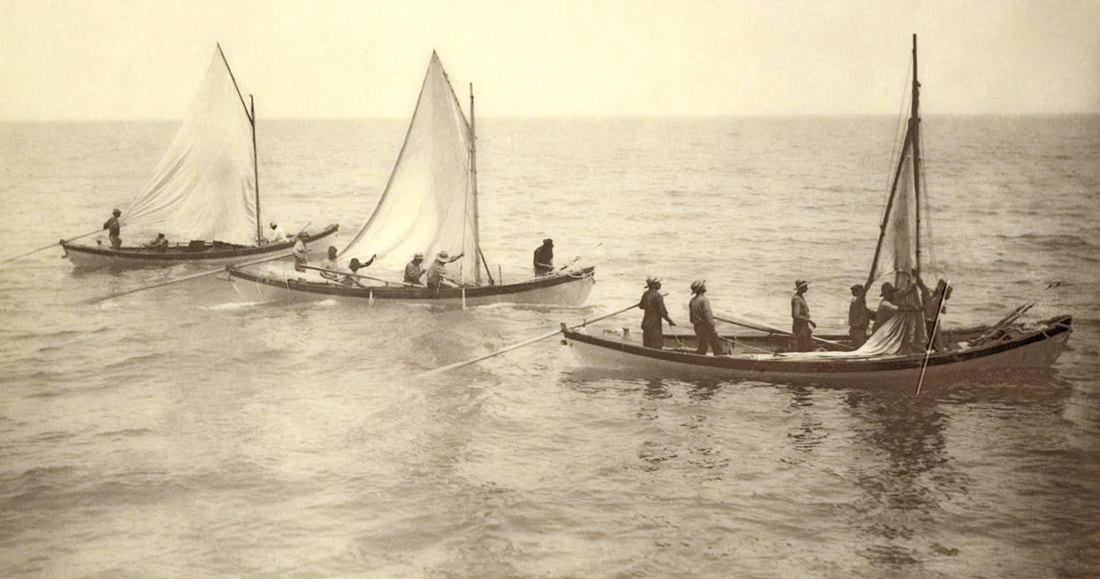
Costa Rika Packet boats on a whale c.1890 in Oz water NLA pic-an24750423
|
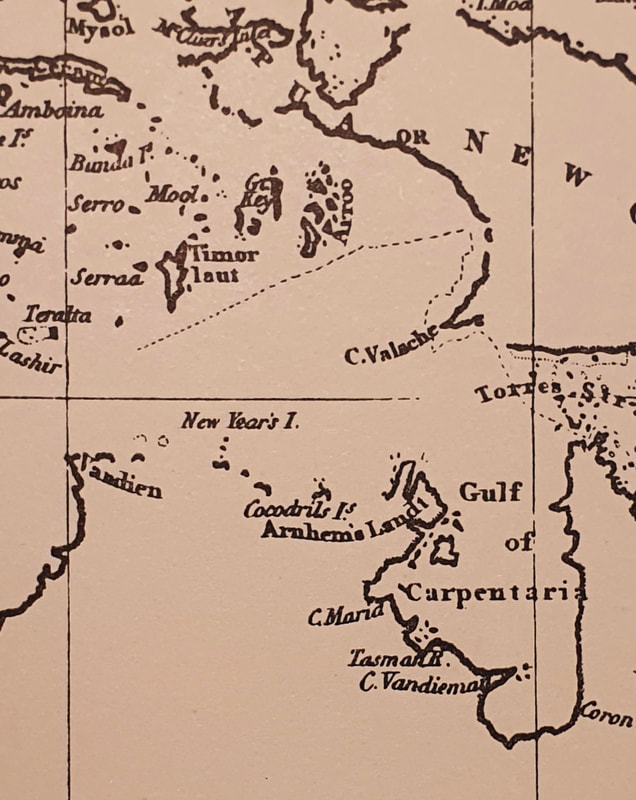
Timor Laut in Arrowsmith's Pacific Ocean 1798 - in Westall
|
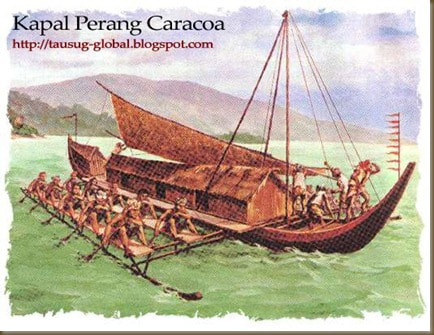
Caracoa or Lanong - 1m interstices
|
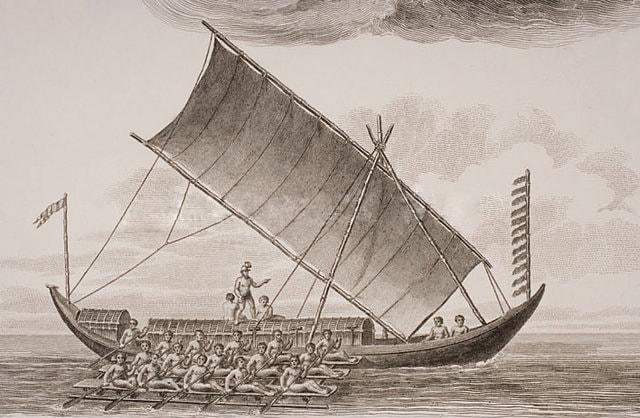
A Caracore from Borneo from an 1820 print engraved by Milton - 1m interstices
|
'Caracoa is large, fast boat used particularly in the southern parts of the Philippine Islands. It is basically a warship, used for raiding expeditions called mangayaw, or what the Spaniards condemned as "piracy". Mangayaw were mounted by gallant warriors and celebrated in heroic lore. Mangayaw raiders took booty but their real objective was slaves.' Source: Filway's Philippine Almanac
The pennant on the Jack Staff resembles that on the Wessels Kora Kora.
The pennant on the Jack Staff resembles that on the Wessels Kora Kora.
3. The Schematic Context
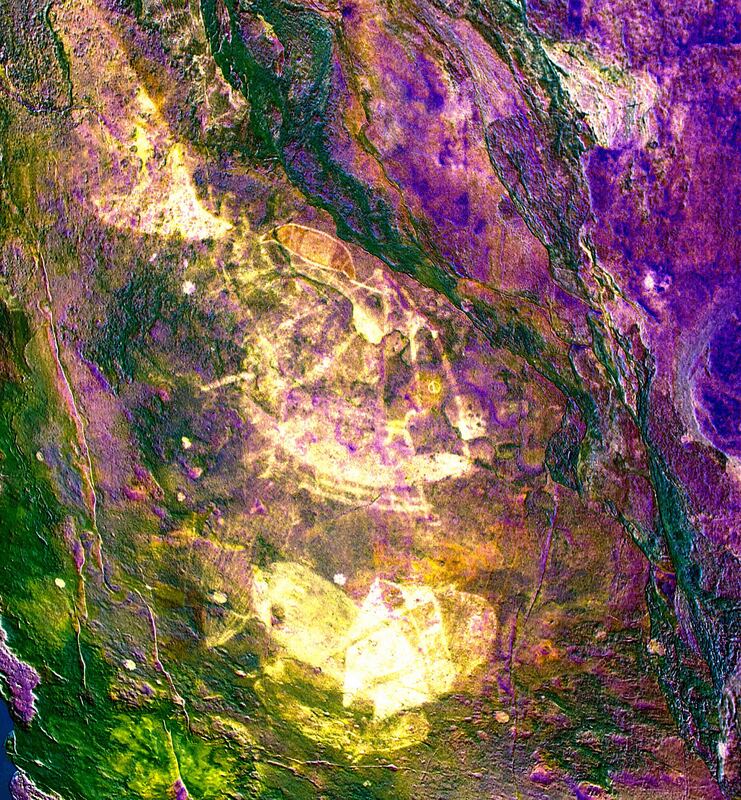
The Kora Kora 2013 ©PastMasters
|
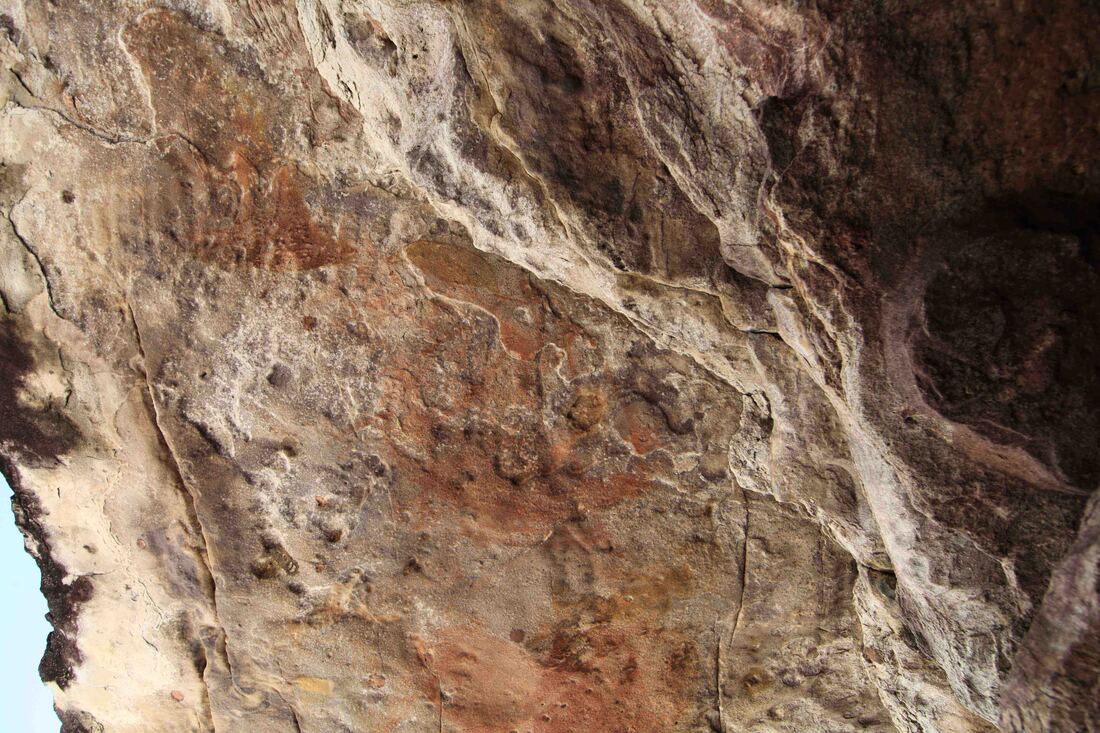
The Kora Kora 2013 ©PastMasters
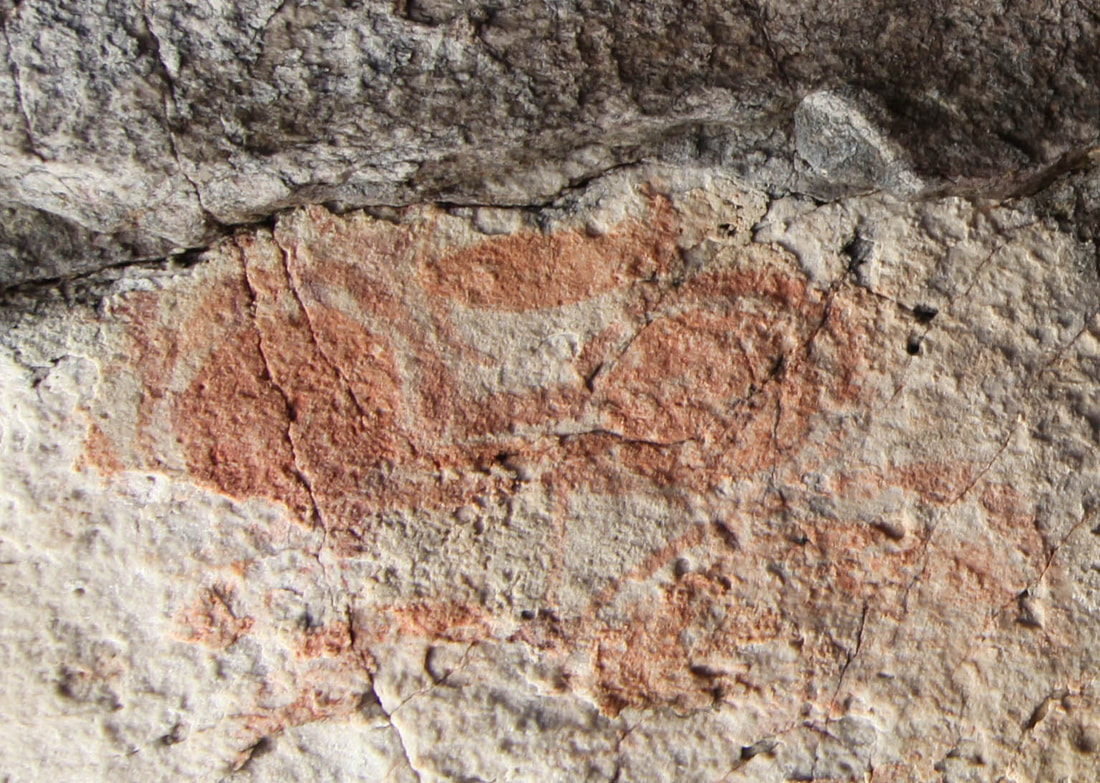
The Kora Kora Cave 2013 ©PastMasters
|
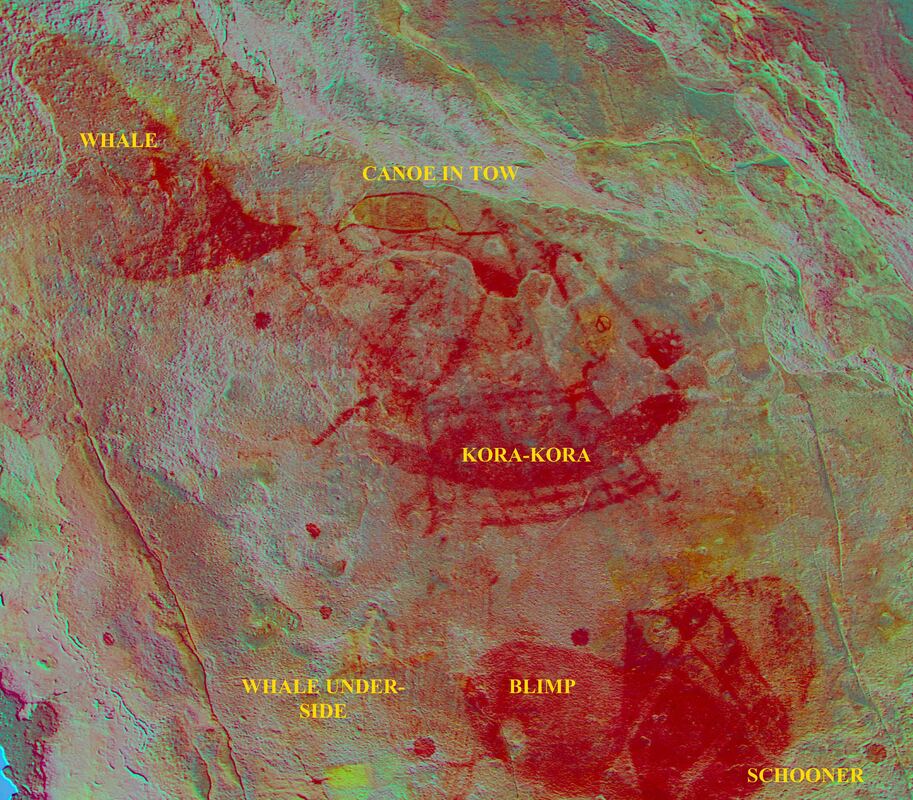
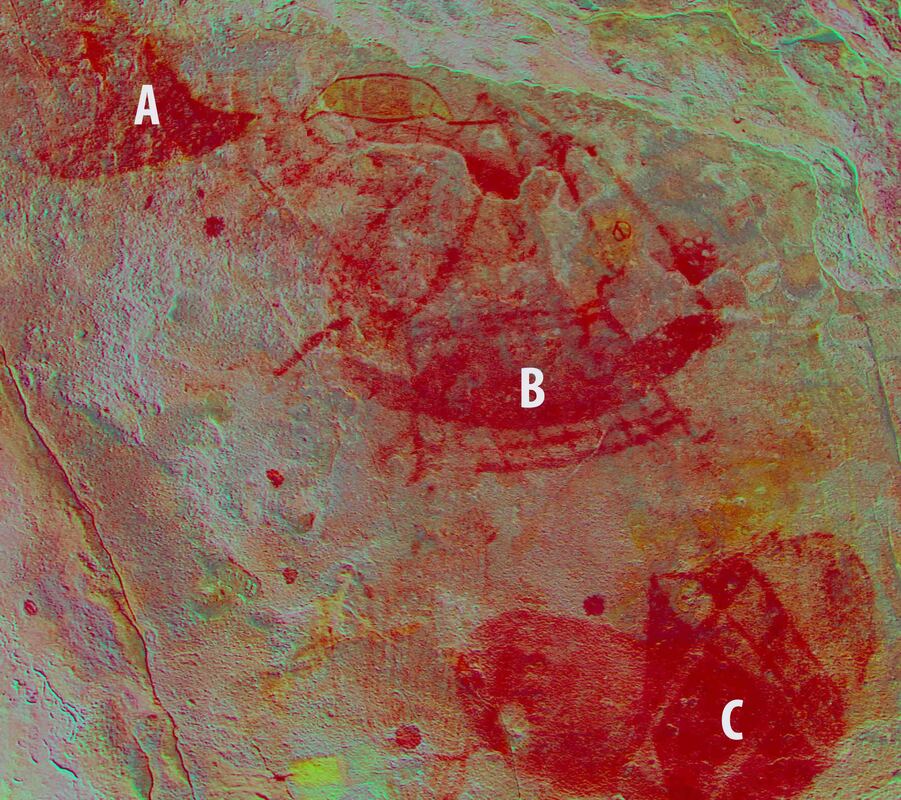
- The Kora Kora is the centrepiece of scheme of contemporaneous - overlain & overlying - elements.
- The overall scheme - above left - is almost entirely opaque to the naked eye.
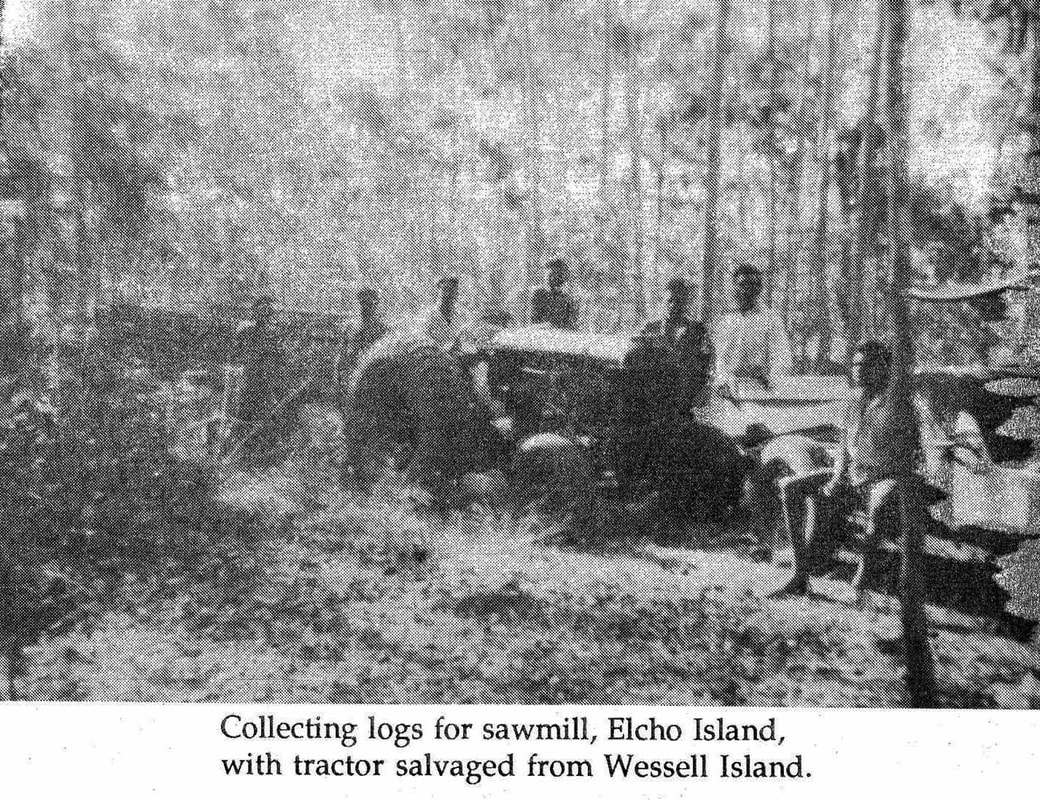
- In contrast is the tractor, which was with 412RS during WW2 and recovered by the Elcho mission soon after the war. It was used by the mission in a contract to clear an airstrip at Cape Wessel enabling the light to be repaired & maintained. One such maintenance visit by sea led to discovery of the pestles & mortars discussed below. It is the adjacent small cave.
- The main elements of the scheme appear here in red under D'Stretch, suggesting they are contemporaneous.
- The 'Blimps' may represent nets, whales or a shoal of herded fish - the main one overlies the sailing vessel which overlies the man.
|
|
|
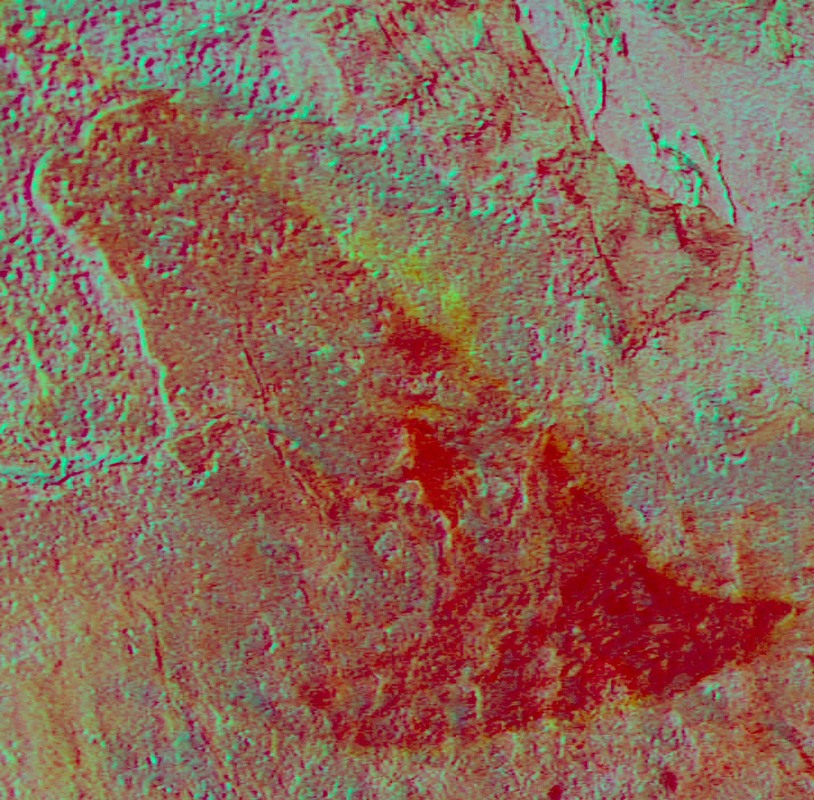
4. A Whale Tail?
The notched whale tail is an example of Confirmation Bias - the new version of D'Stretch revealed a large canoe with the same arched gunnel as evident in the small canoe at the Kora Kora masthead. The canoe has a sharp, dark outline and is infilled with pigment - a great deal of pigment. The masthead canoe also has an outline and infilled with another, 'darker' pigment.
Detail of top left component
|
Detail as a 'whale tail'
|
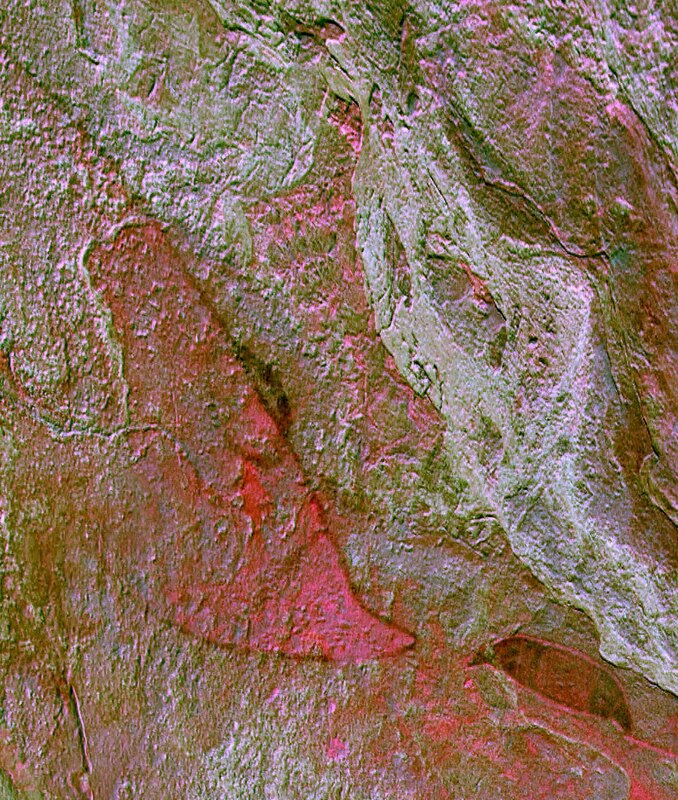
Detail as a large canoe.
|
5. Sailing Ship
A 2 masted - gaff rigged, ketch - the basic Lugger but with a high raked bowsprit and single foresail & high-sided unlike a lugger. The tapering hull from the bow to stern give the perspective of a vessel fast approaching - the hull is partitioned as is common but the sails are solid pigment.
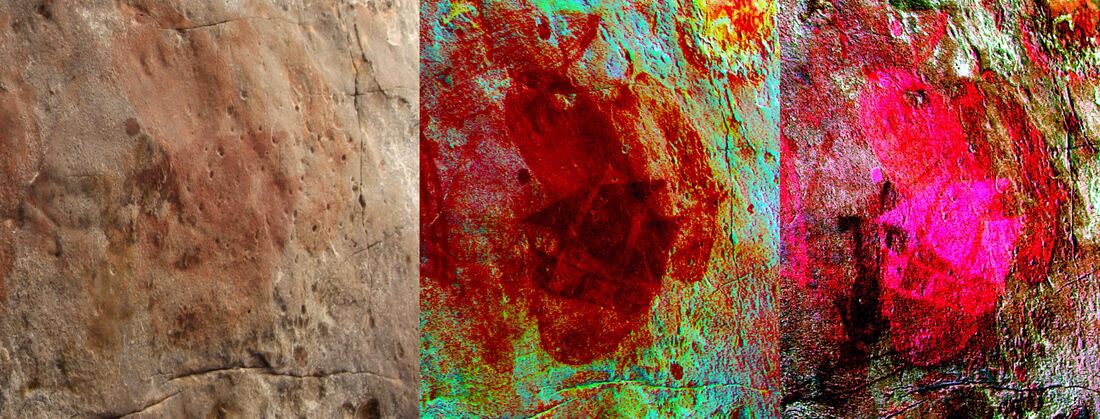
Original Kora Kora image 2013 with D'stretch detail ©PastMasters
Two masted, gaff rigged - high cocked bowsprit & infilled sails
|
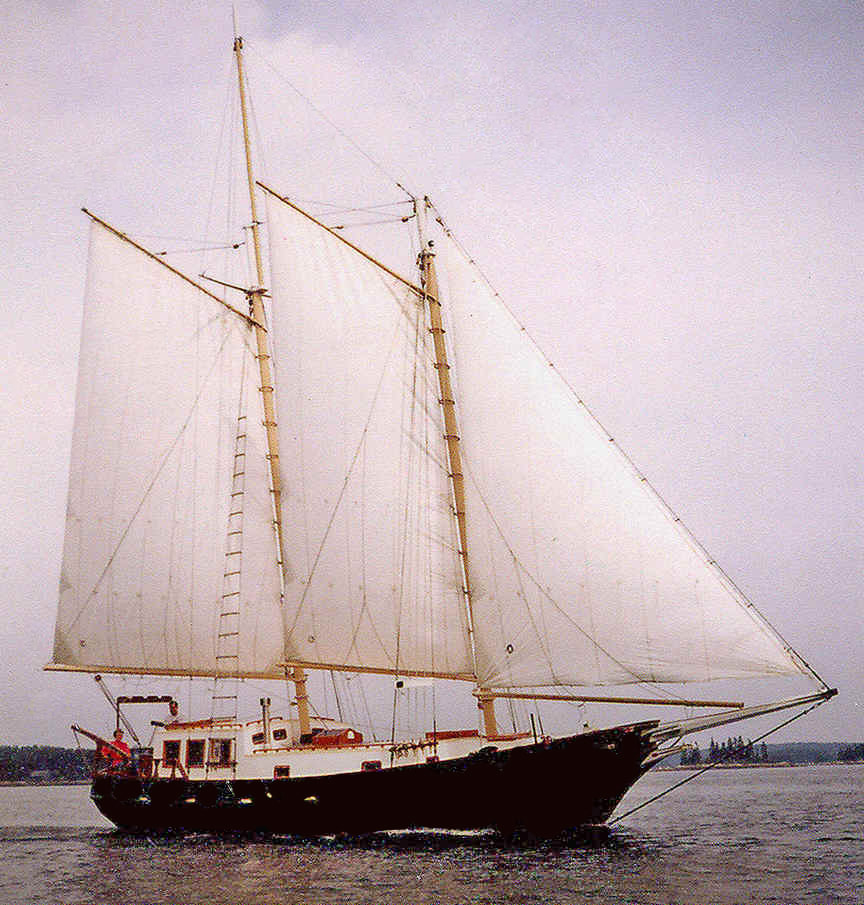
A two masted, gaff rigged yacht with a level, narwhal bowsprit.
|
Gregor MacGregor's fabled Poyais principality.
The late 18th/early 19th century trading vessel vessel in the foreground - especially if gaff rigged - would function well as a mothership for the sort of activity envisaged for the Kora Kora. (See Gregor MacGregor Prince of Poyais below)
The ability of a vessel to point into the wind doesn't remove the advantages of the seasonal reversal of the trade winds - north Australia was eminently accessible to relatively modest vessels. The Pacific Ocean driven currents that flow down from the north of PNG drive the Gulf of Carpentaria Gyre that circulates clockwise. It is also noted that the maritime tradition of the Sulu Sea was the first to embrace European style shipbuilding techniques as a result of ushering tea traders through pirate infested seas up to the China Station.
The ability of a vessel to point into the wind doesn't remove the advantages of the seasonal reversal of the trade winds - north Australia was eminently accessible to relatively modest vessels. The Pacific Ocean driven currents that flow down from the north of PNG drive the Gulf of Carpentaria Gyre that circulates clockwise. It is also noted that the maritime tradition of the Sulu Sea was the first to embrace European style shipbuilding techniques as a result of ushering tea traders through pirate infested seas up to the China Station.
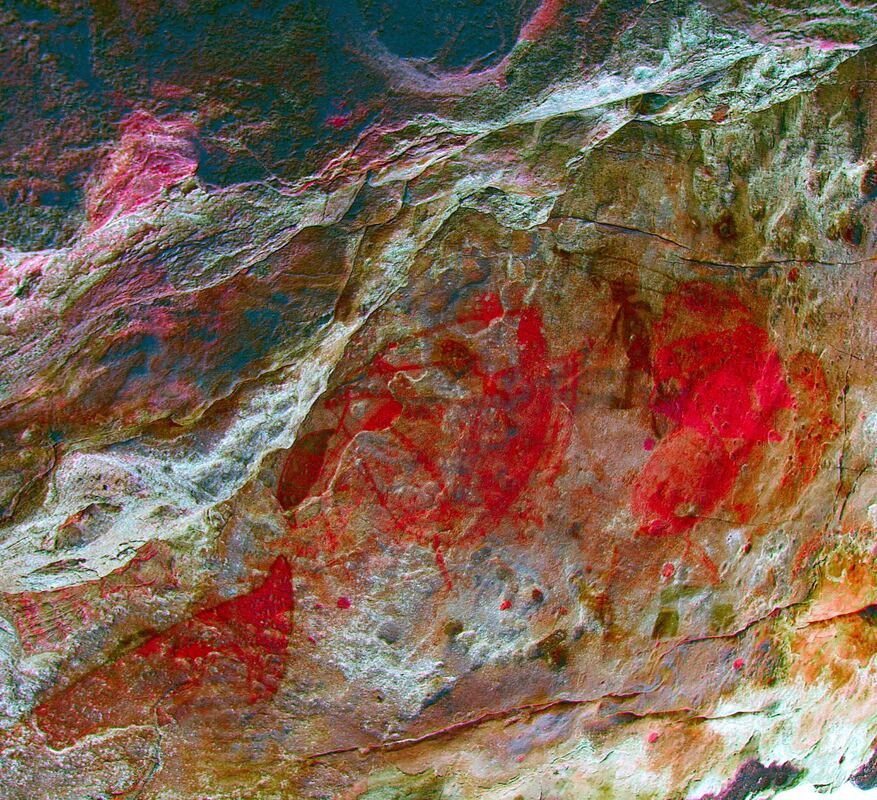
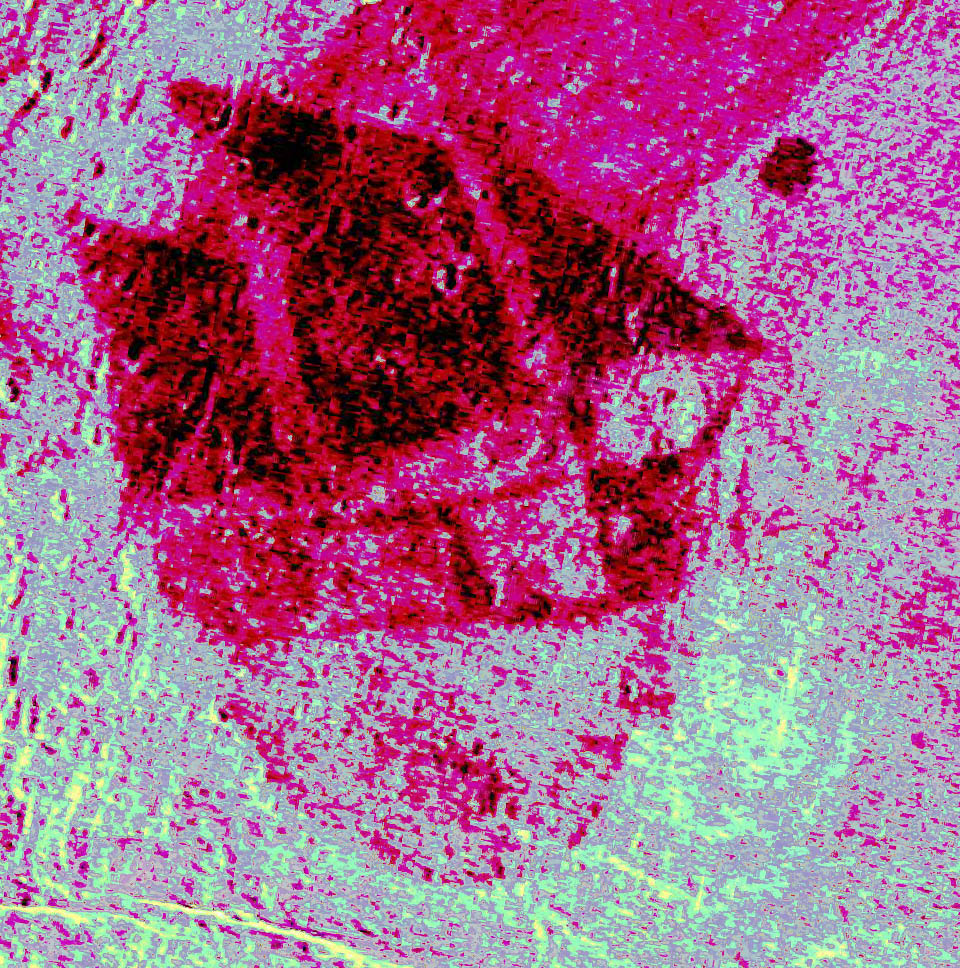
©PastMasters D'Stretch of the Wessel Islands Wurramala Kora Kora rock art scheme.
6. The Man in the Mackerel Hat
|
The fish is in Plan view - like a crocodile image - not the customary elevation view of fish as in a profile recognition chart. This Plan view is unusual but not unique in Wessels rock art.
|
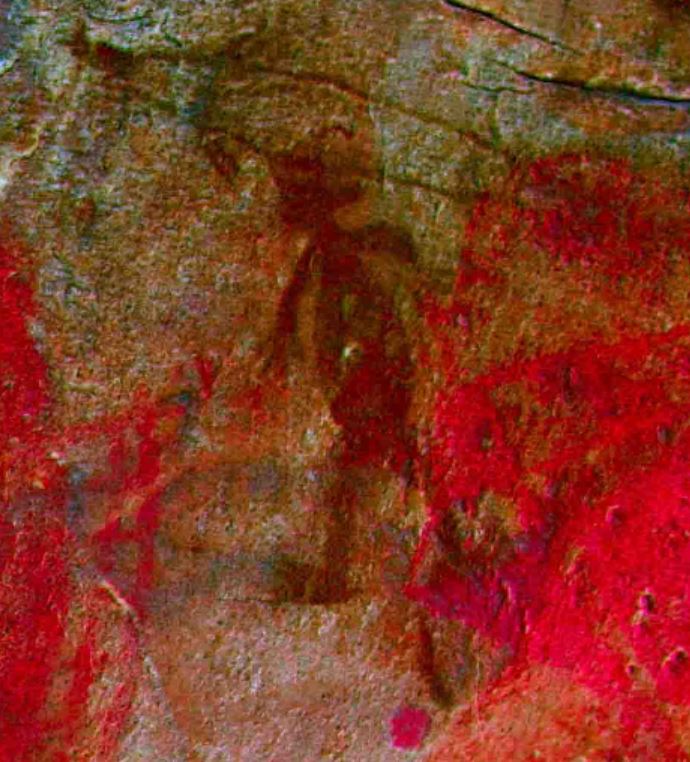
The Man in the Mackerel Hat
|
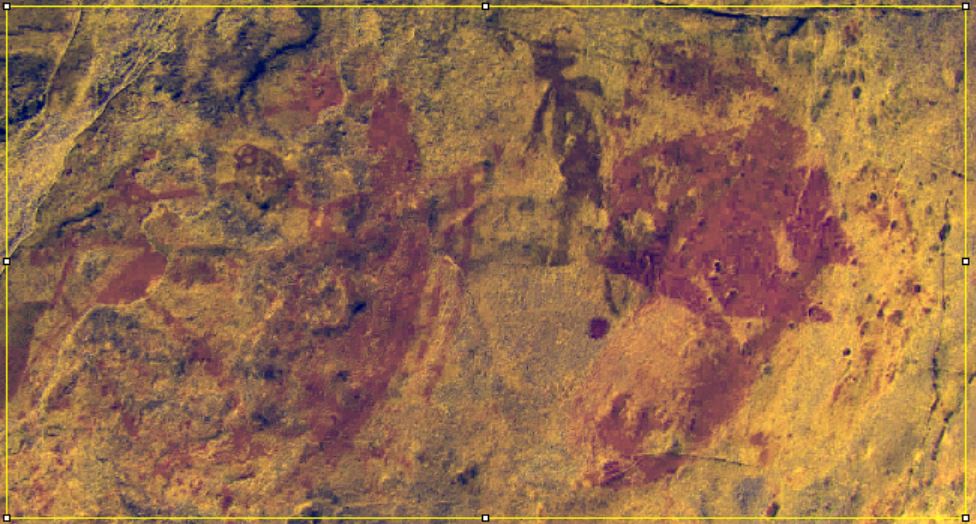
PastMasters D'Stretch of the Wessels Wurramala Kora Kora ©PastMasters .
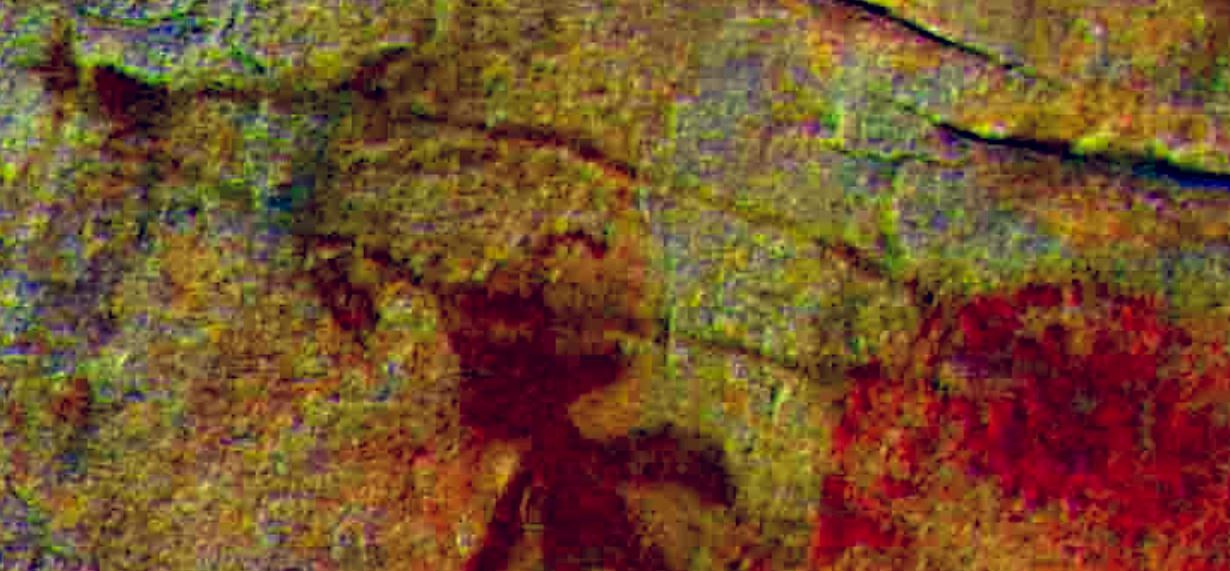
PastMasters D'Stretch of the Wessels Wurramala Kora Kora ©PastMasters.
|
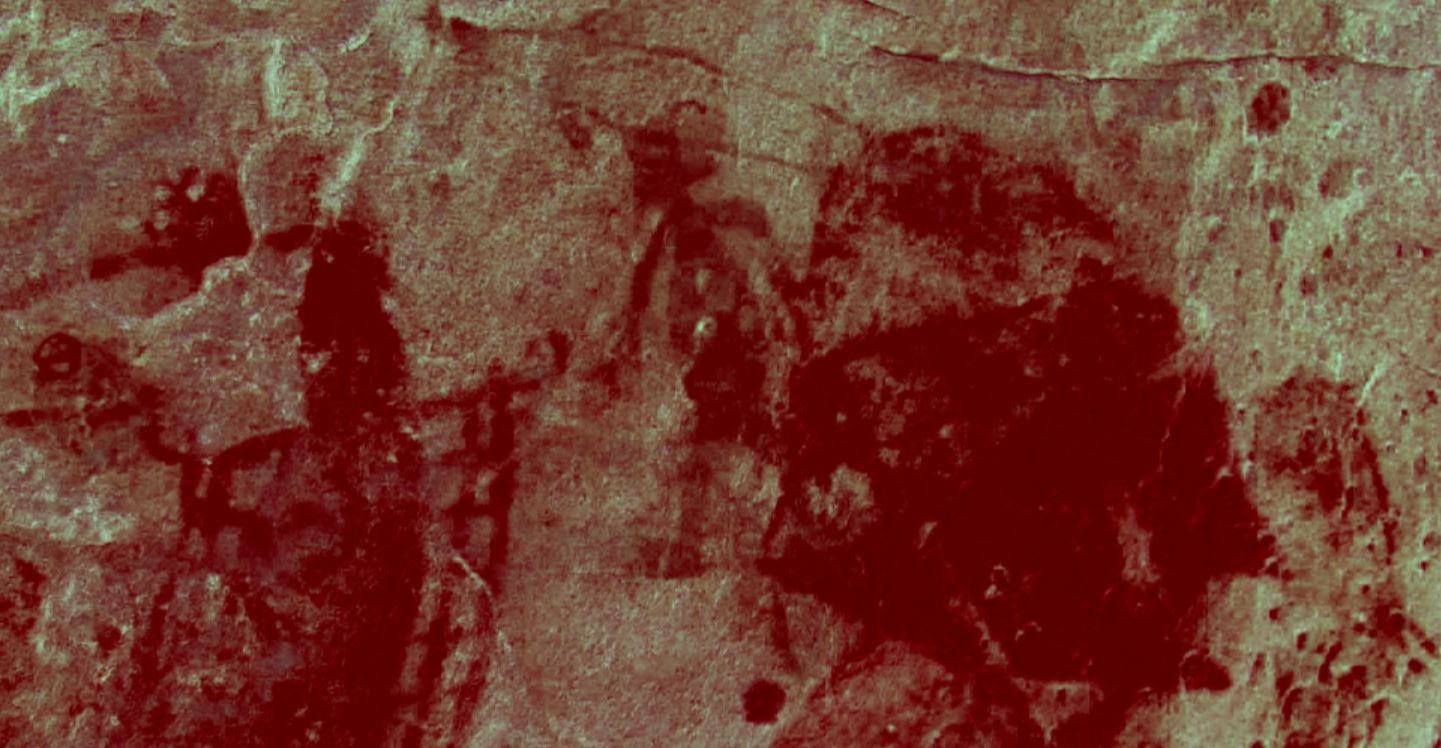
PastMasters D'Stretch of the Wessels Wurramala Kora Kora ©PastMasters.
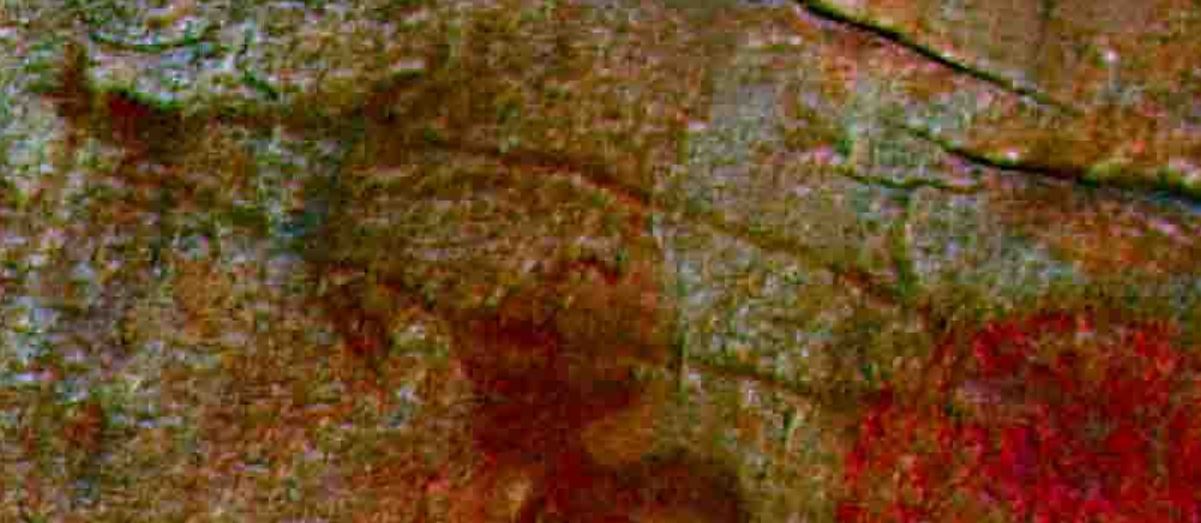
PastMasters D'Stretch of the Wessels Wurramala Kora Kora ©PastMasters.
|
7. Steering Oar
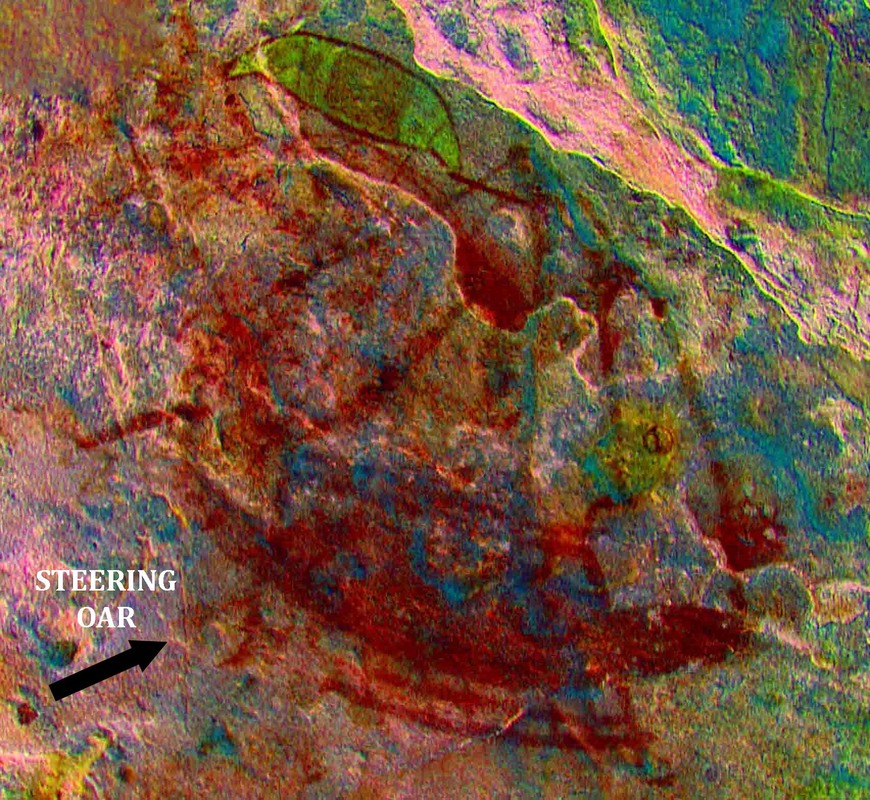
PastMasters D'Stretch of the Wessels Wurramala Kora Kora ©PastMasters.
|
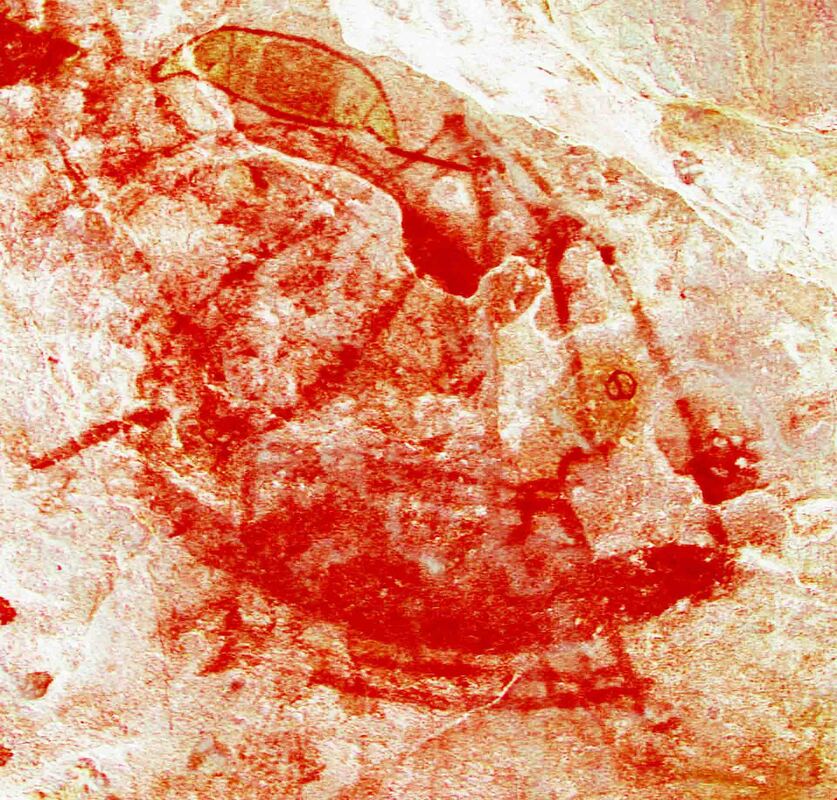
PastMasters D'Stretch of the Wessels Wurramala Kora Kora ©PastMasters.
|
8. The Crew
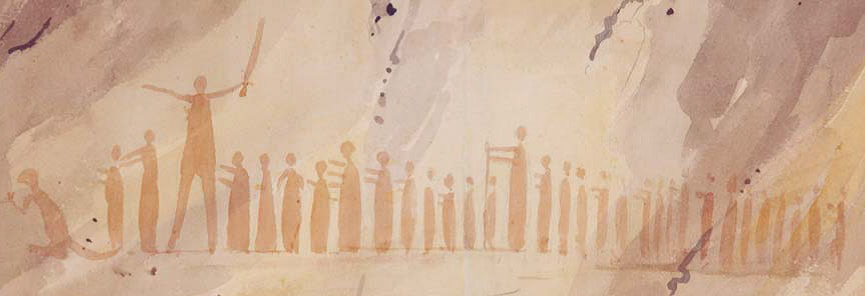
First recorded Australian Rock Art - William Westall - HMS Investigator - Chasm Island 1802
Rows of Paddlers x '4' - Paddlers x '32' - Kangaroos x '0'
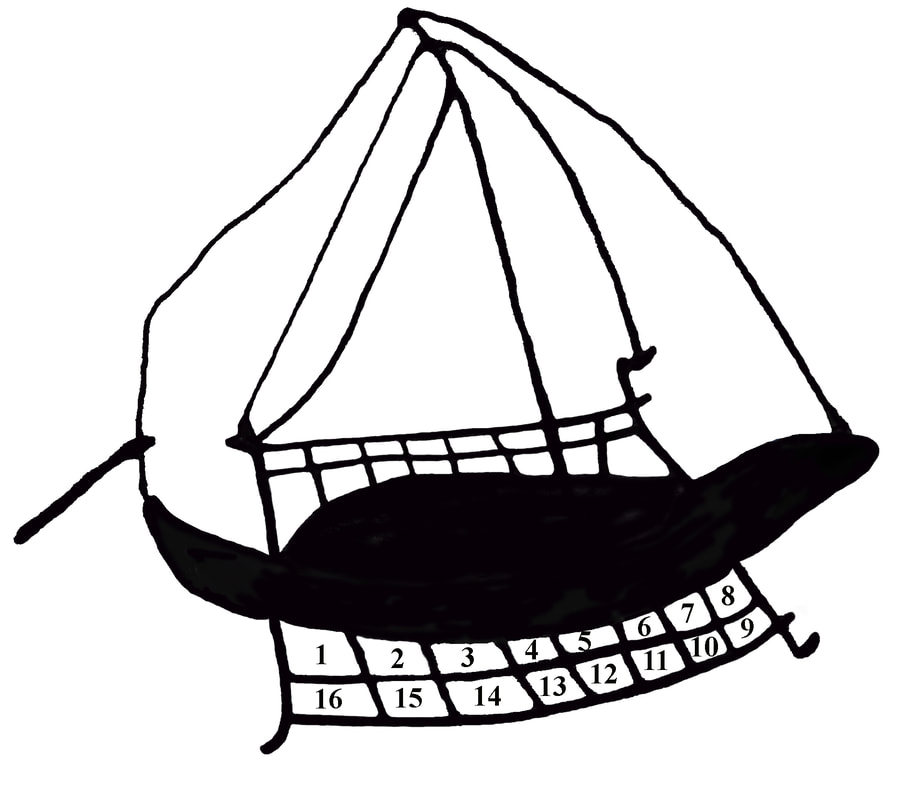
4 Rows of Paddlers - 32 Persons
|
"In the deep sides of the chasms were deep holes or caverns undermining the cliffs; upon the walls of which I found rude drawings, made with charcoal and something like red paint upon the white ground of the rock. These drawings represented porpoises, turtle, kanguroos and a human hand; and Mr. Westall, who went afterwards to see them, found the representation of a kanguroo, with a file of thirty-two persons following after it. The third person of the band was twice the height of the others, and held in his hand something resembling the whaddie, or wooden sword of the natives of Port Jackson; and was probably intended to represent a chief." Matthew Flinders 1803 Voyage to Terra Australis.
George Chaloupka image of Chasm Island rock art.
|
The 'paddlers dance' represents an activity that was not applicable to any Yolngu watercraft. They seemingly began with rafting in craft ranging from bundles of branches, little more than a pigeon's nest, to quite substantial log arrangements able to voyage up and down the east & west side of the Wessels respectively and from the mainland out to Bentinck Island in the bottom of the Gulf - hence Raft Point. The inshore & inland waterways craft was a paperbark canoe in which the operator would stand and paddle in enclosed calm water - perhaps 'calm' is a relative term. The advent of the large Macassan sailing canoe ('Lipalipa') - and the smaller dugouts which were paddled sitting down. Either standing or sitting (which would not work as a dance) the representation of 4 lines of paddlers with a coxswain wielding a leaf shaped paddle within 30 years of the beginning of the trepang trade (viz Pobassoo) is likely to come from pre-Macassan days.
L>R Whale head - ceremony leader with steering oar - 4 rows of paddlers - a steamer/warship's (Wato?) bow and funnel in perspective. George Chaloupka image
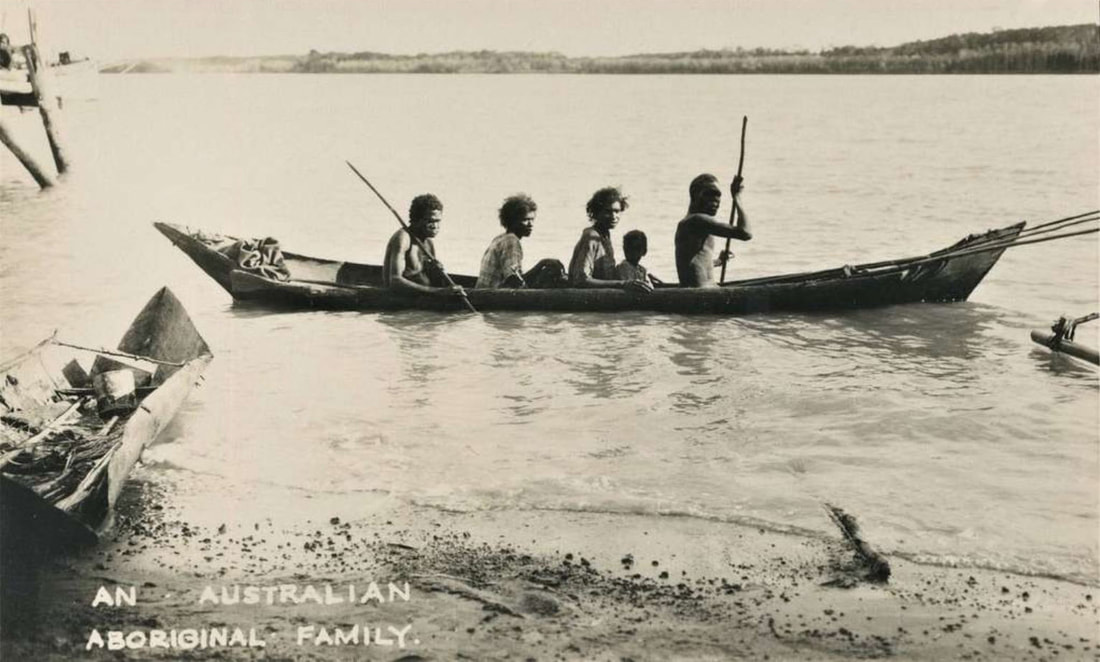
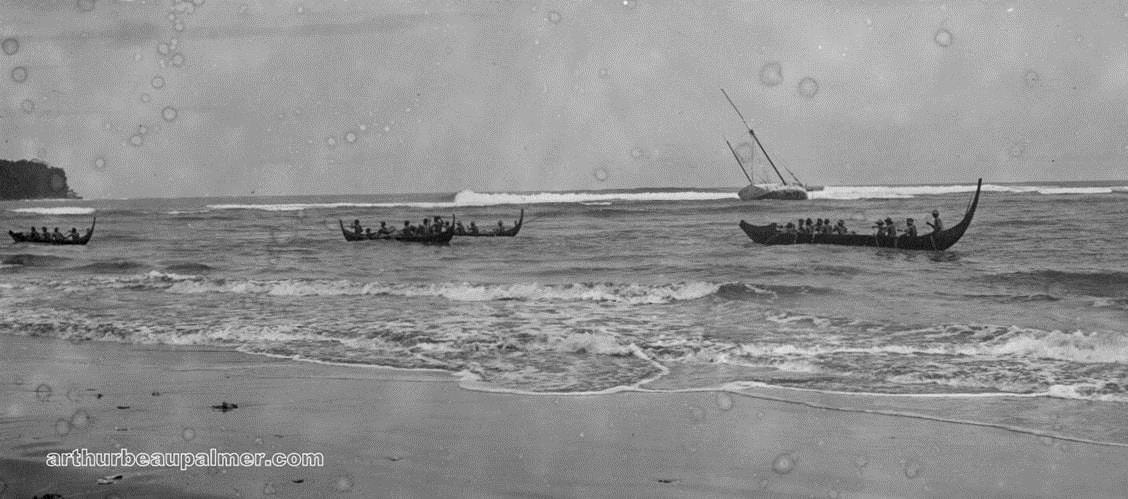
Lipalipa Macassan dugout canoe
These images demonstrate that even the relatively humble Macassan dugout canoes used for trepang gathering were substantial vessels & a lot of fun.
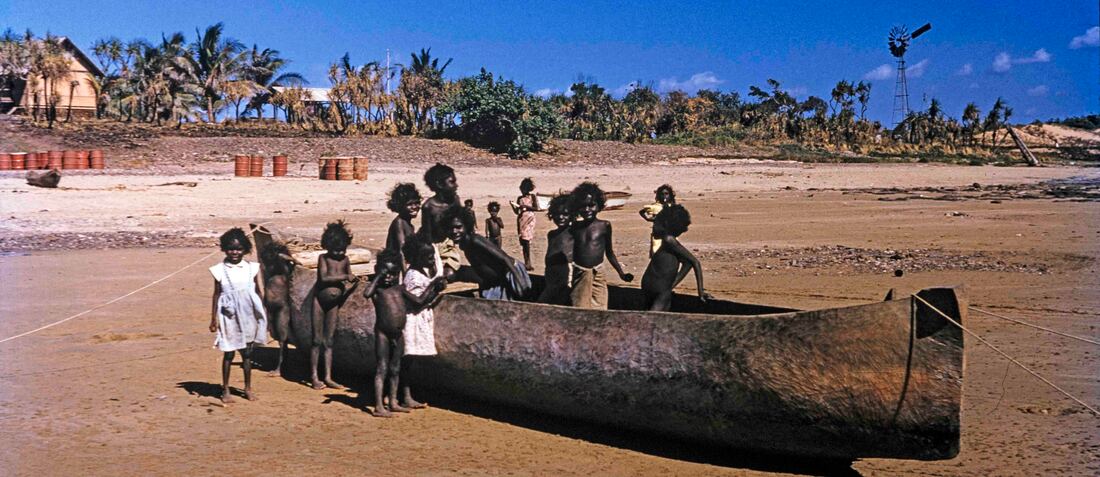
Lipalipa on Mission Beach, Elcho Island 1960 - Truran Col. NTL ph0406-0584
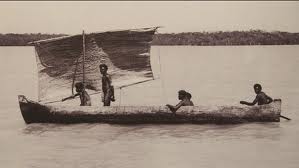
image CALR5TTU
|
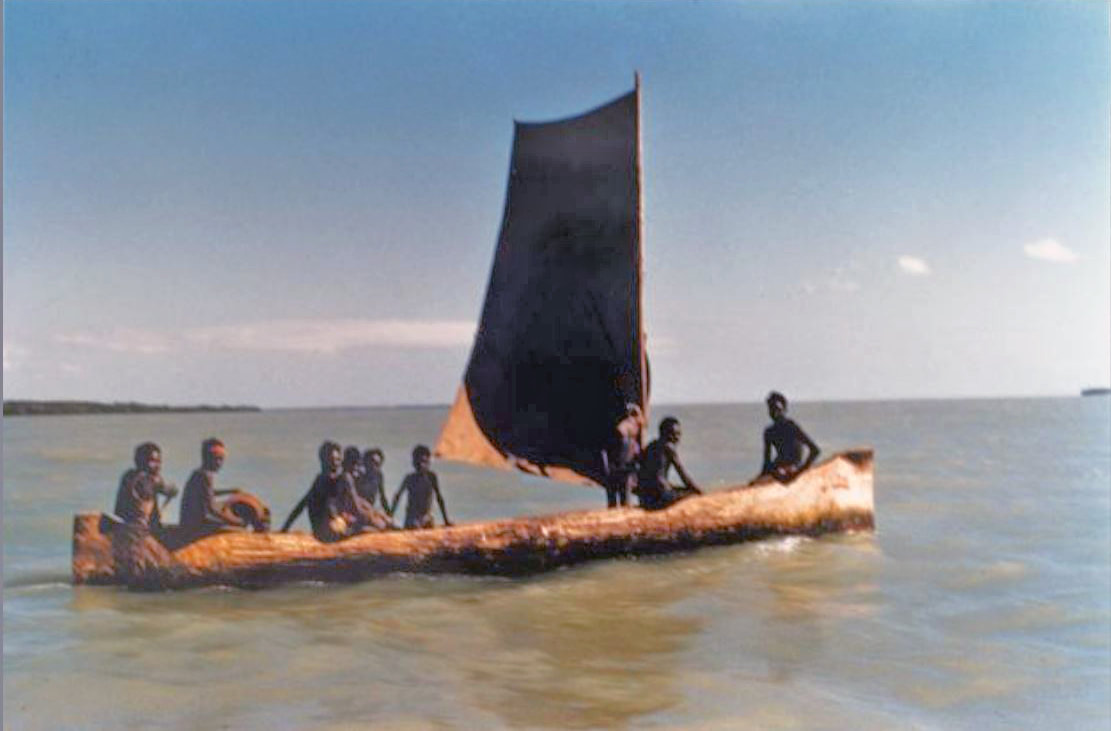
PH00920277 Milingimbi 1958 G & L Helyar - see image above
|
9. Tractor & Kora Kora Scheme
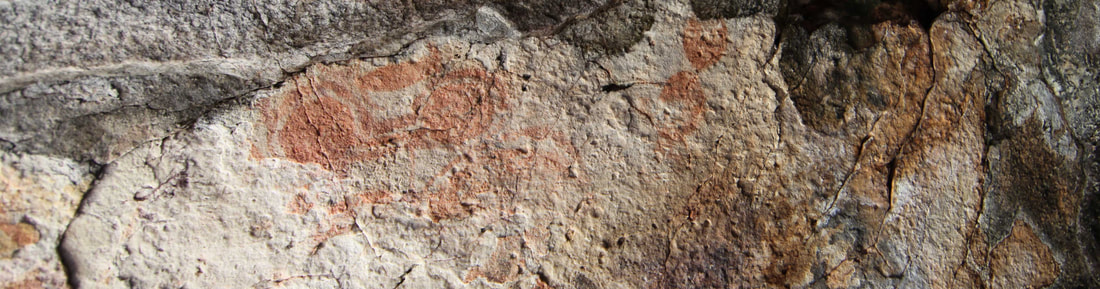
The Kora Kora Cave & Tractor Detail2013 ©PastMasters
|
Both rock art images below are within adjacent rock shelters. They are set together to illustrate the effects of time on the pigments and to contrast the techniques displayed. The tractor is two dimensional and readily mistaken for a motorbike whilst the KK is shown from high above the aft starboard quarter to expose the port side outrigger frame which anchors the rigging.
The image at left appears, at first glance, to be a motorbike - however the enlarged rear wheel and high trailer towing point reveal it to be a tractor. Either the one brought during WW2 by RAAF Radar 312RS located north of Jensen Bay and recovered by the Elcho Island Mission after the war. The mission subsequently built the airstrip at Cape Wessel and may have brought a tractor to drag a grading bar. Image at right is from Half A Century in Arnhem Land by Ella Shepherdson It was to be transferred to Yirrkala but got bogged on Napier Peninsular where it resides today. |
|
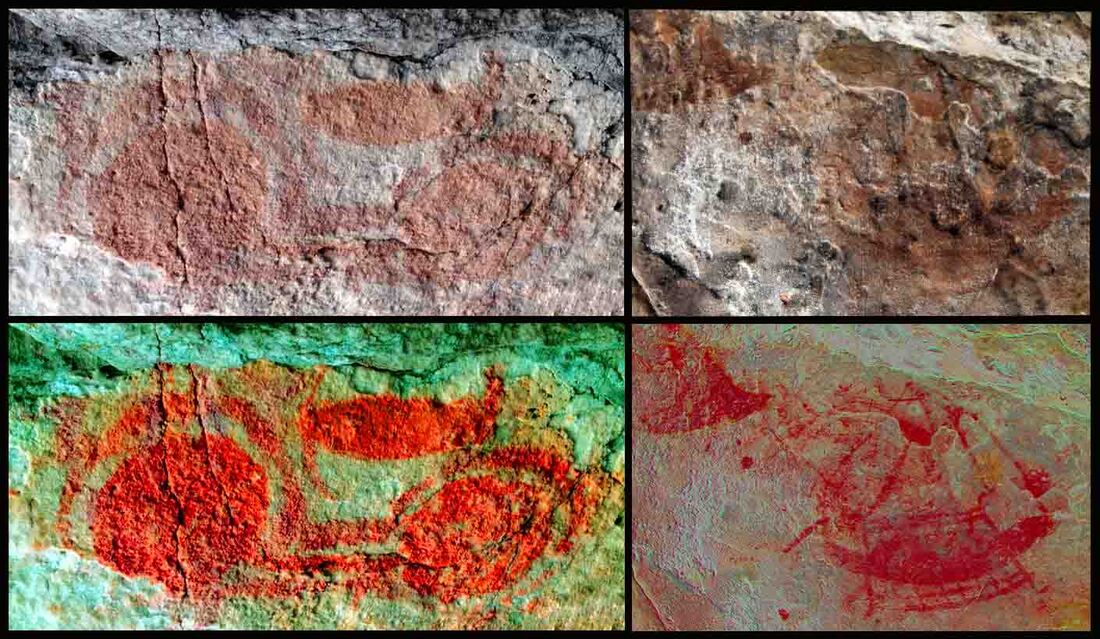
The Tractor & the Kora Kora Scheme 2013 ©PastMasters
10. PESTELS & MORTARS
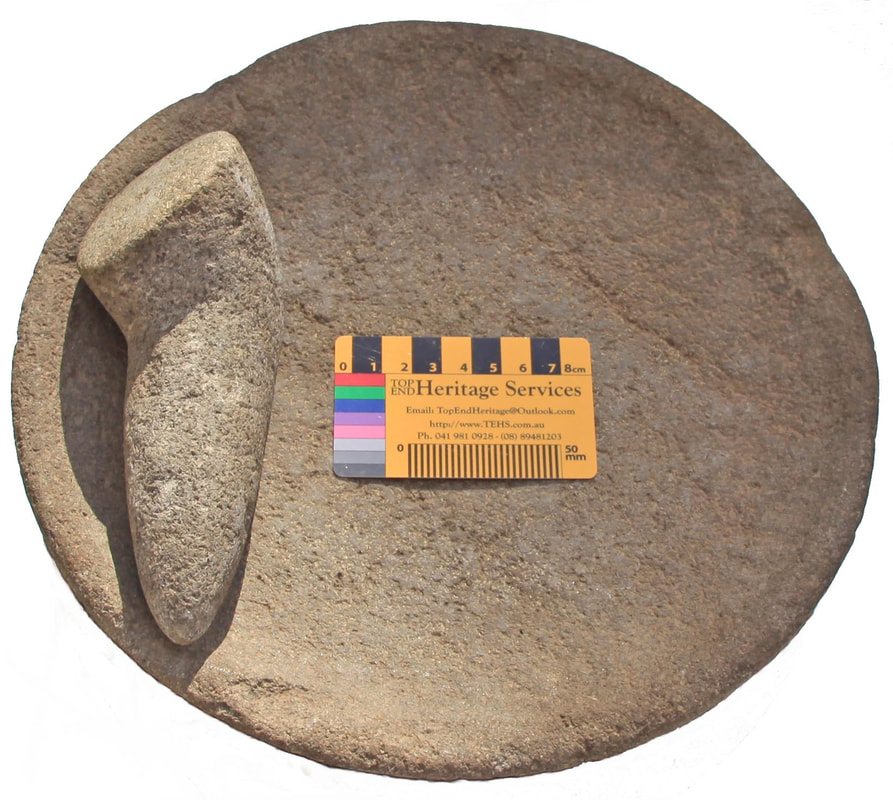
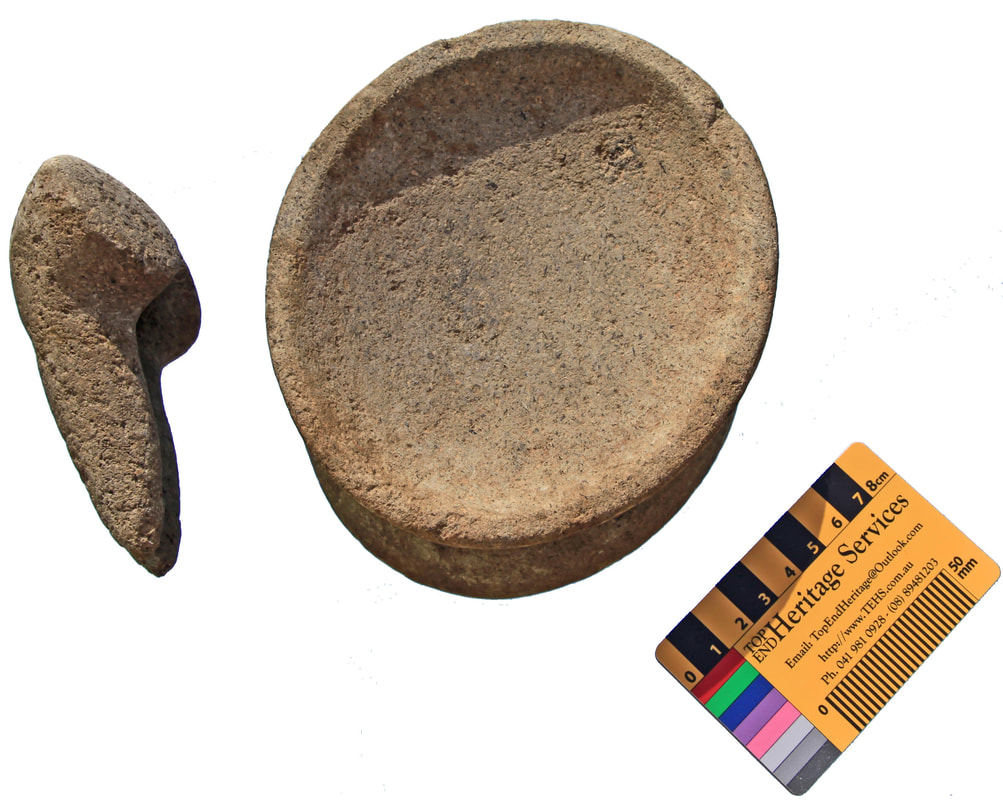
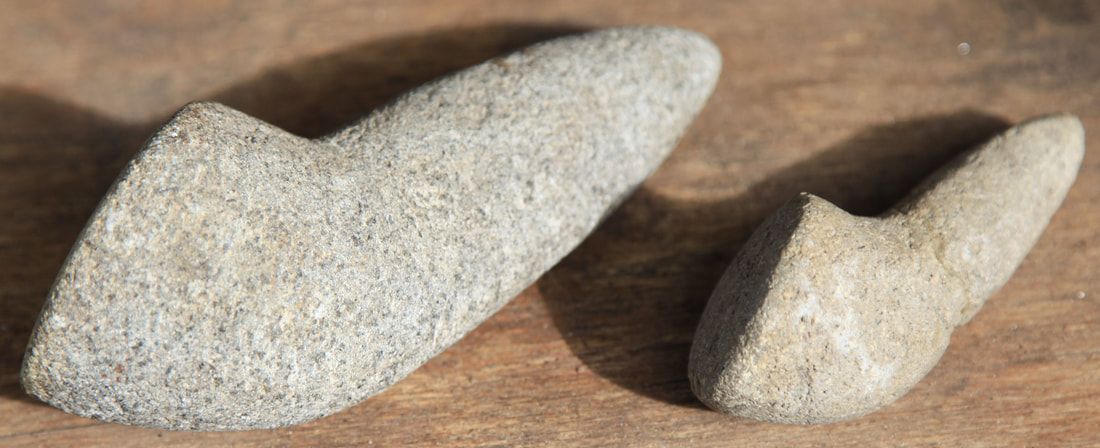
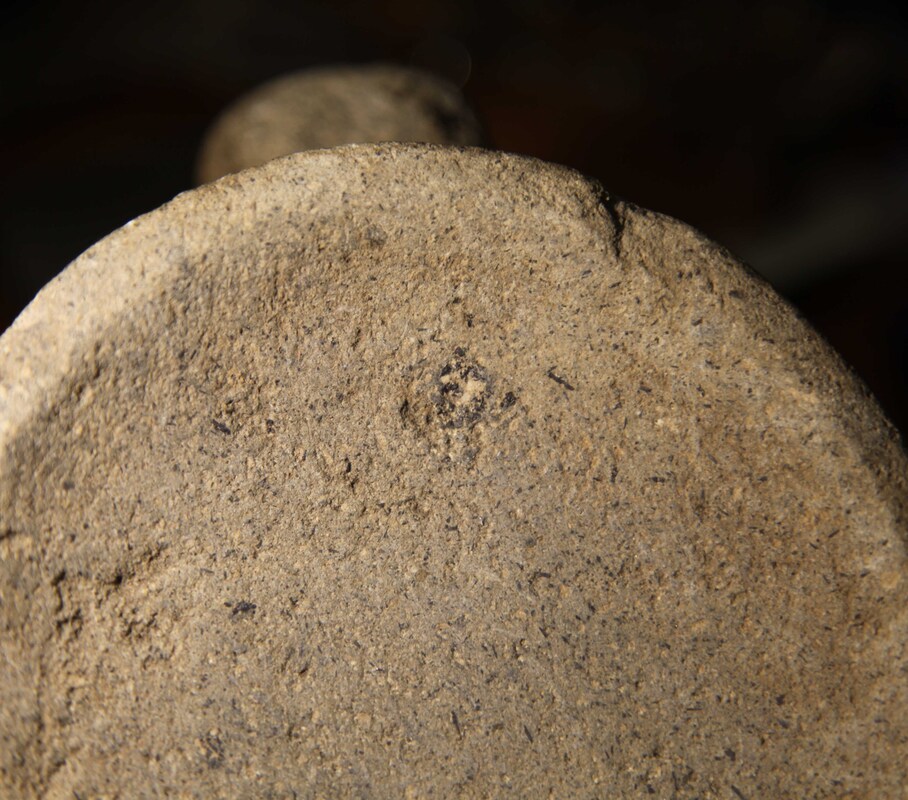
Specific aspects of the finding of these objects and the tasks assigned to the finder by the RAN, leave no doubt that they were found in the roots of a fallen tree, at the water source, adjacent to the rock shelter holding the Kora Kora, tractor etc. No analysis of the fabric or residue has been undertaken.
|
|
|
|
|
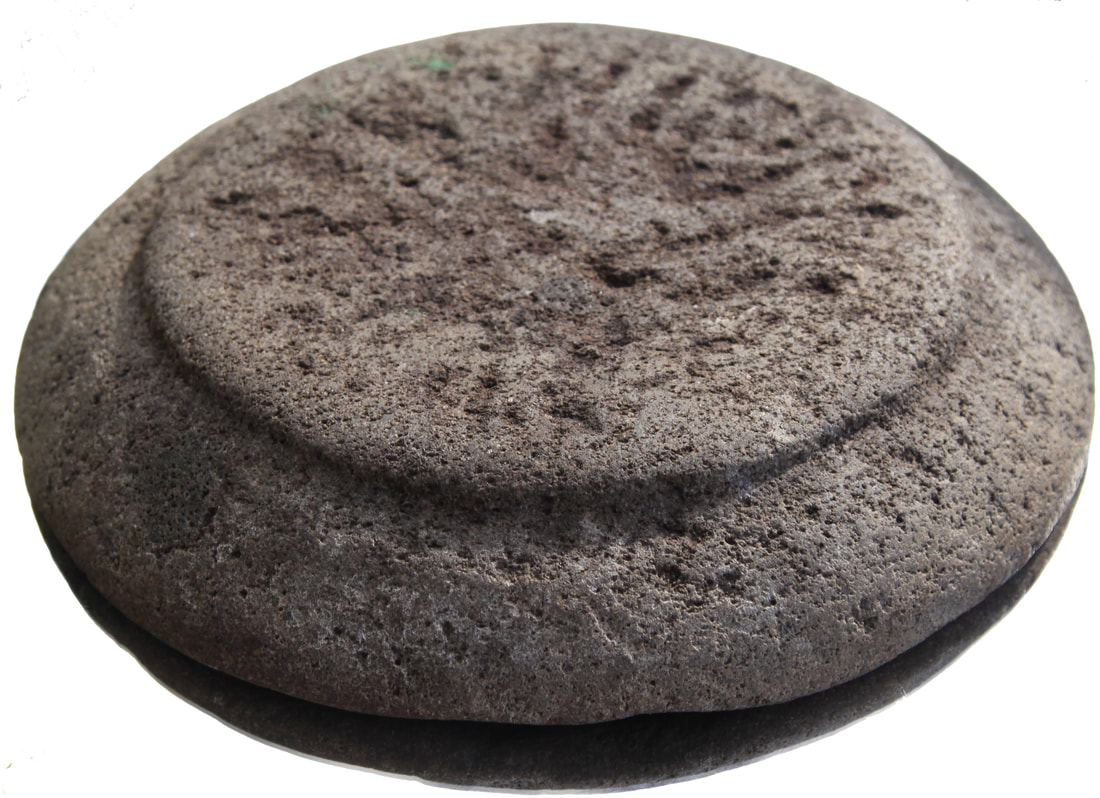
These objects were found in the Wessel Islands by James Douglas McQueen, ashore from a RAN Patrol Boat in the mid-1970's - in a sand dune - beside a Tamarind tree toppled by a storm. Macassans often left boiling pots beneath Tamarinds but no such pestle and mortar sets have ever been found in Australia. Typologically they are SE Asian, Stone Mortar & Pestle (Ulekan & Cobek) widely used throughout Indonesia and Thailand.
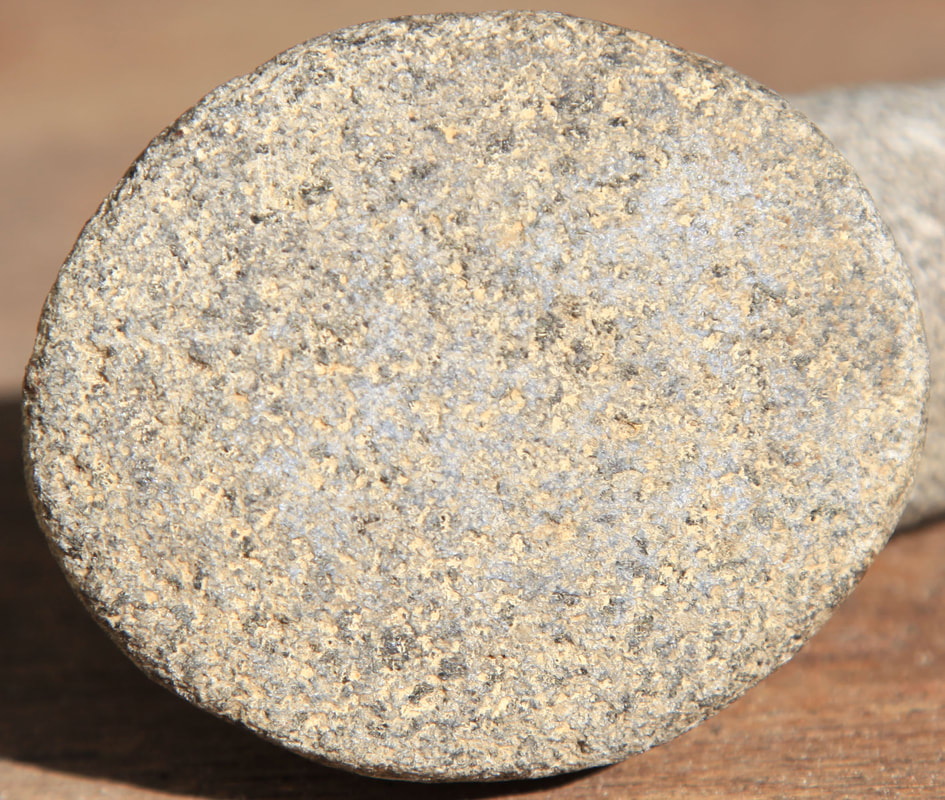
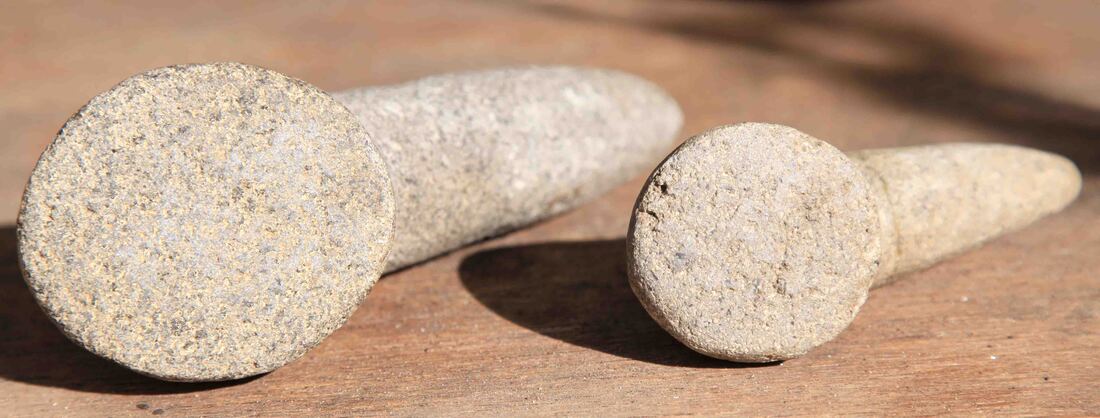
They are well made - the larger is composed of a more robust fabric, even though the smaller might be expected to perform the finer processing. The cavities may yield useful contents for analysis. The convex cheeks of the pestles conform sympathetically to the concave drift of their respective mortars and a close symmetry has been achieved. There is evidence of considerable wear through use by a right-handed person. It is suggested that the deep & crude incisions to the base of both mortars is an end-user modification for maritime conditions where vagrancy in large stone objects is discouraged.
They are well made - the larger is composed of a more robust fabric, even though the smaller might be expected to perform the finer processing. The cavities may yield useful contents for analysis. The convex cheeks of the pestles conform sympathetically to the concave drift of their respective mortars and a close symmetry has been achieved. There is evidence of considerable wear through use by a right-handed person. It is suggested that the deep & crude incisions to the base of both mortars is an end-user modification for maritime conditions where vagrancy in large stone objects is discouraged.
CONSIDERATIONS
The Whale Hunters
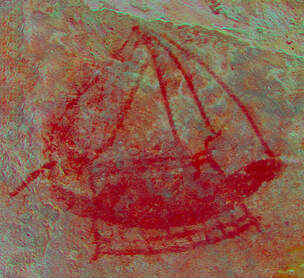 The Kora Kora 2013 ©PastMasters
Well documented narratives describe visitors to Arnhem Land whose presence predates the Macassan trepangers (c.1750-1907). Known as whale, dugong or turtle hunters, the exploits of these ‘spirit people’ - ‘totem hunters’ - were described in mythological terms by Mountford (1956-64), Berndt (1948), and Ronald and Catherine Berndt (1954), even though all acknowledged that the Yolngu said that they were real people, who had once visited Arnhem Land.
The Totem Hunters are linked most closely with the narratives, songs and ceremonies of the journey of the souls of Yirritja moiety Yolngu to the ‘land of the dead’ {known variously as Badu, Nalkuma, Mutilnga, and Badurru etc.} which is said to be to the north-east of Arnhem Land or north of the Wessel Islands (Mountford 1956-64:329-331).
Yolngu were adamant about the direction of this place - which was also the homeland of the hunters - for by so doing they distinguish the totem hunters from the Macassans who are said to have come from the north-west or west. Likewise the sea craft of the hunters were known as Djulpan or sometimes Lambu, as opposed to the Mitjiang or Marthanggay of the Macassans. (Ian McIntosh 1995)
The Totem Hunters are linked most closely with the narratives, songs and ceremonies of the journey of the souls of Yirritja moiety Yolngu to the ‘land of the dead’ {known variously as Badu, Nalkuma, Mutilnga, and Badurru etc.} which is said to be to the north-east of Arnhem Land or north of the Wessel Islands (Mountford 1956-64:329-331).
Yolngu were adamant about the direction of this place - which was also the homeland of the hunters - for by so doing they distinguish the totem hunters from the Macassans who are said to have come from the north-west or west. Likewise the sea craft of the hunters were known as Djulpan or sometimes Lambu, as opposed to the Mitjiang or Marthanggay of the Macassans. (Ian McIntosh 1995)
Loan Words
The whale spear of the hunters was known as bokipanda, with boki being the curved hook on the spear, and bungurrtja was the thick rope used for catching the whale. The hunter’s paddle, which Yolngu decorate and use in their mortuary ceremonies, is known as latarri (See Mountford 1951-64:34 for drawings of these paddles).
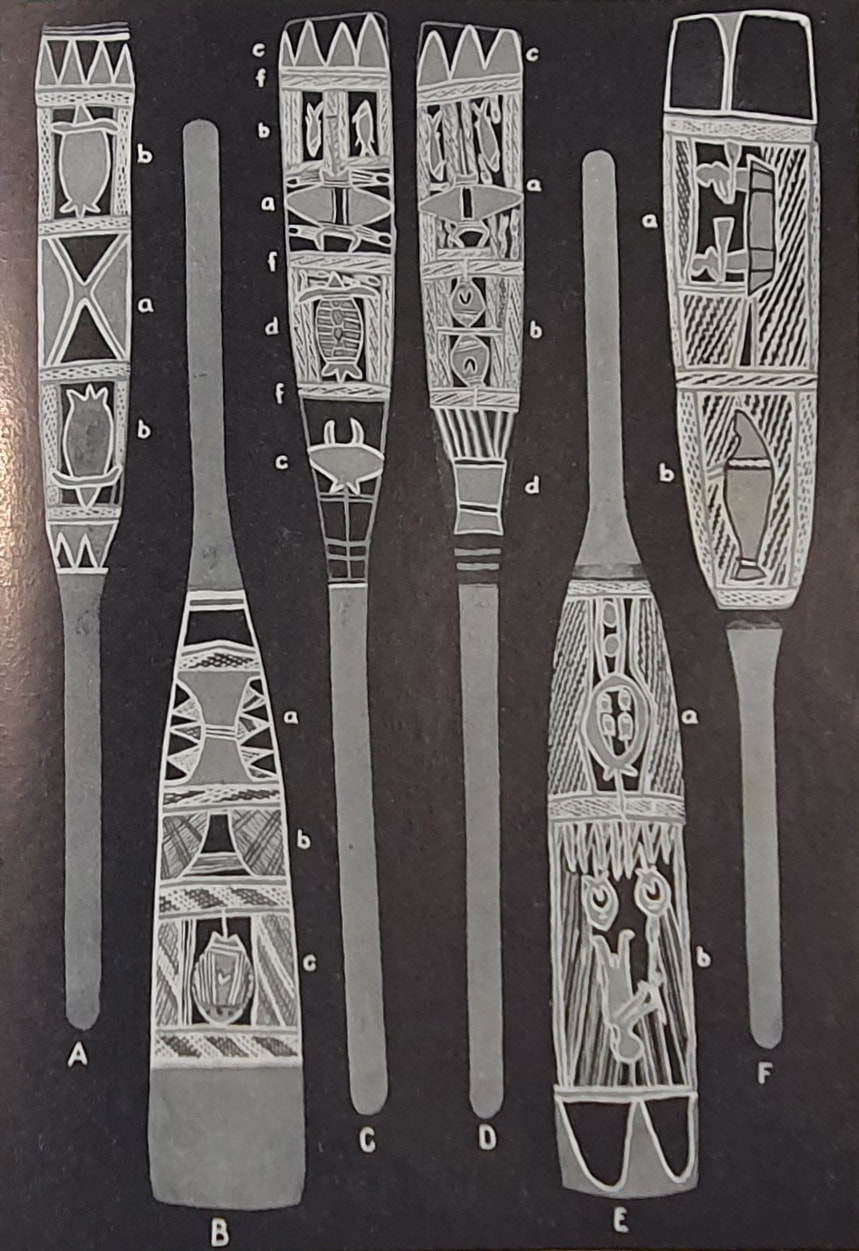
Mountford 1951-64:34
|
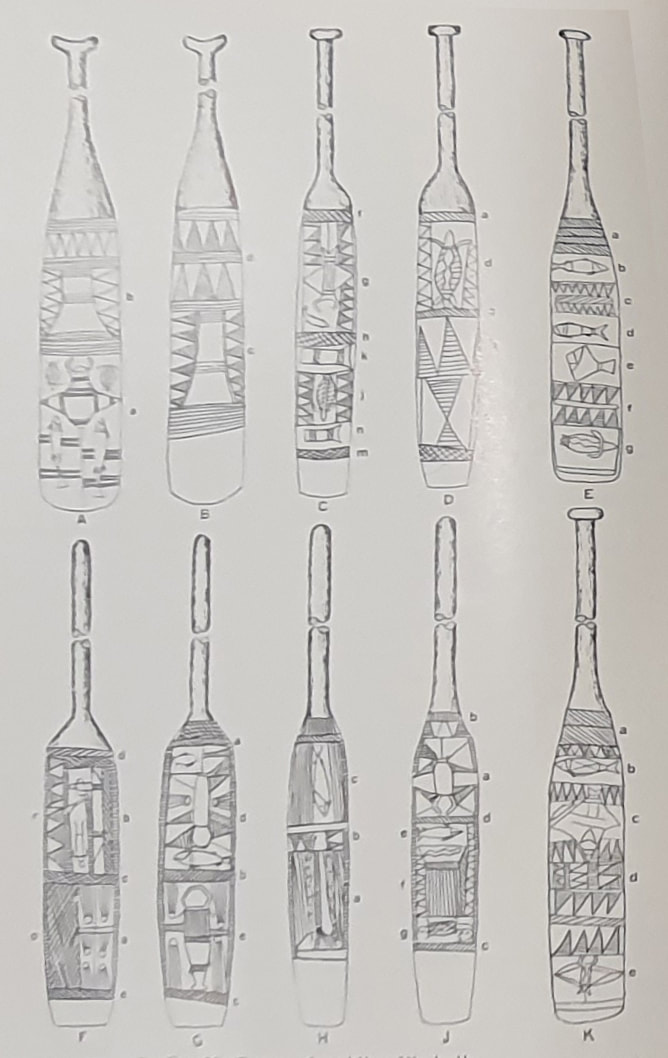
Mountford 1951-64:34
|
Identity - Continuity
Whilst there is this clear distinction, in oral history and mythology, between totem hunters and Macassans; it is known that Sama-Bajau like the Dhurritjini (Turijene) – one of the whale hunter groups identified by Yolngu - also travelled with Macassans on trepang expeditions to Australia (Sopher, 1965:145).
From Myth to History
|
In the 1940s and 50s, informants from Yirrkala and Elcho Island would stress the spiritual nature of these people and of their idyllic homeland to the north (See Berndt 1948:94). However, by the 1980s some of these same informants would also refer to the historical nature of the visits (McIntosh 1995). They were not just figments of Yolngu imaginations, a way of explaining the presence of outrigger canoes, coconuts, and other flotsam and jetsam which would have been arriving on north-east Arnhem Land shores since time immemorial. Rather, informants told me that these hunters were actual people, albeit timid, who would visit Arnhem Land each wet season. At any point of time were just off the coast and over the horizon, ready to come in (See Berndt & Berndt 1954: 65; McIntosh 1995).
Yolngu are said to have travelled with them as far as the Wessels Islands and in some cases to Badu itself. Despite them having canoes, tobacco, and knives, they were described as being ‘one’ or brothers with Yolngu and relationships of reciprocity were developed with them. Indeed, when David Burrumarra, the late Warrimirri leader described his vision of the past, he would do so by reference to both the skin colour of the visitors and the nature of the relationship. The earliest were these black whale hunters and there was a reciprocal relationship with them for the most part. Then came the golden brown Bayini, with astonishing new ideas and innovations, but somewhat less reciprocity. Finally, there were light brown Macassans and white Japanese and Europeans, with little or no reciprocity in the relationship. (McIntosh 1995) |
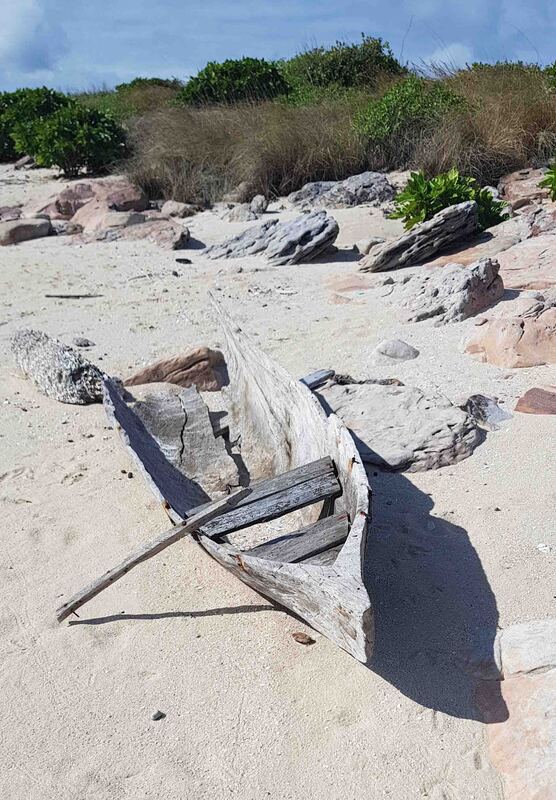
Marchinbar Is. 2018 an MH image
|
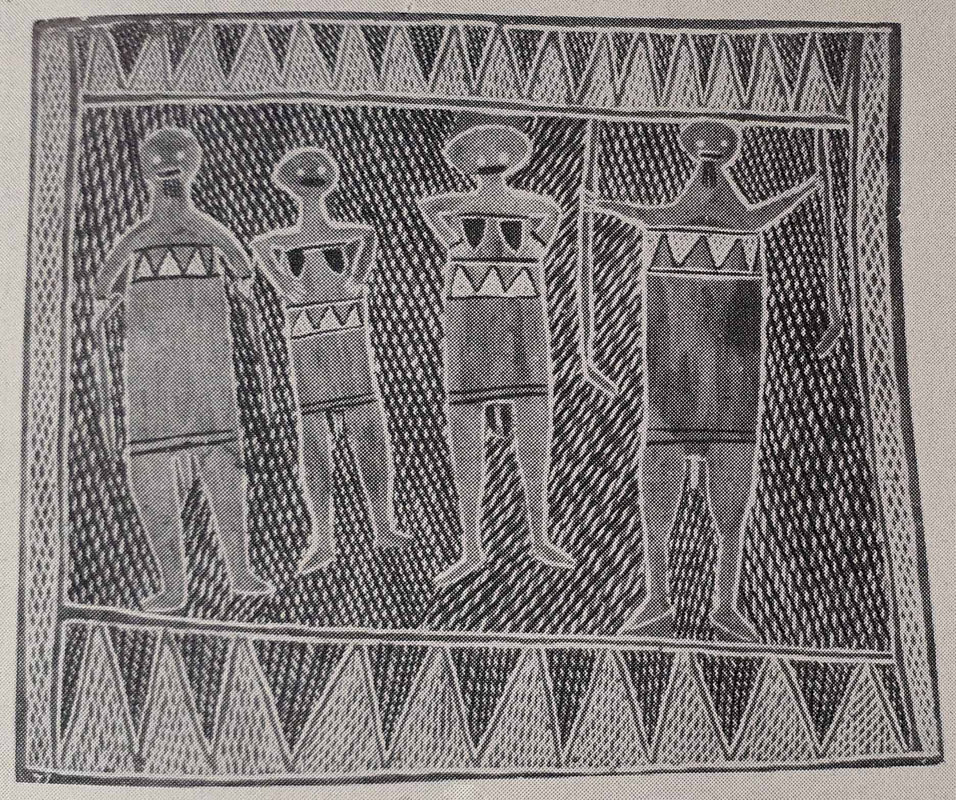
Mountford Vol. 1 p335
|
The totem hunters, especially Wurramala, were held in high regard by Yolngu because of their superb hunting skills, but the well-known ‘Dog-Macassar’ myths recorded by Warner and others indicate that relationships might have been somewhat strained at various points of time, especially over access to Yolngu women. Many of these narratives are not about trepangers at all for they involve stranded whales being cut up using the hunter’s long knives. For the most part, however, accounts stress equitable relationships. As Burrumarra said: ‘The sea is not for Yolngu. It is for the whale. We are friends of the whale, dugong, and dolphin… The whale hunter is for our whale places… We honour the whale. The whale hunter is more on the whale than us, so we can call them bunggawa [leaders].’
|
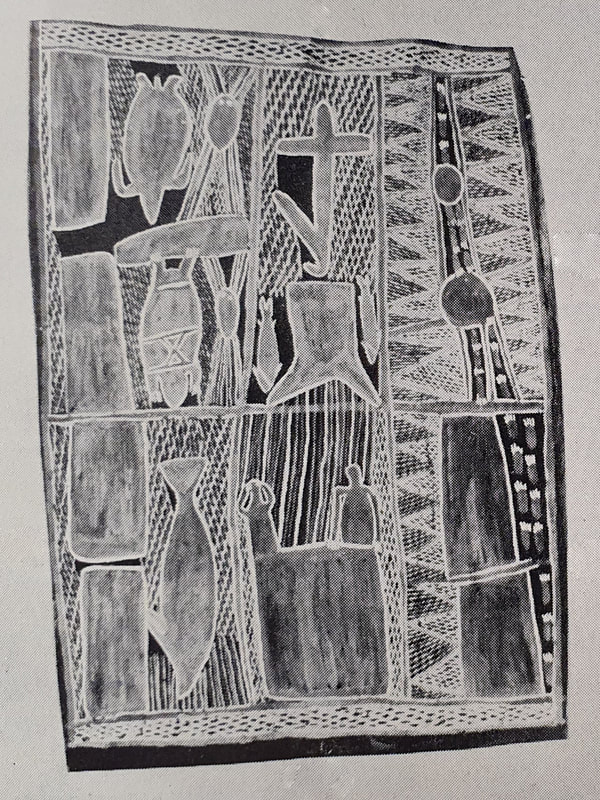
Mountford Vol. 1 p335
|
Following a kill, the whale hunters would cover the upper part of their bodies with whale fat and blood, and the Yolngu of the Warrimirri clan would replicate this practice, but the meanings were probably quite different. (McIntosh 1995)
Origins
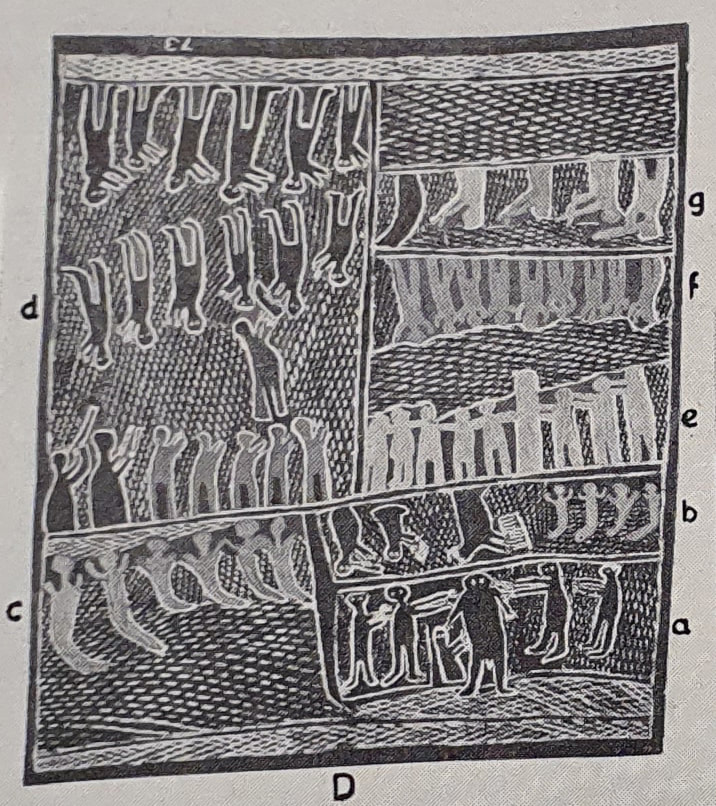
Mountford Vol. 1 p314
|
Yolngu created wooden sculptures of the various totem hunters (See Berndt 1948; Elkin, Berndt & Berndt 1950:58) and a multitude of stories about them. The first contact was said to have been when a harpooned whale towed the whale hunter’s boat ashore on Truant Island at the beginning of time.
Yolngu describe these hunters variously to denote either the ‘killers of the whale’ (Gelurru, Wurramala), Dhurritjini, or the assembled group of hunters (Bapayili). Gulthana, was a name for the land of the dead, and it is where the hunters came from to Arnhem Land and also where the whale meat was consumed by peoples such as Djamulapu, whom I have traced to the Sulu Sea in eastern Indonesia. Dhurritjini were a known group of Sama Bajau who lived in the vicinity of Macassar on the offshore islands. (McIntosh 1995) |
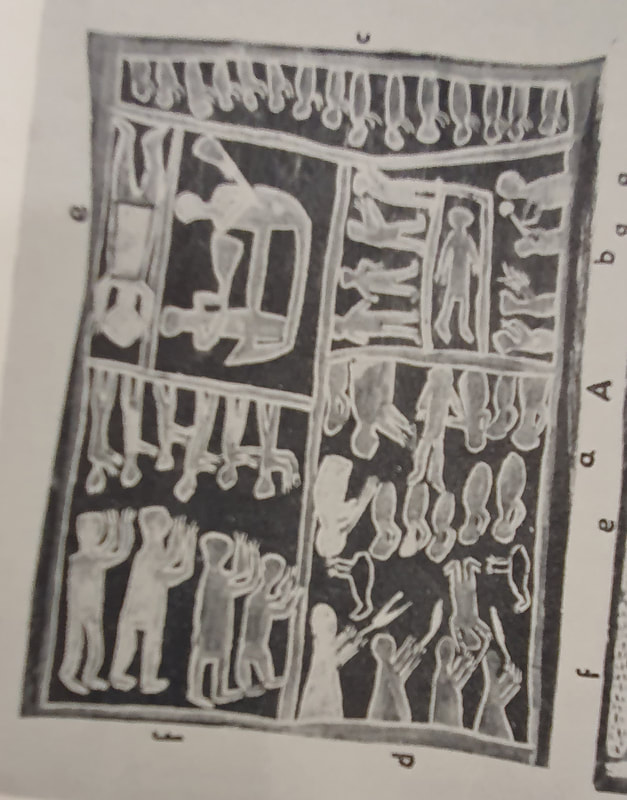
Mountford Vol. 1
|
CONCLUSIONS
Artistic Aspects
|
The largely opaque scheme 'fluoresces' under D'Stretch better than any other from the Wessel Islands. Perhaps the artist powdered and roasted iron ore nodules, which abound in the area, to create an iron oxide powder to mix with oil (whale) or blood. Suchlike might explain its density, endurance & D'Stretch fluorescence. XRF could assist but they are expensive.
The use of an elevated 'bird's eye view' to reveal the port outrigger frame is unusual and whilst the use of perspective is adept, it is evident elsewhere - as in the Chasm Island image. The overall rendition is consistent with Yolngu artwork in the area. Underlying incised lines - if present - would account for the accuracy of the work and provide a depth of pigment to excite D'Stretch. Plan views in Wessels rock art are unusual but not unique as evidenced by the 'Map of Banda' image on an adjacent island. |
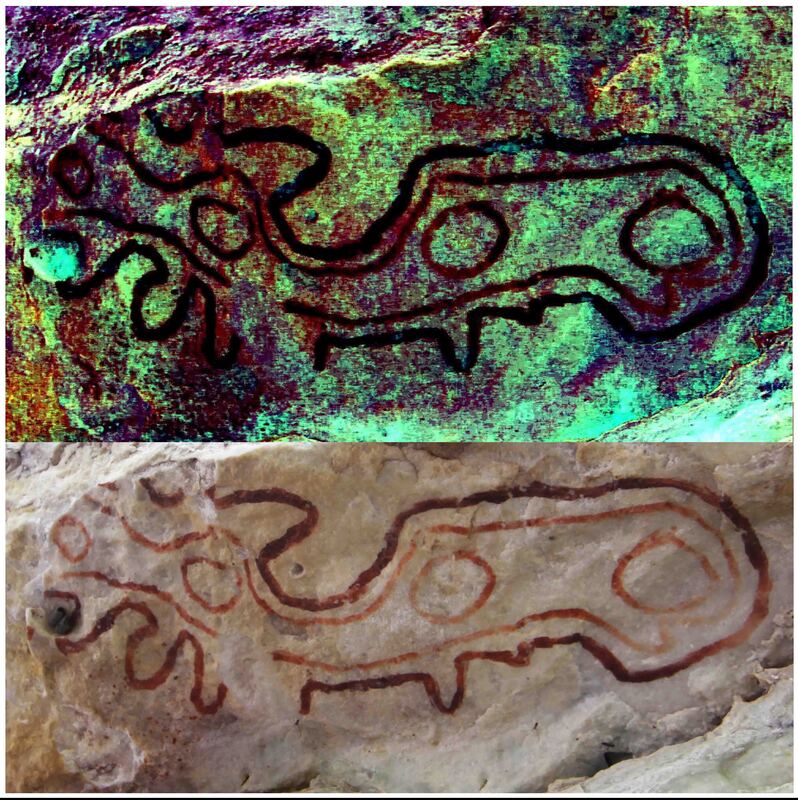
'Map of Banda' ©PastMasters
|
ADDITIONAL MATERIAL
Early Australian Whaling
Australia's whaling industry and whales - http://www.australia.gov.au/about-australia/australian-story/australias-whaling-industry-and-whale
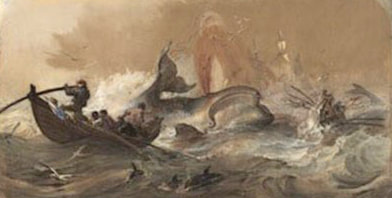 The Death Flurry,1865, NLA by Oswald WB Brierly (1817–1894)
Whaling was a central part of life in the first 70 years of the Australian colonies, from the 1790s to the 1850s. Whaling was the first primary industry of the colonies, as important as wool production. The founding of the first colonies in New South Wales and Tasmania in the late 1700s coincided with a great expansion of deep-sea whaling into the Indian and Pacific Oceans. This unrestrained exploitation unfolded with extreme daring and no real sense of national boundaries. Hundreds of whaling ships from the United States, Britain and elsewhere worked around the coast of Australia.
Whaling became less important after the 1850s with the development of petroleum and the attraction of the gold rush. A big resurgence of whaling then occurred in the 1900s due to the advent of the harpoon gun and steam-powered factory ships.
Whaling became less important after the 1850s with the development of petroleum and the attraction of the gold rush. A big resurgence of whaling then occurred in the 1900s due to the advent of the harpoon gun and steam-powered factory ships.
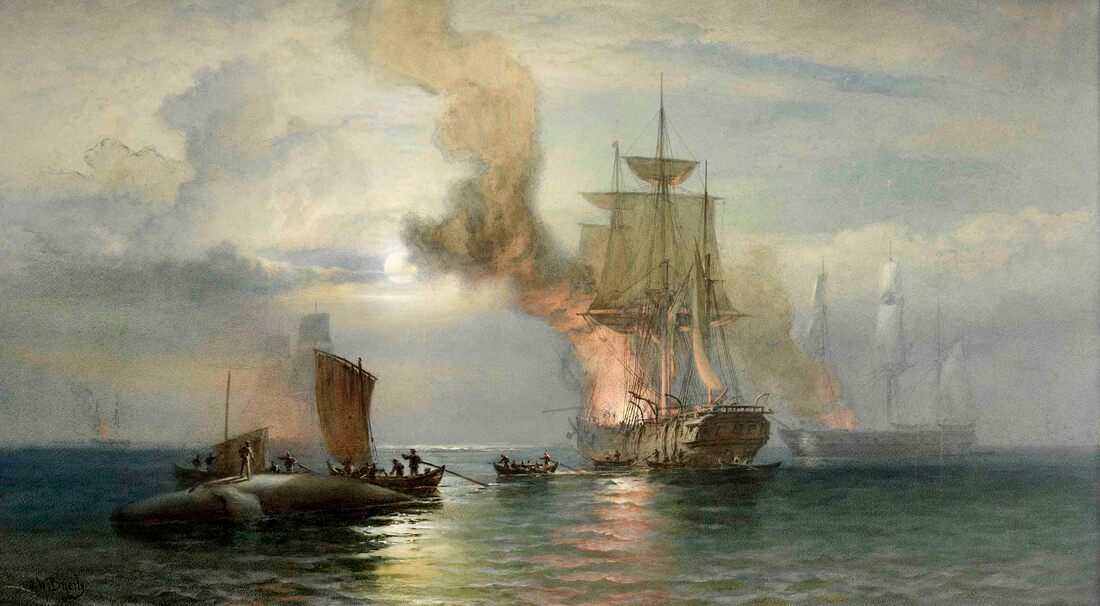
Brieley c1876 South Sea Whalers Boiling Blubber - SLNSW DG 366
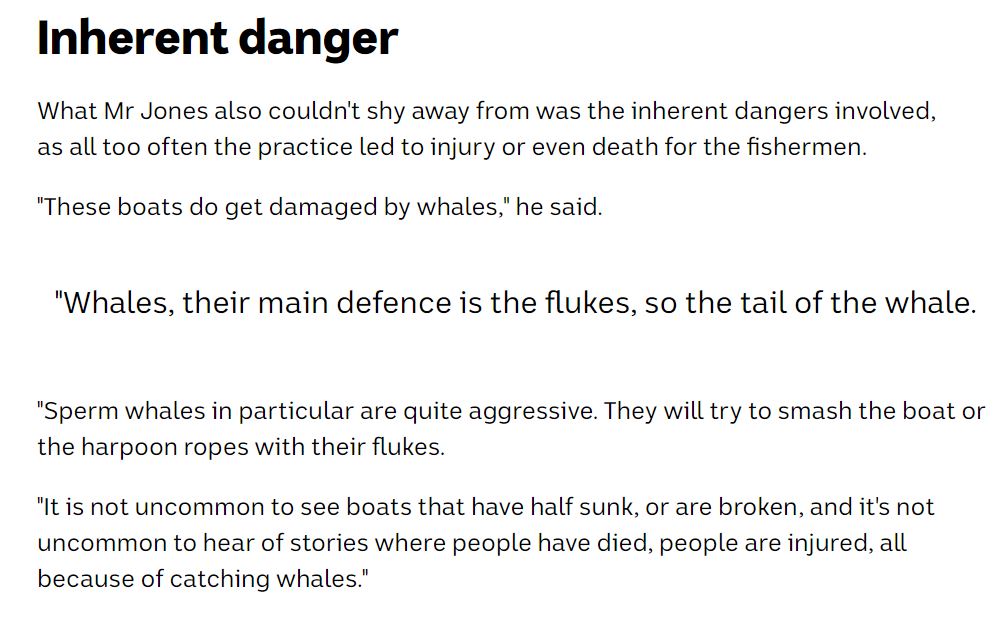
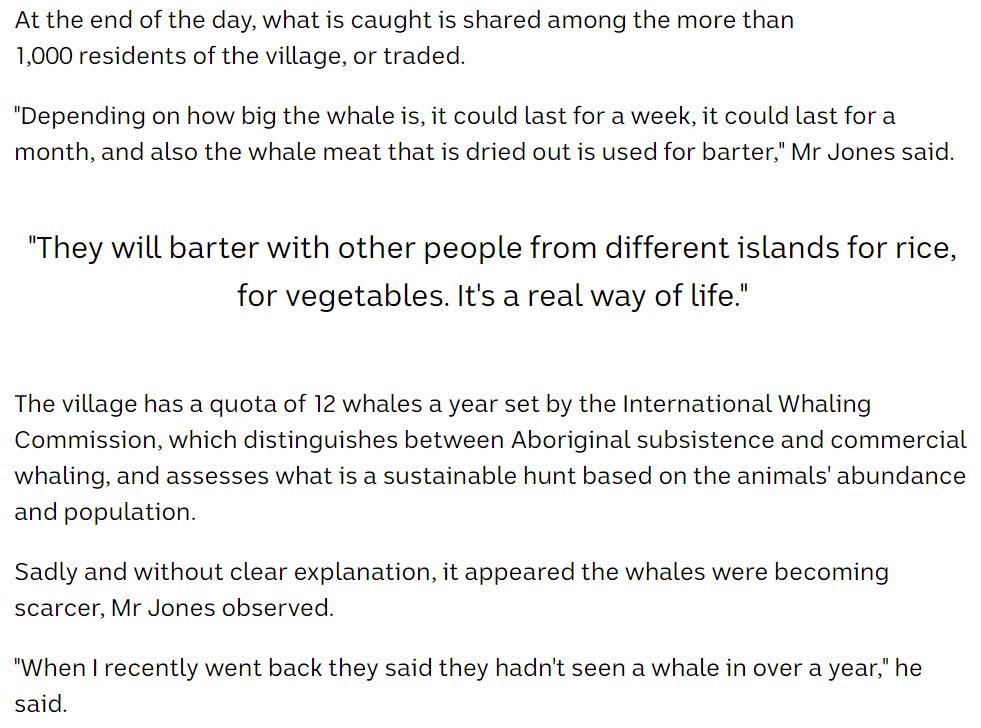
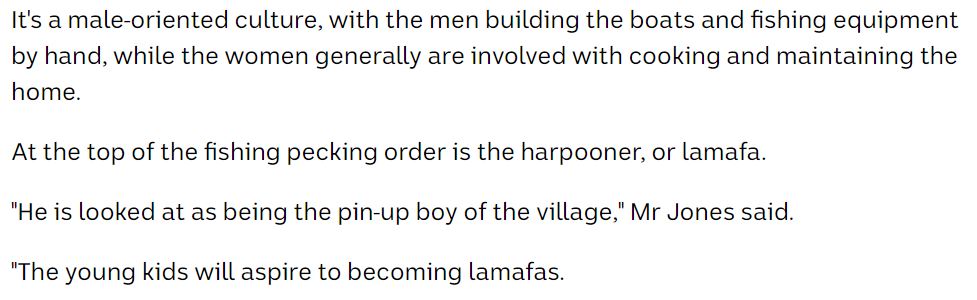
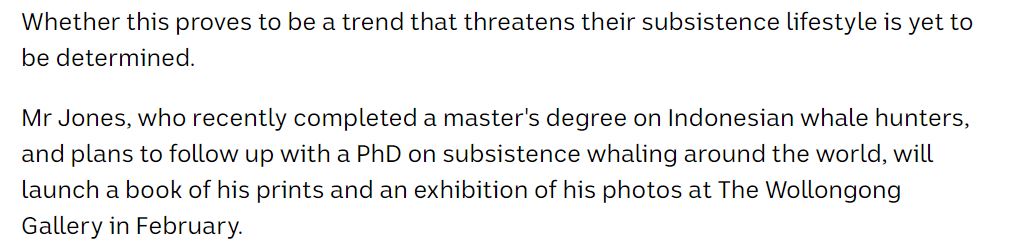
Current Subsistence Whaling Lembata Is. SE Asia
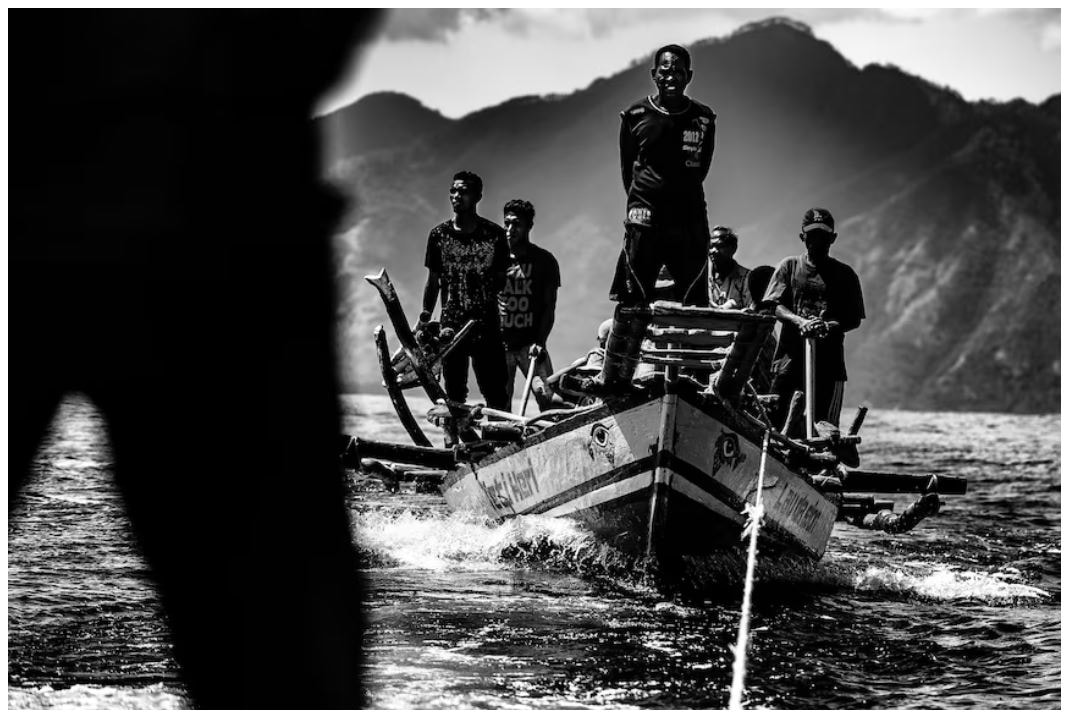
Lemalera whalers - Paul Jones image via ABC
|
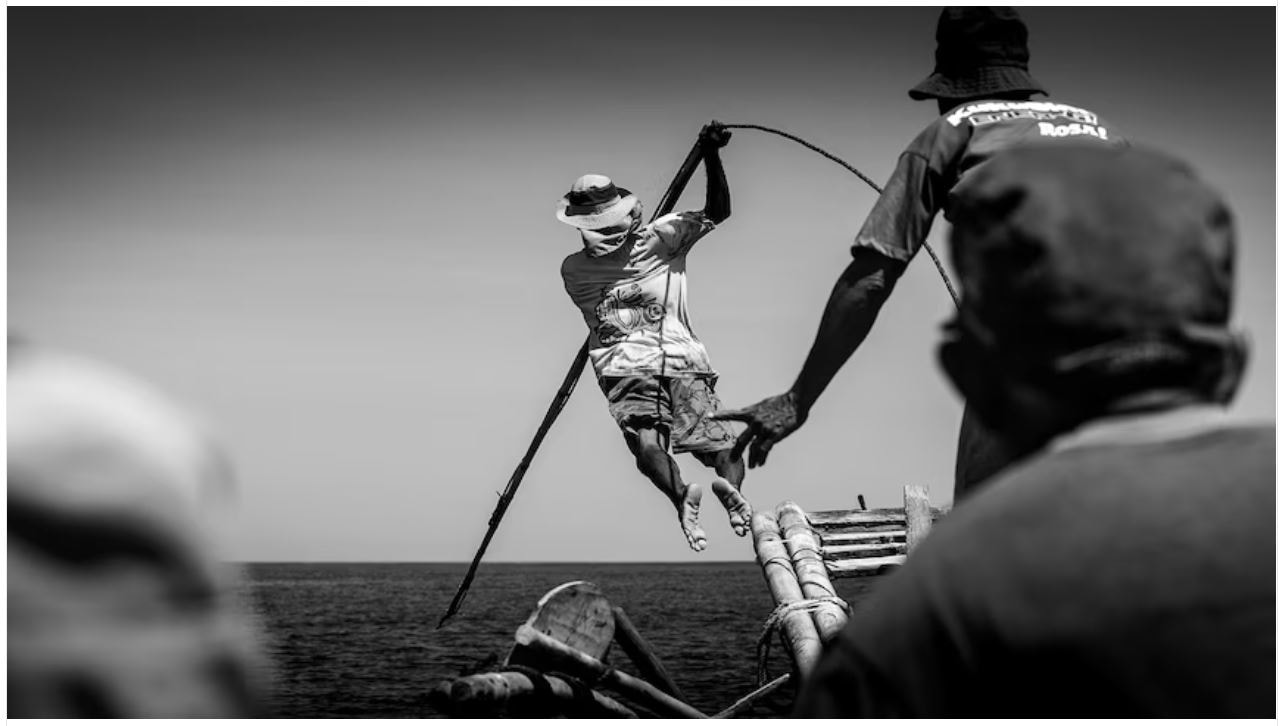
Lemalera whalers - Paul Jones image via ABC
|
|
|
|
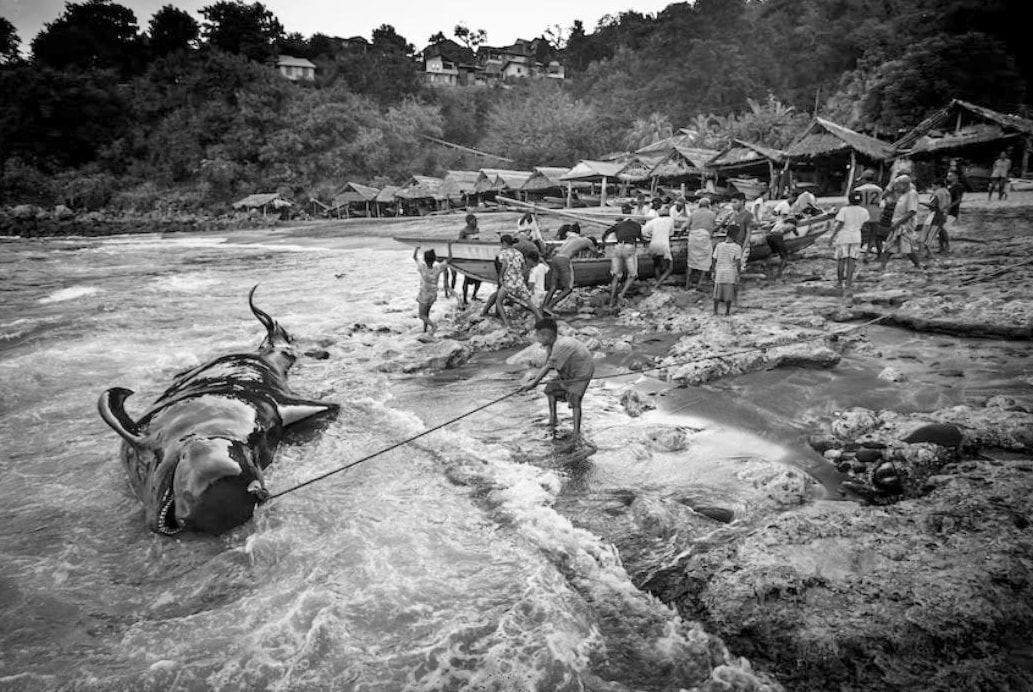
Lemalera whalers - Paul Jones image via ABC
Flinders 1803 Encounter
|
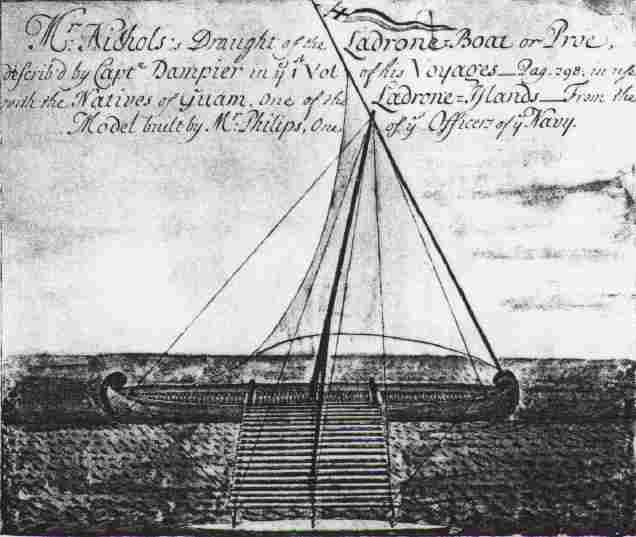
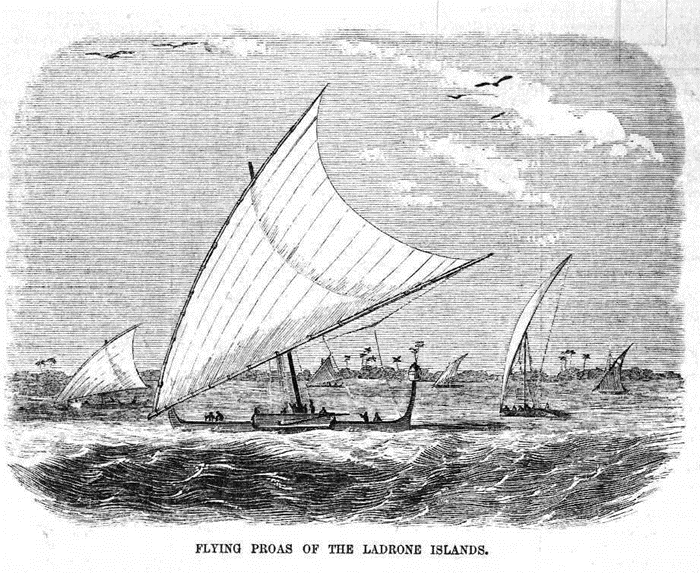
In January 1803, having left the Gulf of Carpentaria, Flinders encountered the prau fleet at anchor at the SW extremity of Cotton Island - some 2,000 miles to the SSW of the Marianas.
'Under the nearest island was perceived a canoe full of men; and in a sort of roadsted, at the south end of the same island, there were six vessels covered over like hulks, as if laid up for the bad season. Our conjectures were various as to who those people could be, and what their business here; but we had little doubt of their being the same, whose traces had been found so abundantly in the Gulph. I had inclined to the opinion that these traces had been left by Chinese, and the report of the natives in Caledon Bay that they had fire arms, strengthened the supposition; and combining this with the appearance of the vessels, I set them down for piratical Ladrones who secreted themselves here from pursuit, and issued out as the season permitted, or prey invited them. Impressed with this idea, we tacked to work up for the road; and our pendant and ensign being hoisted, each of them hung out a small white flag. On approaching, I sent lieutenant Flinders in an armed boat, to learn who they were; and soon afterward we came to an anchor in 12 fathoms, within musket shot; having a spring on the cable, and all hands at quarters.' VtoTA
|
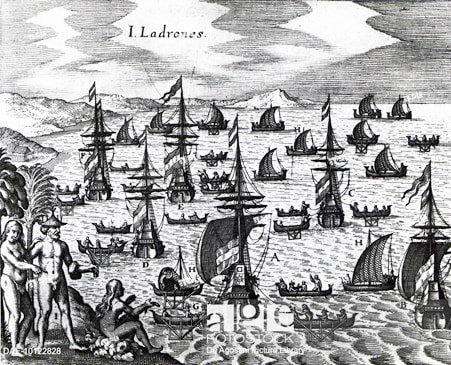
The Islands of Thieves (Islas de los Ladrones, today Marianas islands), engraving from Peregrinationes, by Theodor de Bry (1528-1598).
|
|
|
Louisiade Archipelago BM Oc,A69.85 - Owen Stanley 1851
|
1920 Kaye Flikr
|
Skid mounted double plank outriggers
|
|
Stepwise - Macassan trolling scene
|
|
Borobudur
|
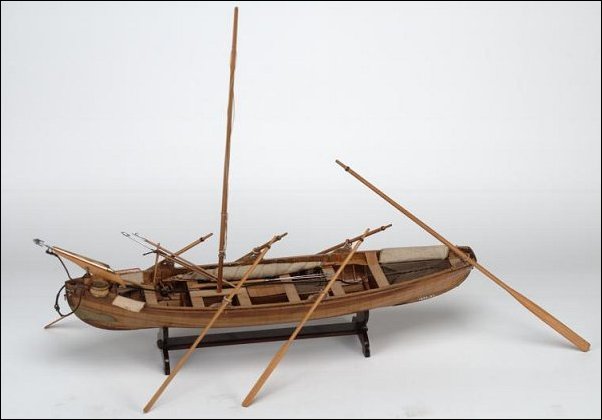
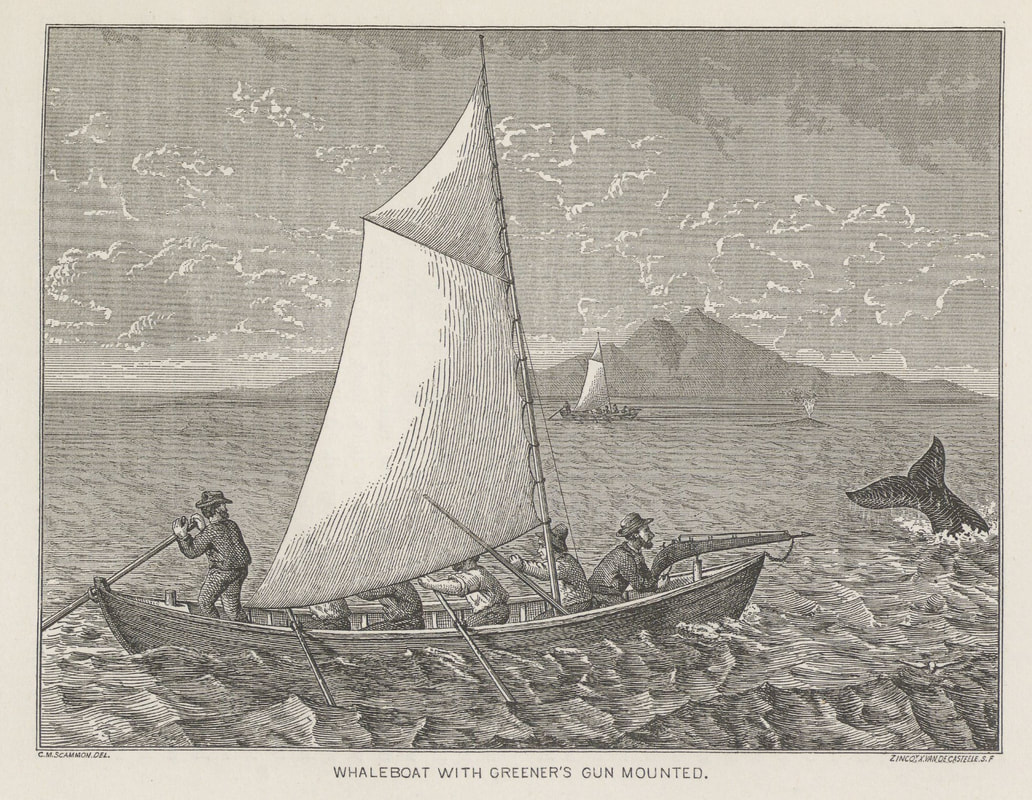
Whale boat c30ft - beam 1/5 length
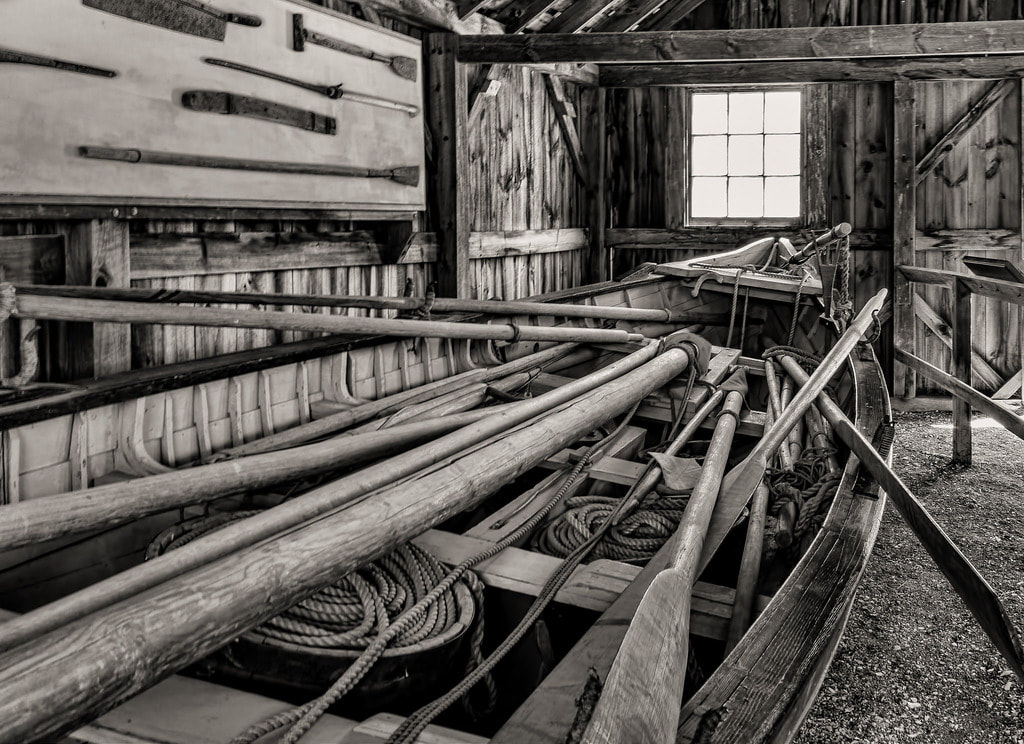
Whale boat configuration & implements
|
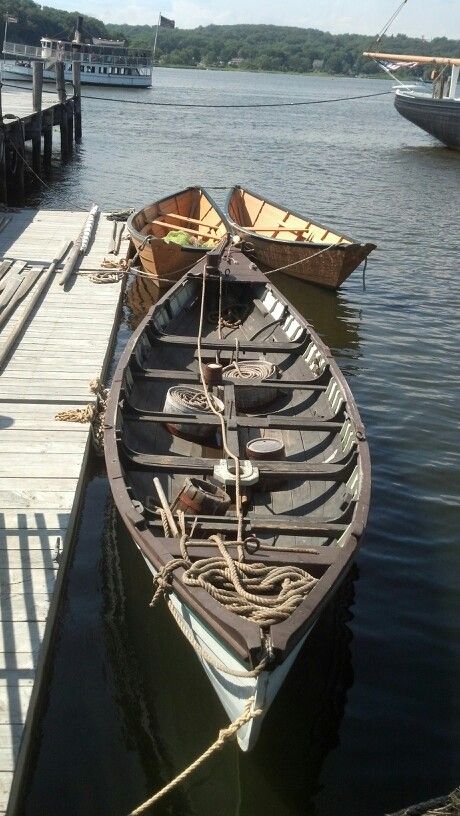
Whaler - Pinterest
|
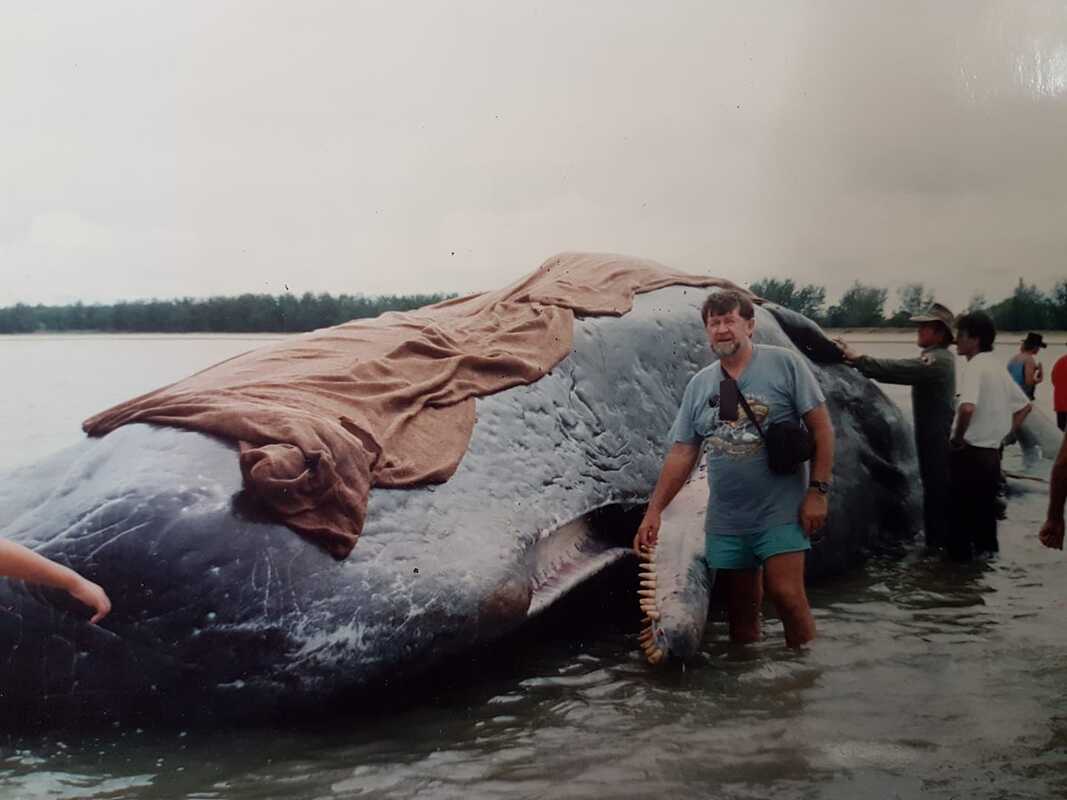
50ft Sperm Whale Casuarina Beach Darwin NT 1994
|
Whale strandings in the Northern Territory. I. Great Sperm Whale Physeter macrocephalus on Casuarina Beach, Darwin
Whale strandings in the Northern Territory. II. Dwarf Sperm Whale Kogia simus Whale strandings in the Northern Territory. III. A mass stranding of Melon-headed Whales Peponocephala electra on Elcho Island |
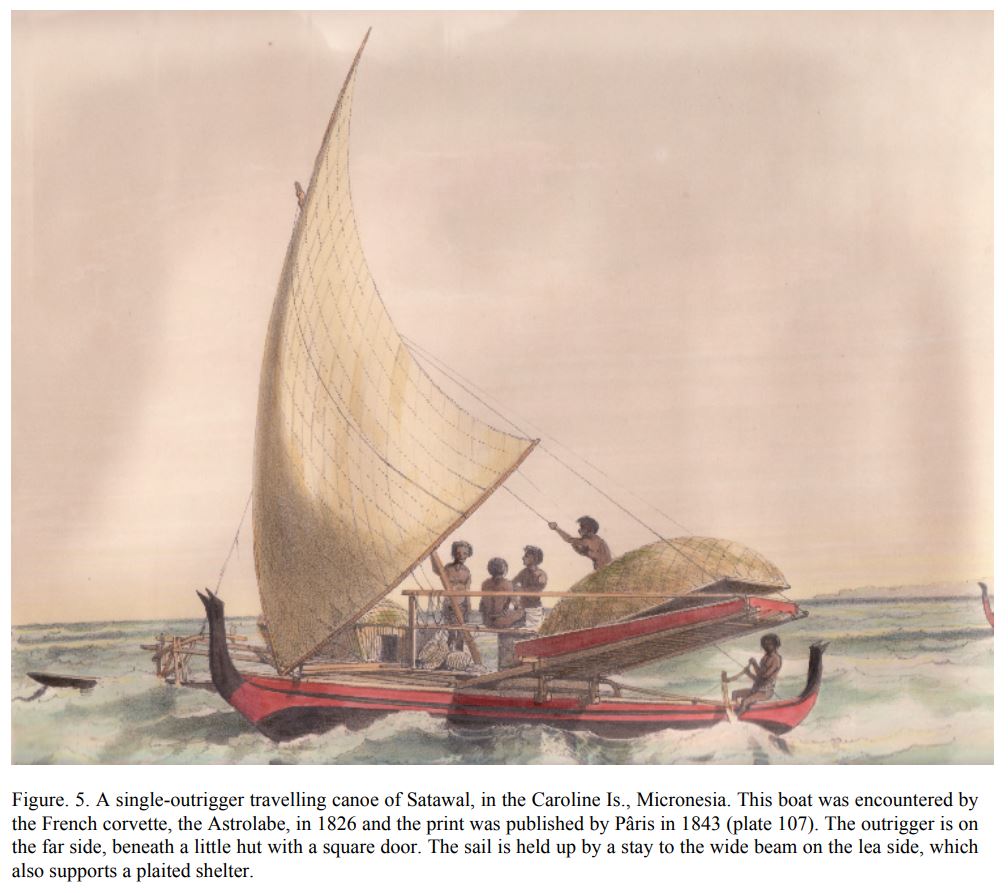
Horridge - Pacific Canoes
|
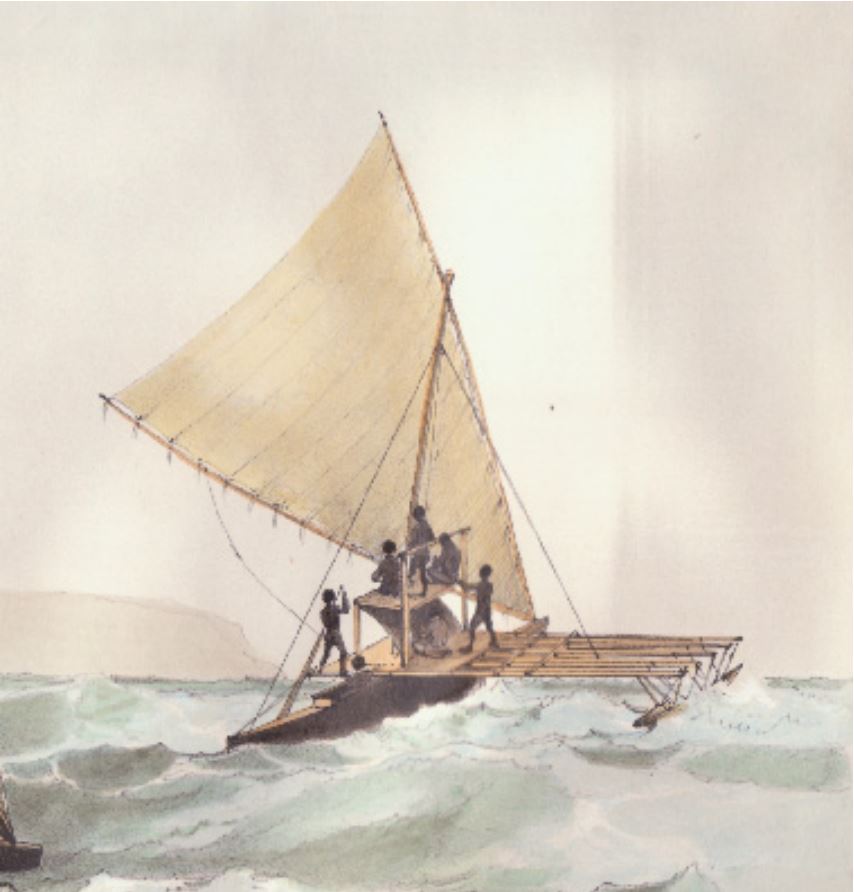
Horridge - Pacific Canoes
|
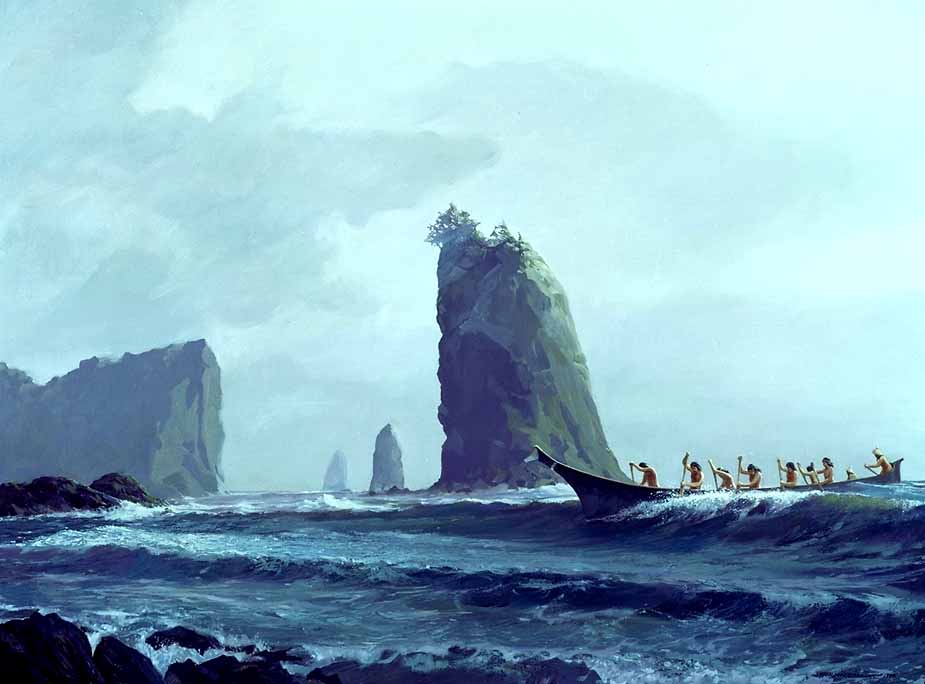
Sea Hunters-Gordon Miller 1993
|
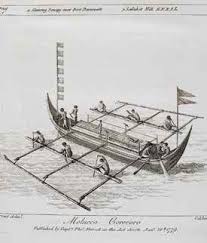
|
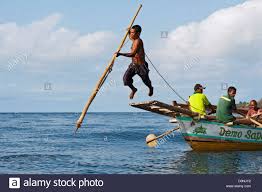
|
Antiques Print & Map Room
|
Riedel 1886 plate XIX inset
|
|
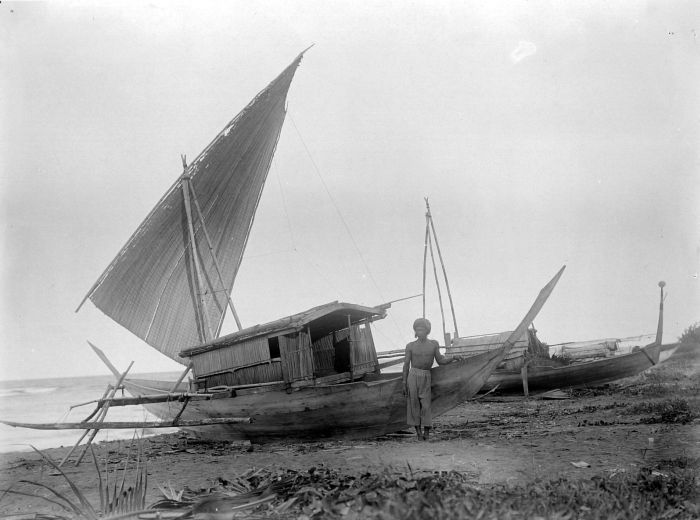
COLLECTIE TROPENMUSEUM Halmahera Pakata Tobelo (voorgrond) en rorehe TMnr 10010571 Stern at Rt similar to KK
|
The flying foxes encountered by the men of HMS Beagle in the Adelaide River were known to them as the Ternate Bat.
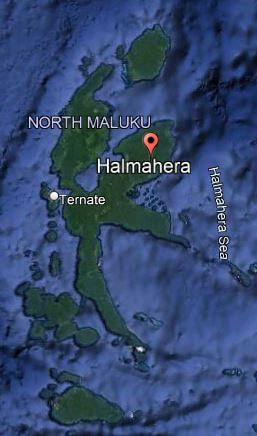
Molucca Sea - Google Earth
|
Steering Oars - Mountford 1948 Vol 1 p342 - Groote Eylandt
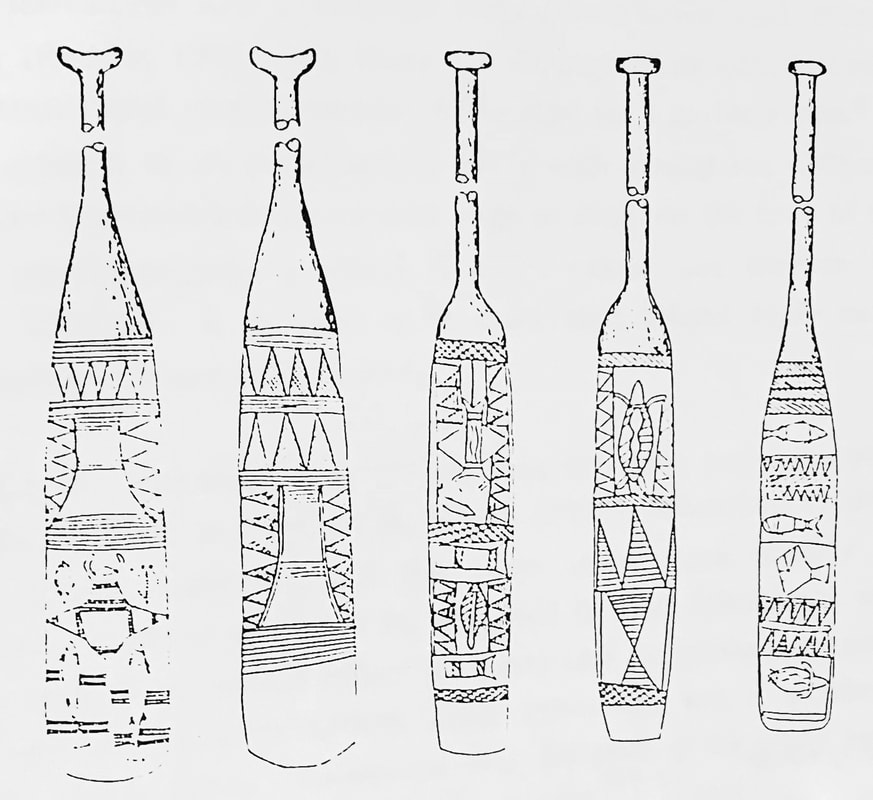
Steering oars Mountford V1 p342
|
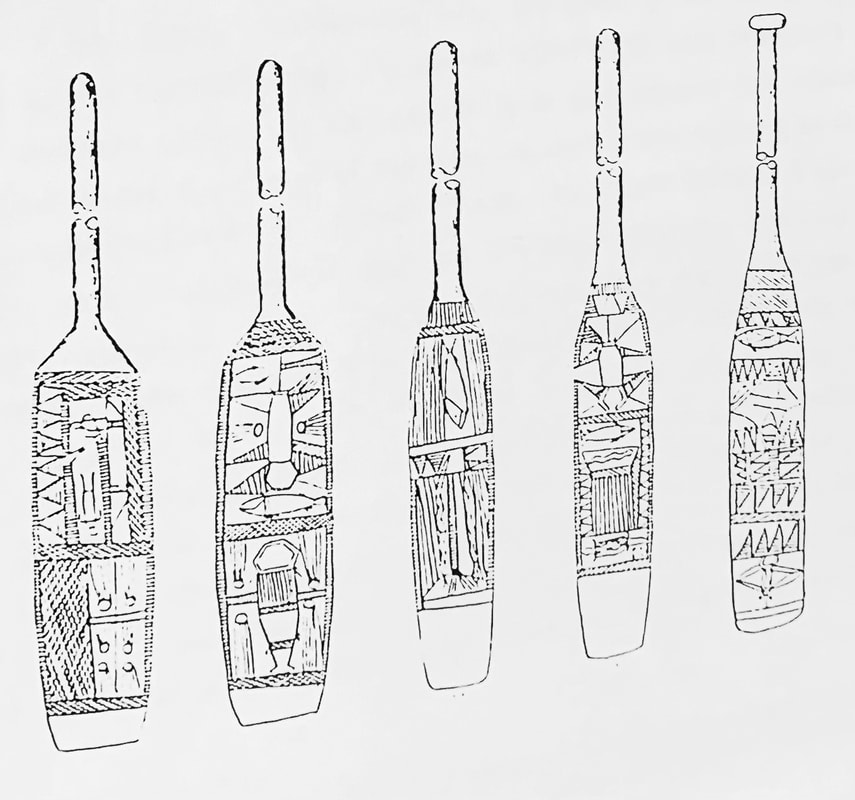
Steering oars Mountford V1 p342
|
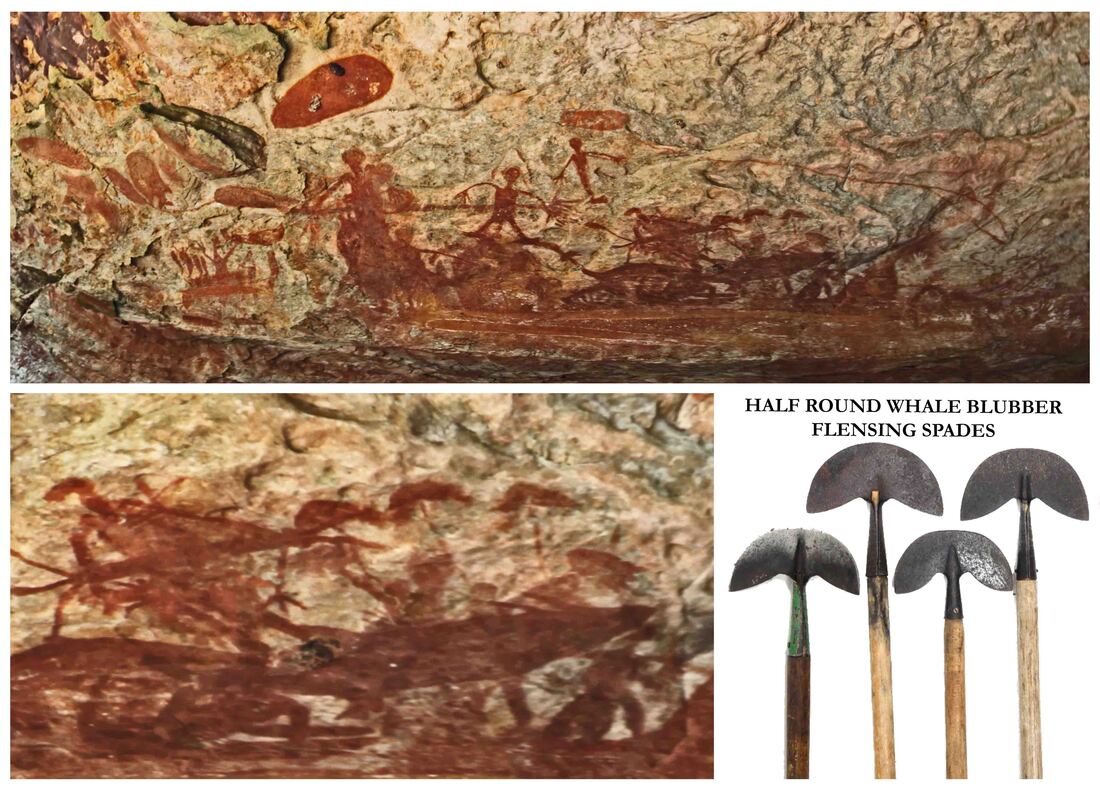
Possible Flensing Spades ©PastMasters
|
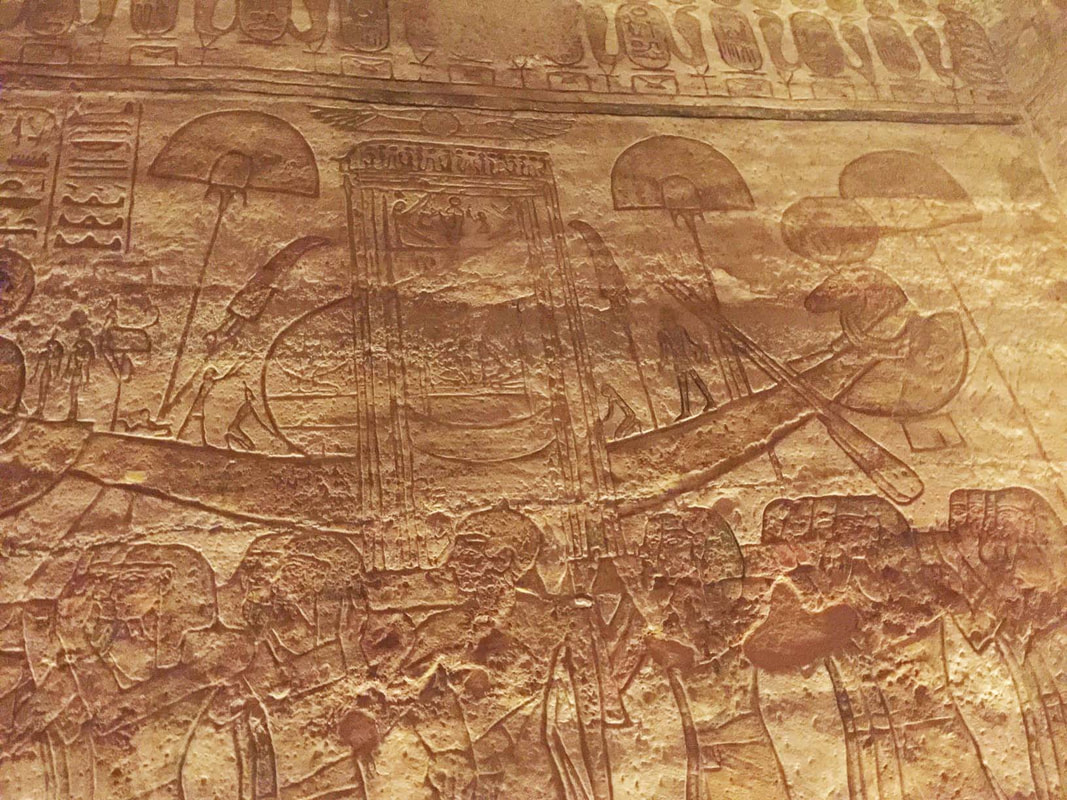
The Nile Hypothesis
|
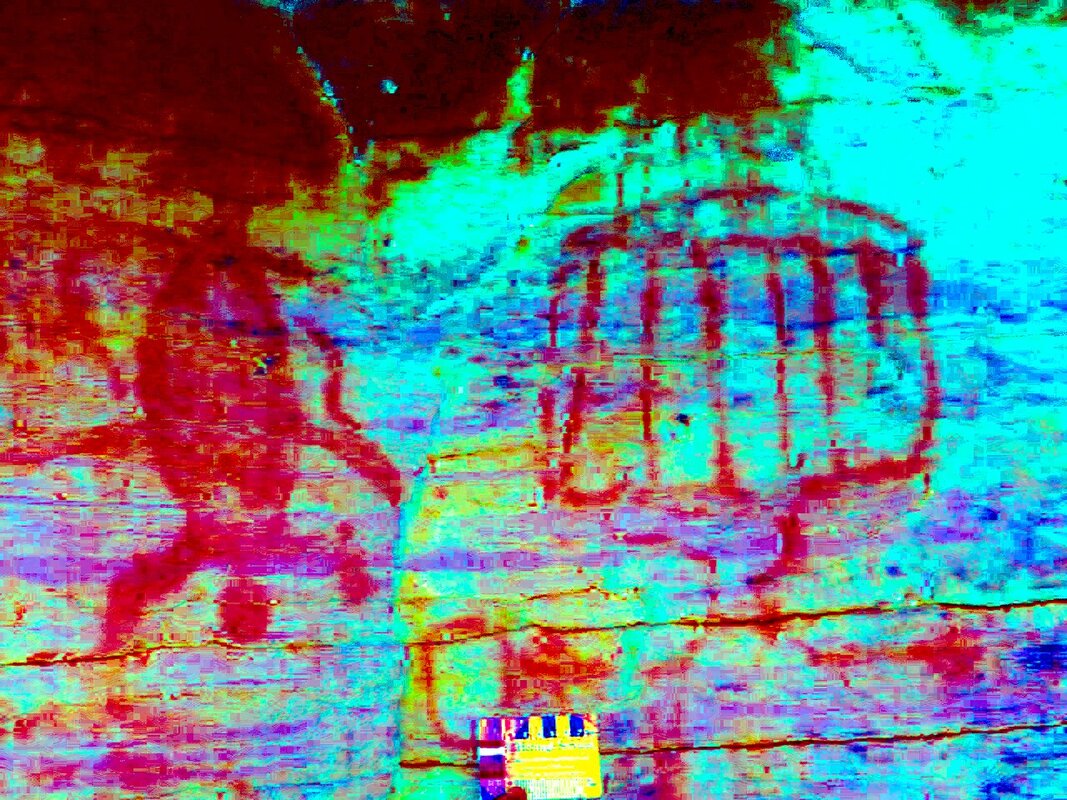
Bird Cage art ©PastMasters
|
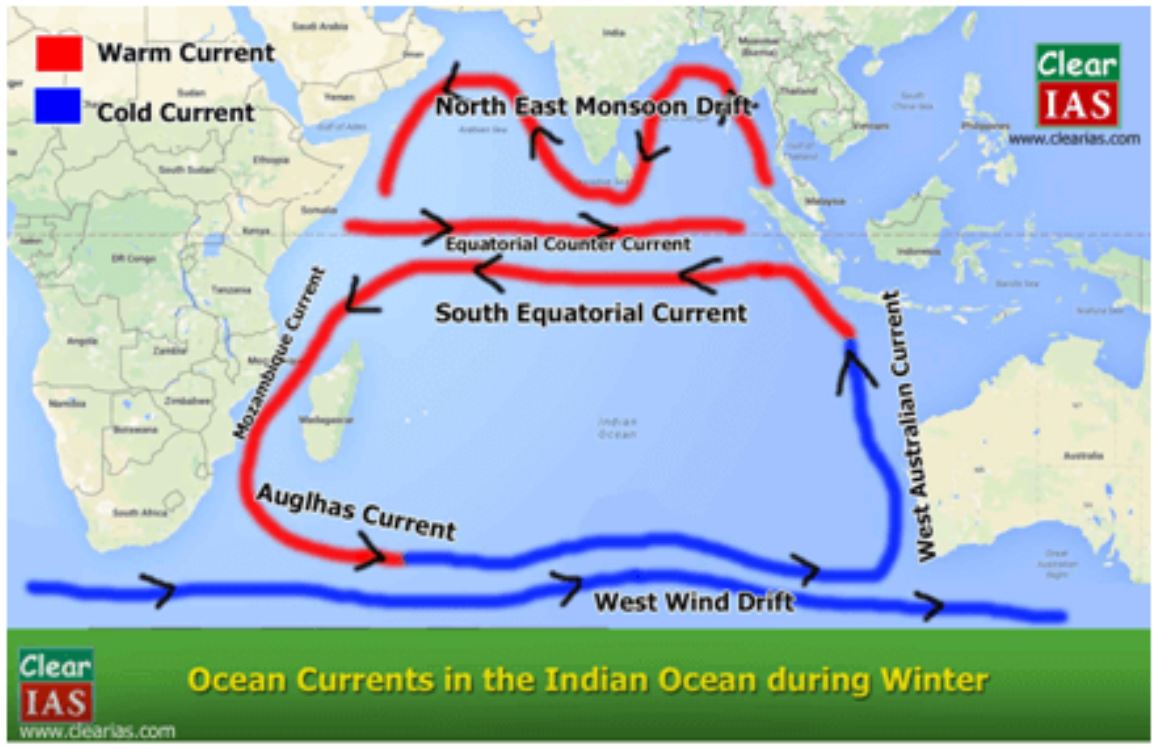
Trade goods from the north Australian coast, 'Marege to the Macassans', included trepang - turtle shell - pearls (fresh & salt water) - palm wax - hardwood - manganese - perhaps iron ore & clay and more exotic goods such as wild animals, especially parrots and feathers. The distances are relatively small - winds & currents reliable & predictable. During the Wet Season (NW Monsoon) the seas are quiet - save the occasional cyclone - the skies are generally overcast, so it is much cooler - there is abundant freshwater and by mid April the wind has swung through 180 degrees for the homeward voyage.
The Australian historical narrative is Sydney-centric & New South Wales is so remote that it took Cook to find it. In contrast, North Australia during the Wet is part of the maritime world of SE Asia with its super-abundant Spice Islands. It is not remarkable that there was early contact with Australia - what it is remarkable is that it has taken so long to be recognised.
The Australian historical narrative is Sydney-centric & New South Wales is so remote that it took Cook to find it. In contrast, North Australia during the Wet is part of the maritime world of SE Asia with its super-abundant Spice Islands. It is not remarkable that there was early contact with Australia - what it is remarkable is that it has taken so long to be recognised.
|
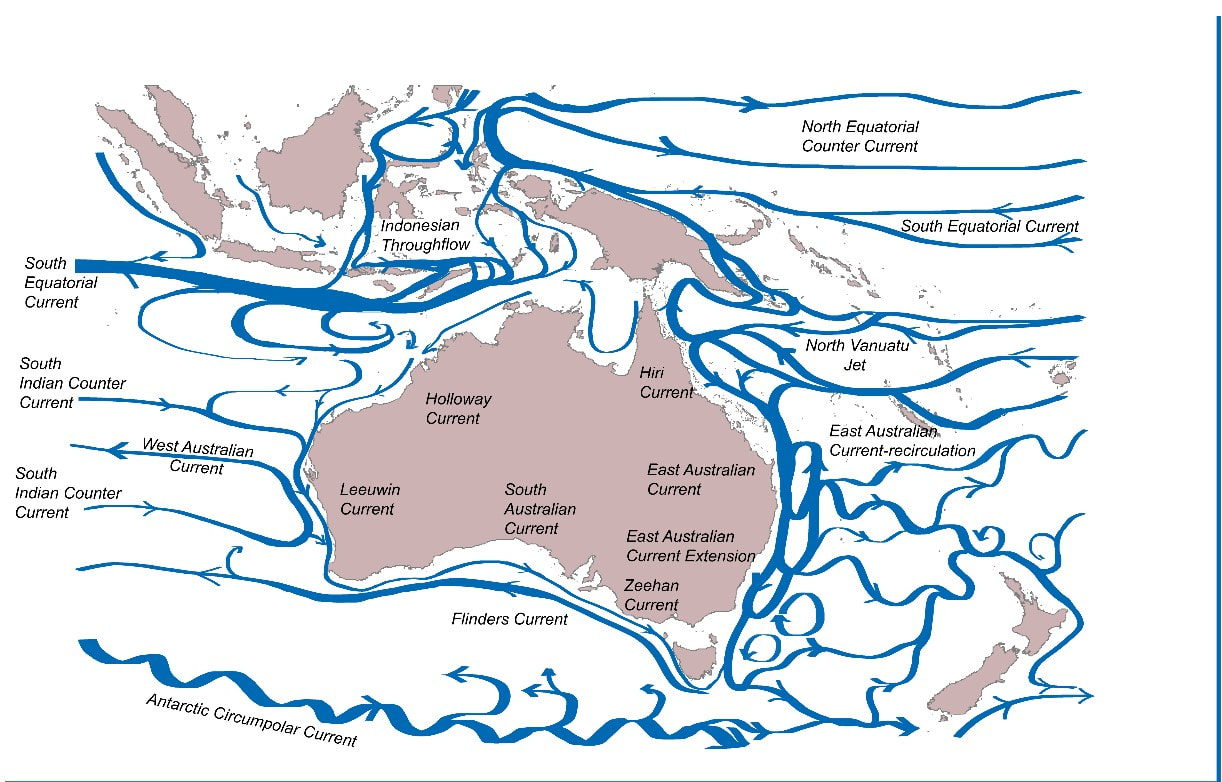
Mean Surface Currents STAR1.4-Pattiaratchi.et.al
|
The currents that flow down the western side of Papua New Guinea drives the clockwise gyre of the Gulf of Carpentaria. They are in turn driven by the great imbalance between the Pacific Ocean in the east and the Arafura & Banda Seas, on the rim of the Indian Ocean, to the west. At some phases of the Moon, it is high tide at one end of Torres Strait and low tide at the other - creating a tide-race that is visible from space. Other factors conspire to make the sea levels and tides impossible to predict. Beyond this torrid zone the accomplished mariners of SE Asia could travel with confidence down to the Marege Coast and home again, as regularly as the seasons allow.
Resources
Cyclopaedia or Universal Dictionary of Arts, Sciences and Literature by Abraham Rees et al Plates Vol. 4, Navigation
Ships Boats Plate 7 Caracore – 15 rowers – single sided – crew of 21. If each rower occupies 3ft of board – frame =15ft + another 15ft = 30ft craft
Boat Building and Seamanship in Classic Philippine Society – Philippine Studies Vol. 30, No. 3 1982, pp 356-376 – published by Ateneo de Manilla University.
Iranun and Balangingi Globalization, Maritime Raiding and the Birth of Ethnicity
By James Francis Warren (2001) – Singapore University Press ISBN 9971-69-242-2 (Paper) (numerous images)
Warren Murdoch Uni. Lives in Perth – wife Carol anthropologist – daughter Kristin vet.
Iranun and Balangingi raiding and slaving - Iranun from late eighteenth century in support of English tea from China & 19th century regional based slaving and maraudinh. Sulu-Mindinao region known for piracy for several centuries.
Early 19th century Iranun and Balangingi - State sanctioned maritime raiding SE Asian maritime settlements & ships sailing for the Spice Islands, Singapore and Batavia.
The Sulu Zone, 1768-1898: The Dynamics of External Trade, Slavery, and Ethnicity in the Transformation of a Southeast Asian Maritime State.
By James Francis Warren 1981 – Singapore University Press ISBN-13 987-9971-69-386-2 (pbk)
Alungi Bisalla Alenyap na Bangsa – Lost Language – Vanished People - an old Samal Bajau Laut adage.
Intro by John Butcher Griffith Uni 2007
Barangay: Sixteenth-century Philippine Culture and Society
ISBN 971-550-135-4 (pbk) Manilla University Press 1994
Boat-Header: The man who steers the boat going on a whale, and afterwards kills it. Generally a mate, but sometimes an experienced whaleman with no ship duties save masthead and cutting stage, whose only title is boat-header.
Boat-Crew: The six men who comprise her full complement, or the four men who row a whaleboat, generally the former.
Whale hunt segment from TV show 'North Water' is an historically accurate re-enactment.
Ships Boats Plate 7 Caracore – 15 rowers – single sided – crew of 21. If each rower occupies 3ft of board – frame =15ft + another 15ft = 30ft craft
Boat Building and Seamanship in Classic Philippine Society – Philippine Studies Vol. 30, No. 3 1982, pp 356-376 – published by Ateneo de Manilla University.
Iranun and Balangingi Globalization, Maritime Raiding and the Birth of Ethnicity
By James Francis Warren (2001) – Singapore University Press ISBN 9971-69-242-2 (Paper) (numerous images)
Warren Murdoch Uni. Lives in Perth – wife Carol anthropologist – daughter Kristin vet.
Iranun and Balangingi raiding and slaving - Iranun from late eighteenth century in support of English tea from China & 19th century regional based slaving and maraudinh. Sulu-Mindinao region known for piracy for several centuries.
Early 19th century Iranun and Balangingi - State sanctioned maritime raiding SE Asian maritime settlements & ships sailing for the Spice Islands, Singapore and Batavia.
The Sulu Zone, 1768-1898: The Dynamics of External Trade, Slavery, and Ethnicity in the Transformation of a Southeast Asian Maritime State.
By James Francis Warren 1981 – Singapore University Press ISBN-13 987-9971-69-386-2 (pbk)
Alungi Bisalla Alenyap na Bangsa – Lost Language – Vanished People - an old Samal Bajau Laut adage.
Intro by John Butcher Griffith Uni 2007
Barangay: Sixteenth-century Philippine Culture and Society
ISBN 971-550-135-4 (pbk) Manilla University Press 1994
Boat-Header: The man who steers the boat going on a whale, and afterwards kills it. Generally a mate, but sometimes an experienced whaleman with no ship duties save masthead and cutting stage, whose only title is boat-header.
Boat-Crew: The six men who comprise her full complement, or the four men who row a whaleboat, generally the former.
Whale hunt segment from TV show 'North Water' is an historically accurate re-enactment.

|
|

|
| ||||||||
|
|
| ||||||
Bibliography
Berndt RM 1948, ‘Badu, Islands of the Spririts’, Oceania,’ vol.19, no. 2, pp. 94-103.
Berndt RM & Berndt CH 1954, Arnhem Land, its History and its People, FW Cheshire, Melbourne.
Elkin AP, Berndt RM & Berndt CH 1950, Art in Arnhem Land, F.W. Cheshire, Melbourne.
Macknight CC 1976, The Voyage to Marege. Macassan trepangers in northern Australia, Melbourne University Press, Melbourne.
McIntosh IS 1992, The Bricoleur at Work: Warrang (Dingo) Mythology in the Yirritja Moiety of North-east Arnhem Land (1992), MLitt Thesis, College of Arts and Sciences, University of New England.
McIntosh IS 1994, ‘The Dog and the Myth Maker - Macassans and Aborigines in Northern Australia,’ Australian Folklore, vol. 9, pp. 77-81.
McIntosh IS 1995, ‘Who are the Bayini?’ The Beagle. Records of the Museums and Art Galleries of the Northern Territory, vol. 12, pp. 193-208.
McIntosh IS 1995a, ‘Maluku Totem Hunters and Sama-Bajau in North Australian Aboriginal Mythology?’Australian Folklore, vol. 10, pp. 50-60.
McIntosh IS 1995b, ‘Yolngu Sea Rights in Manbuynga ga Rulyapa (Arafura Sea) and the Indonesian Connection,’ In Native Title: Emerging Issues for Research, Policy and Practice, eds J Finlayson & DE Smith, CAEPR Research Monograph No. 10, Canberra, pp. 9-22.
Mountford CP 1956-64, Records of the American-Australian Scientific Expedition to Arnhem Land, vol. 1, Art, Myth, and Symbolism, University of Melbourne Press, Melbourne.
Sopher, D.E. 1965. The sea nomads: A study based on the literature of the maritime boat people of Southeast Asia. Lim Bian Han, Singapore.
Warner WL 1969, A Black Civilization. A Social Study of an Australian Tribe, Harper & Roe, Chicago.
Berndt RM 1948, ‘Badu, Islands of the Spririts’, Oceania,’ vol.19, no. 2, pp. 94-103.
Berndt RM & Berndt CH 1954, Arnhem Land, its History and its People, FW Cheshire, Melbourne.
Elkin AP, Berndt RM & Berndt CH 1950, Art in Arnhem Land, F.W. Cheshire, Melbourne.
Macknight CC 1976, The Voyage to Marege. Macassan trepangers in northern Australia, Melbourne University Press, Melbourne.
McIntosh IS 1992, The Bricoleur at Work: Warrang (Dingo) Mythology in the Yirritja Moiety of North-east Arnhem Land (1992), MLitt Thesis, College of Arts and Sciences, University of New England.
McIntosh IS 1994, ‘The Dog and the Myth Maker - Macassans and Aborigines in Northern Australia,’ Australian Folklore, vol. 9, pp. 77-81.
McIntosh IS 1995, ‘Who are the Bayini?’ The Beagle. Records of the Museums and Art Galleries of the Northern Territory, vol. 12, pp. 193-208.
McIntosh IS 1995a, ‘Maluku Totem Hunters and Sama-Bajau in North Australian Aboriginal Mythology?’Australian Folklore, vol. 10, pp. 50-60.
McIntosh IS 1995b, ‘Yolngu Sea Rights in Manbuynga ga Rulyapa (Arafura Sea) and the Indonesian Connection,’ In Native Title: Emerging Issues for Research, Policy and Practice, eds J Finlayson & DE Smith, CAEPR Research Monograph No. 10, Canberra, pp. 9-22.
Mountford CP 1956-64, Records of the American-Australian Scientific Expedition to Arnhem Land, vol. 1, Art, Myth, and Symbolism, University of Melbourne Press, Melbourne.
Sopher, D.E. 1965. The sea nomads: A study based on the literature of the maritime boat people of Southeast Asia. Lim Bian Han, Singapore.
Warner WL 1969, A Black Civilization. A Social Study of an Australian Tribe, Harper & Roe, Chicago.
Prince Gregor MacGregor of Poyais
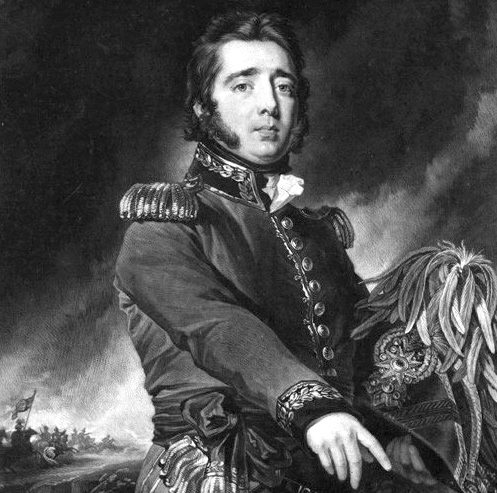 Gregor MacGregor of Poyais
'General' Gregor MacGregor was a relation of the infamous Rob Roy & was born on Christmas eve 1786, in Stirlingshire, Scotland - unlike Robert The Bruce who was, it seems, born in Essex. MacGregor served in the British Army being described as:- "A mere Scottish solider, Gregor MacGregor, pulled off a notorious swindle known as the Poyais Scheme. Titling himself “Cazique,” or prince, of the fictitious territory “Poyais” in Central America, MacGregor enticed enthusiastic investors with bonds he advertised. He convinced fellow Scotsmen to buy tracts of Poyaisian land and settle there as his loyal subjects. By January 1823, two ships carrying around 250 passengers had arrived in Poyais to find not a thriving town as promised, but untamed jungle. Disease and malnutrition soon set in and about 180 of them died; some even after the settlers were rescued by a passing ship in May 1823. Word of MacGregor’s fraud quickly reached England. He escaped to France, where he was imprisoned but ultimately acquitted. In its October 25, 1823 story about the scheme, The Guardian called MacGregor, “a person of whom we do not choose to say all that we think.” {Ancestry.com}
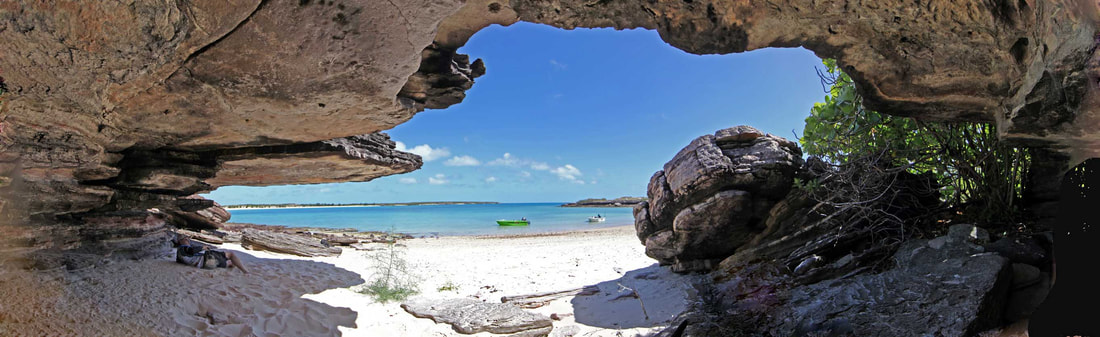
IM escapes the midday heat in the Wessel Islands of the Northern Territory's Arnhem Land coast in 2013 ©PastMasters